Blog
Blog
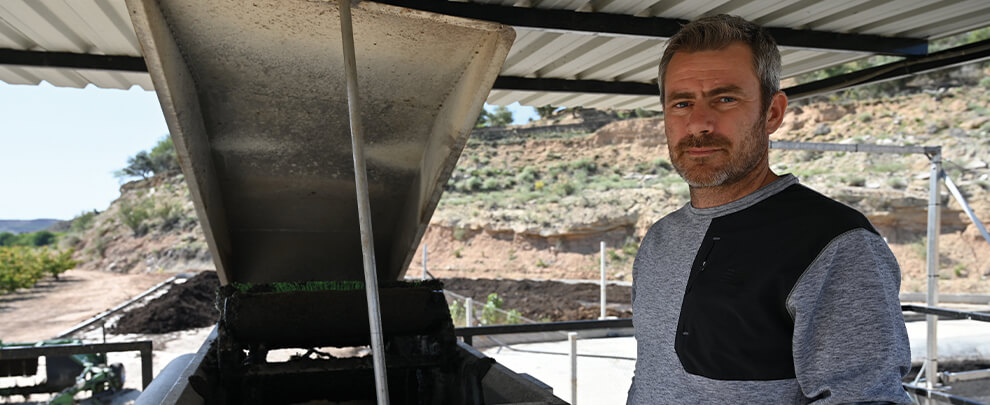
D. Navarro: "A slurry separation system is necessary due to the significant economic savings that are achieved"
15th December 2025 - Success stories
Intending to meet the new environmental requirements and reduce the economic costs of slurry management, the owners of the Hinaga farm in Sariñena (Huesca) decided to invest in the installation of the Tecnapur solids separator, which they were already working with in another farm, and go one step further with the installation of an acidifier. David Navarro, head of the Hinaga farm, with a capacity of 3,500 sows, explains what they do daily to ensure proper slurry treatment and achieve savings of up to 40%.
What is the origin of this farm?
It is a newly built farm launched in 2023 with a capacity of 3,500 sows. Since 2015, we have already had a farm with the same capacity in Monzón, and we decided to build this one to double the number of sows.
How is the farm distributed?
It is organised into three buildings: first, a maternity building with 25 rooms of 36 places each, for a total of 900 farrowing pens; a second building for mating-gestation; and a third building for rearing, mating, and gestation of first-time sows.
Why decide to install on the farm the Tecnapur solids separator?
Having a solids separator, like the one in Tecnapur, installed on the farm results in significant economic savings in slurry management. In addition, for several years, we have had a separator on the farm in Monzón that works very well for us, so when we built this farm, we decided to install one as well.
"The liquid phase is pumped to irrigation hydrants on nearby plots, where it is applied as fertiliser."
How do you carry out the slurry treatment process using the separator?
This facility consists of three buildings, all connected by a slurry extraction system with pipes leading to a collection well. Inside this well, we have an agitation and pumping system that raises the slurry to the Tecnapur separator for solid-liquid separation.
What do you do with each of the fractions?
The liquid portion exiting the separator is directed to the Tecnapur acidifier, where sulfuric acid is injected to lower the slurry's pH and fix ammonia nitrogen, thereby reducing ammonia emissions into the atmosphere. This liquid phase is then collected in a storage pond with a floating expanded clay cover, where it remains until final disposal. From this pond, the liquid phase is pumped to irrigation hydrants on nearby plots, where it is applied as fertiliser by injecting it into the sprinkler irrigation system. This allows us to use the precise dose required by the crop at any given time. The portion of the liquid phase not applied through this system, as well as the solid phase, is removed by a waste management company for use as fertiliser.
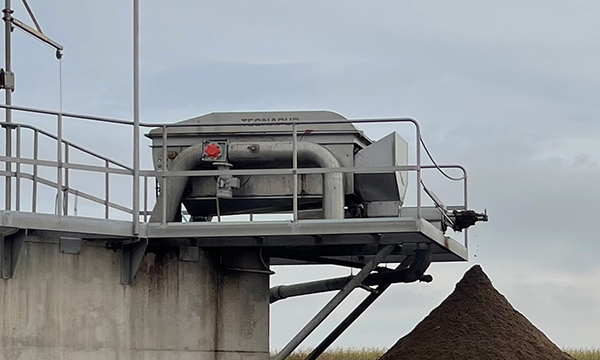
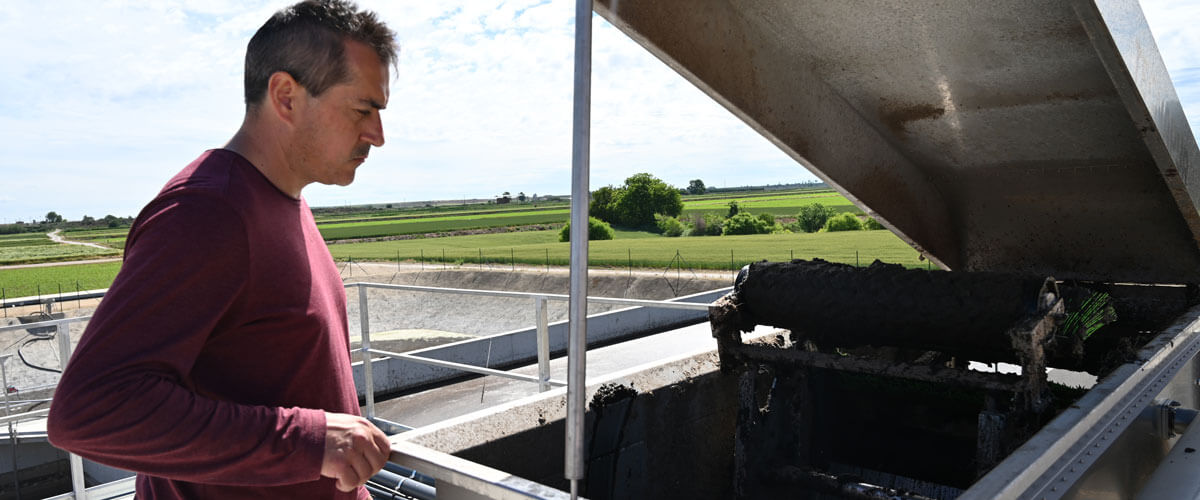
Image of the slurry treatment facility with the solid separator and the compactor. Photo: Rotecna.
How many cubic meters of slurry do you treat per day?
With this management system, we are processing approximately 150-200 m3 of slurry per day.
Alongside the separator, they installed the Tecnapur solids compactor. What advantages does working with these two products offer?
Due to the large volume of slurry generated at this facility, we decided to incorporate the Tecnapur compactor at the outlet of the solids separator to increase the separator's slurry treatment flow rate and, in addition, improve separation of the liquid from the solid fraction.
What percentage of solid and liquid fraction do you obtain after separation?
Regarding the initial slurry volume, which is about 18,000 m³/year, we separate about 6-7% of the solid fraction, depending partially on the source of the slurry (farrowing or gestation). The remaining 93-94% is the liquid fraction obtained after separation.
"This installation model substantially reduces ammonia volatilization through acidification.
The processing system they have installed, therefore, includes a solids separator, a compactor, and an acidifier. What are the most significant benefits of having this type of installation?
The benefits are primarily economic and environmental. Transporting slurry by tanker or truck is very costly. In contrast, installing a slurry management system on the farm can save up to 40% on slurry processing costs, resulting in an approximate payback period of 5 years for the equipment. Furthermore, it's important to note that regulations for this type of farm require the application of Best Available Techniques (BAT) for environmental farm management, including techniques to reduce gas emissions into the atmosphere. This installation model substantially reduces ammonia volatilization through acidification, as well as emissions from the pond through the floating expanded clay cover. Finally, it should be noted that by separating the solid portion, we also substantially reduce odour emissions, as separation prevents the putrefaction of organic matter, which generates methane and other gases that cause unpleasant smells in the surrounding area.
Is investing in a system like this affordable for livestock farmers in the sector?
Yes. Furthermore, nowadays, having a slurry separation system is essential for any livestock farm, as it provides significant cost savings and helps reduce the environmental impact of slurry through proper management.