Blog
Blog
Five ways to improve piglet survival in farrowing
05th March 2026 - News
Óscar Toledano. Rotecna Sales Manager
Reducing piglet mortality in farrowing is one of the biggest challenges for any breeding farm, and one of the most critical parameters influencing the sector's economic profitability, since the cost of a newly weaned piglet represents 20 to 30% of the total production cost of a pig ready for live sale.
Each piglet lost not only represents an economic loss, but also a sign that something can be improved. Pre-weaning mortality usually ranges between 5 and 20%, and more than 80% of deaths occur during the first three days of life. Let's review five main opportunities for improvement available to any farm to increase profitability.
Environmental Control
Piglets are born with few energy reserves and almost no thermoregulation capacity. If a piglet loses heat too quickly and becomes hypothermic, it weakens, fails to nurse, and eventually dies of starvation or is crushed under the sow due to exhaustion. Between 35 and 60% of piglet deaths are caused by crushing, and most of these piglets were already cold or inactive; the rest are trapped under the sow when she lies down or rolls over after lying down, because they were close to her.
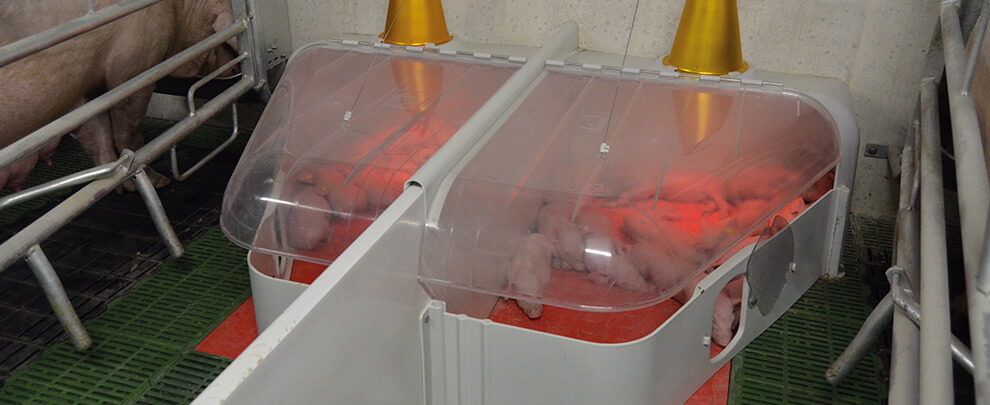
Piglets should have a resting area at around 35°C for the first few days, and as they grow, the temperature should be gradually reduced to 28°C. This area should be enclosed (to prevent drafts) and large enough to accommodate a litter of 14 to 15 piglets up to 28 days old (0.72 to 0.90 m² total). If the floor is adequately insulated, only 0.48 to 0.60 m² of the floor needs to be heated. This is the area occupied by the litter during the first few days, when the animals are still small (5-7 days of age). By then, the piglets generate enough heat to remain comfortable without external heating. The temperature should be evenly distributed (so that all the animals are within their comfort zone), the heating should be located at least 40 cm from where the sow lies down, and the heat source should not disturb the sow. For this purpose, heated plates offer several advantages over infrared lamps, both in terms of suitability and energy consumption. However, radiant heat sources can be helpful during the first 24 hours, when the animals need to dry off and locate the nest as quickly as possible.
The room temperature should be maintained between 22 and 24°C to maximise the sow's comfort and feed and water intake, and to minimise the time piglets spend outside the farrowing nest. The temperature difference between the nest and the farrowing box maximises the time piglets remain in it and reduces the likelihood of them seeking warmth from their mother and being accidentally crushed. This is especially important in partial-confinement systems, where the sow keeps the crate open once the piglets are just a few days old. Furthermore, sows experiencing heat stress tend to get up and move around more, increasing the number of crushing incidents.
Drafts over the piglets should be avoided. Fixed or movable covers can be used for this purpose; these concentrate heat, reducing energy consumption and helping to maintain the farrowing box temperature, even in low ambient temperatures.
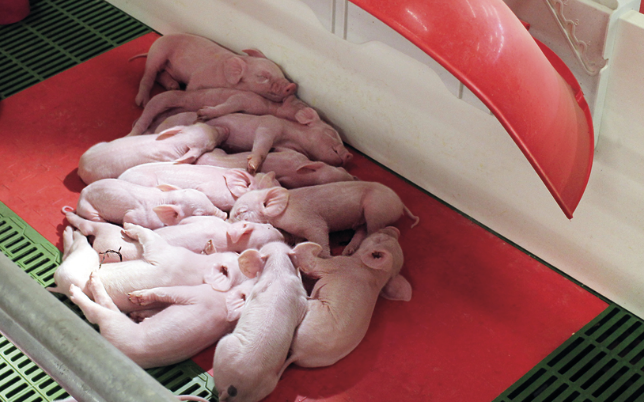
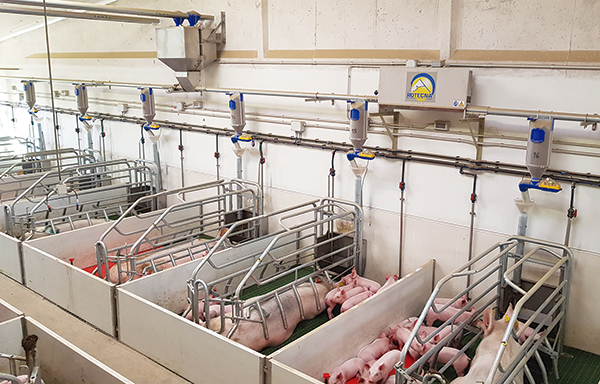
Piglets should have a resting area at around 35°C for the first few days. Photo: Rotecna.
Design of the farrowing pen
The design and maintenance of the farrowing pen directly influence the sow's well-being and the piglets' survival. A sow with little space, who is uncomfortable, or who moves abruptly, can increase the number of piglets crushed. To prevent crushing and maximise survival, it is recommended to use crates that confine the sow to prevent her from lying down and turning abruptly, at least from the time of farrowing until the piglets are entirely using the nesting area (3 to 7 days).
A permanently confined farrowing pen should have a surface area of at least 4.3 m². A partially confined one should have between 5.5 and 6.5 m², since the sow, once released, should not have access to the area where the piglets rest, but should have enough space to move freely, with a free area of 4.2 to 5.1 m² and a turning diameter of 1.8 to 2.2 m. It is worth noting that, with the right design, equipment, and management, this type of farrowing pen can offer the same or even better results than a total confinement pen.
The floor must have sufficient drainage to remain dry, be soft and insulating for the piglets, and non-slip and firm for the sow.
Colostrum
Colostrum, the milk that the sow produces during the first 24 hours after giving birth, provides energy and immunity to piglets. Its quality decreases over time, so the first 6 hours of life are crucial. Piglets that ingest less than 200 grams of colostrum have up to six times the risk of dying before weaning.
Farrowing should be actively supervised, piglets should be dried and warmed as soon as possible after birth, and it should be ensured that all piglets nurse during their first two hours of life. Piglet movement should be avoided for at least the first 12 hours postpartum to ensure they receive colostrum from their own mother, unless circumstances prevent some piglets from nursing during their first 4 to 6 hours of life.
Suppose partial colostrum feeding techniques are used, temporarily removing some piglets so the rest can nurse without competition. In that case, it must be ensured that these techniques are implemented within the first 12 hours postpartum, that some animals are not harmed more than others (especially those with low or no viability) and that the labor invested would not be more efficient if that time were used for other management tasks around farrowing, such as drying, warming, or bringing piglets to the teats, or facilitating fostering.
Farms that implement assistance and colostrum protocols, in addition to reducing neonatal mortality, produce heavier, more homogeneous piglets with a better start and greater resistance to health challenges in later stages.
Feeding of the lactating sow
A sow that eats and drinks enough produces more milk, weans larger litters with higher average weights and greater uniformity, maintains better body condition during lactation, and shows greater fertility and prolificacy in subsequent farrowings, with piglets having higher birth weights.
On farms, strategies to maximise feed intake in lactating sows are based on a set of key points: abundant water, fresh and fractionated feed, appropriate temperature, and individual attention.
A sow that does not drink enough can reduce her feed intake by up to 30%. To ensure they reach 30–40 litres per day, easy access to sufficient, constant, and high-quality water must be guaranteed. Cool water (15–20°C) stimulates consumption and can be offered in a separate drinker or in the same feeder, as well-managed wet feed (a mixture of water and feed) increases total intake. To achieve this, the feed-to-water ratio must be appropriate (1.0:1.0 to 1.0:2.0), and any accumulation that could degrade the mixture must be avoided. It is important to use systems that allow for the controlled flow of water and feed, preferably automated, to ensure efficient management and minimise waste and labour.
Feed should be offered frequently, divided into 3 or 4 daily meals (more frequent feedings keep the intestines active and stimulate appetite, thus improving digestive performance and energy intake) or through controlled ad libitum feeding systems. If the system does not prevent wet food from remaining in the feeder, it should be removed. In hot weather, it is essential to allow access to feed during the coolest hours of the day. With completely ad libitum feeding, up to 60% of consumption may occur at night during the summer.
A sow that arrives at farrowing with an active gut eats better afterwards and has more energy to cope with the birthing process, which will be faster. This reduces the stillbirth rate and increases the time available for colostrum intake.
For every degree above 22–23°C, feed consumption can drop by 100–150 g/day. Therefore, it is essential to have a climate control system that allows for air renewal without direct drafts on the animals, and to use ambient cooling and localised cooling systems, such as radiant floor heating under the sow cooled with chilled water. These systems also reduce the number of piglets lying next to her, decreasing the risk of crushing. Individual feed intake should be monitored, and sows that eat less or waste feed should be identified to detect the causes (health-related, environmental, or behavioural) and address them.
If water intake is adequate, each extra kilogram of properly formulated feed increases milk production by 1.1 to 1.4 kg, and each extra litre of milk translates to an additional 250 to 300 grams of growth per piglet (the average density of a sow's milk is 1.03 kg/l). With maximised intake, the average weaned piglet weight can increase by 0.5 to 1.0 kg; furthermore, sows with high intake during lactation wean up to one more piglet per farrowing.
Maximized feed intake will improve piglet survival. Photo: Rotecna.
Biosecurity
Neonatal diarrhoea and other diseases, such as PRRS, remain a significant cause of piglet mortality. To reduce the pathogen load in the environment and the likelihood of outbreaks, good internal and external biosecurity practices must be strictly implemented: access control and perimeter fencing in good condition; a single entrance with a disinfection trench and shower with mandatory clothing change; restricted access to unauthorised vehicles and personnel; vector control, like birds, rodents, and insects, is essential, with a pest control plan and airtight seals on silos, warehouses, and windows. The surrounding areas must be kept clear of vegetation and trash.
A strict "all in, all out" policy must be followed: equipment and facilities must be washed with detergent, rinsed to remove organic matter, and disinfected, allowing a minimum of 24 hours for drying before introducing new sows. Sows must be washed before entering the farrowing area. Piglet movement between litters must be minimised after the first 24 hours postpartum, and movement between farrowing pens must be avoided without disinfecting footwear. A logical sequence for the movement of personnel and animals must be maintained, moving from areas of higher to lower health status. Boots must be changed or disinfected between areas, and dedicated equipment must be used for each area. The management of carcasses and slurry must also prevent personnel or removal vehicles from coming into contact with clean areas.
These five strategies, applied consistently, can transform the results of a farm, reducing mortality in farrowing by between 20 and 80% (in farms with serious problems), which can represent a reduction in the production costs of weaned piglets of 1-20%, and of live fattened pigs of up to 5%.