Blog
Blog
How can we improve the adaptation of piglets in transition?
07th April 2026 - News
The piglet intake phase is one of the most critical moments in pig production, during which management, stress, and biosecurity directly influence animal development and health. To delve deeper into the key aspects of this stage and learn about best practices that facilitate the transition to fattening, we spoke with Emilio Magallón, a veterinarian and expert in pig production and agricultural economics.

Emilio Magallón, veterinarian and expert in pig production and agricultural economics. Photo: E. M.
Why do you consider that the piglet intake phase is a critical point within pig production?
Post-weaning is crucial in pig production, as freshly weaned piglets are exposed to a very high level of stress. This stress is due to separation from the mother, the transition from a hot, liquid diet to a cold, solid one, the transfer to new facilities, often after long trips, and mixing with other animals, which can lead to fights to establish hierarchies. If this phase is not managed correctly, mortality and growth problems can occur, affecting subsequent fattening. Correct management from the outset, with good facilities and temperatures around 28 ºC, is key to a successful transition.
What are the critical factors in the piglet reception phase in transition farms?
Firstly, the quality of the piglet, both from a health point of view and in terms of weight and age at weaning, since these aspects directly condition its ability to adapt to the transition. The higher your weight and age, the better you fare in this stage. This requires prior work on the breeding farm, avoiding weaning too early (no less than 21 days), and ensuring average weights greater than 6 kg with low variability. Secondly, the transition must ensure adequate environmental conditions for low-weight animals. It is not appropriate to house freshly weaned piglets, weighing around 5 kg and with a still immature intestinal system, in non-adapted feedlots, as occurs in some Wean-to-Finish models. This system can be interesting from a health and economic perspective, provided the facilities have hoppers, grates, and adequate heating and ventilation. With correct weights and ages, mortality is reduced, average daily gain improves, and fattening results are optimised.
What measures do you consider key to minimising the risk of entry of diseases such as ASF for imported piglets?
There is no “zero” risk when importing piglets from areas with ASF presence. Therefore, it is essential to be very rigorous with the origin of the animals and the conditions of transport. Today, some trucks have filtered air systems that help reduce this risk. My advice, especially given the current ASF situation in Spain, is to reduce imports as much as possible. We must think not only individually but also collectively to adjust production to the slaughter levels and export volumes that the Spanish pork sector can deliver, at least while the current market situation of extreme seriousness persists.
From a health point of view, what biosafety protocols do you consider essential during intake?
The biosecurity measures in phase 2 are the same as in the rest of production. The most important thing is to be able to work with sanitary voids, ideally by rooms or buildings, although the optimal thing is to apply it by batch. Likewise, working with piglets of the same origin and age is essential, as it facilitates health control and reduces the risks associated with mixing animals.
Once the piglets are obtained, what grouping, batch management, or source-mixing strategies do you recommend?
The epitome is to work with piglets of the same origin and age, since the more origins and ages are mixed, the greater the stress and health problems, especially if the animals are not PRRS-negative. Once received, they must form homogeneous batches by weight, separating runts or sick piglets, to treat them and adjust the diet to their needs. Previous work on the breeding farm is also important, such as separating piglets from gilts and applying differentiated feeding treatments to previously weaned piglets. In short, the less the animals mix, the better, since you avoid having to reestablish hierarchies. Whenever possible, working with the same origin and age is the most efficient strategy to optimise performance.
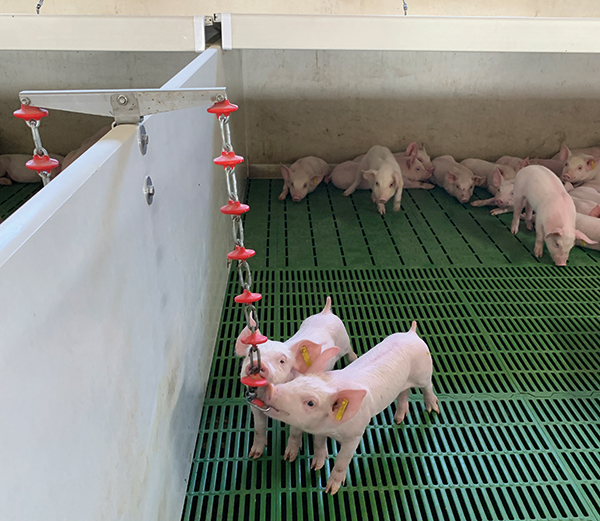
Having toys helps piglets adapt. Photo: Rotecna.
How does the nutritional adaptation of piglets after entering the transition farm influence their subsequent performance?
A good diet during transition is key to ensuring the piglet grows correctly and avoids digestive problems, which can increase mortality and reduce growth and average daily gain. To do this, it is recommended that piglets enter the post-weaning period consuming the same feed that was given to them during the last week on the breeding farm. In addition, they must have enough feeders and space in the pens so they can eat together, as they were used to doing with their mothers during lactation. On the other hand, water is also a determining factor: it must be biochemically and bacteriologically adequate, and there must be a sufficient number of drinker nipples so that all piglets can drink without competition. Finally, it is recommended to use low-protein diets and to restrict feed slightly during the first two weeks to reduce digestive problems.
When managing stress in newly arrived animals, what measures do you recommend to facilitate their adaptation?
To reduce stress on freshly weaned piglets, it is essential to provide adequate space, avoid overcrowding, and avoid unnecessarily mixing animals. Most post-weaning facilities are overused, and piglets have less space than advisable. In this sense, densities of 0.25-0.30 m² per animal are recommended, assuming piglets around 25 kg. Piglets try to rebuild the social hierarchy established in farrowing, so mixtures and regroupings that increase stress must be avoided. In addition, having toys and manipulable material stimulates exploration, reduces aggression and promotes adaptation. Regarding the lot size, the ideal would be to maintain the same composition as in maternity, though it is difficult to implement. I recommend small batches at weaning, of about 12-24 piglets, always with enough space to avoid fights and attacks.
What productive indicators do you consider key to evaluating whether the reception phase is being carried out correctly?
The main indicators are mortality and piglet growth, two critical factors in Spanish pig production. According to data from SIP Consultors, mortality in this phase averages around 8%, and can exceed 20-30% in cases of PRRS or other pathologies. In terms of growth, average daily weight gain in piglets weighing 6-20 kg is usually less than 300 g/day, a figure lower than in other European countries.
Finally, what recommendations would you give as “best practices” to achieve an efficient transition to fattening?
First, it is essential to conduct preparatory work on farrowing farms. If the piglet is not of adequate weight and age, optimal results and a successful transition cannot be achieved. Furthermore, it is essential to receive the piglets in adequate facilities with good environmental conditions during the transition from entry to the post-weaning period. Finally, piglets should be prevented from making too prolonged journeys between mother farms and post-weaning facilities, as this can negatively affect their adaptation and performance.