Blog
Blog
How can we reduce the risk of hypothermia in piglets?
04th December 2025 - News
The arrival of winter always brings an additional challenge in farrowing. Although most farrowing rooms are designed to maintain an adequate temperature, newborn piglets remain extremely sensitive to even small thermal variations. Their physiology, low energy reserves, limited insulation capacity, and high heat loss immediately after birth, makes them especially vulnerable during the first hours of life.
For this reason, even in well-climatized facilities, microclimate management through specific heating systems and piglet nests continues to be a key tool for preventing hypothermia, improving colostrum intake, and reducing losses caused by chilling or crushing. Proper thermal management at critical moments plays a decisive role in improving the survival and performance of each litter during the coldest months of the year.
Why are piglets especially sensitive to cold?
The newborn piglet is extremely vulnerable to cold for several physiological reasons. It is born into an environment far colder than the inside of the sow, and it is also wet, which accelerates heat loss through evaporation. Its ability to maintain body temperature is very limited because it has almost no subcutaneous fat or natural insulation.
On top of that, its energy reserves are minimal. When chilled, a piglet quickly loses mobility and struggles to reach the udder to ingest colostrum, which further reduces its energy levels and its capacity for thermoregulation. When this happens, the piglet enters a negative cycle: chilling makes suckling difficult, and the lack of energy leads to an even further drop in body temperature. Hypothermic piglets also seek the sow’s body heat more insistently, significantly increasing the risk of crushing. All these factors make temperature control a decisive element for saving lives during the first hours after birth.
Heating management in farrowing rooms during winter
Localized heating is the most efficient tool for preventing hypothermia in piglets without compromising the sow’s welfare. Instead of raising the temperature of the entire room, something inefficient and potentially stressful for sows, the use of heated plates and infrared lamps allows the creation of a warm microclimate exactly where piglets need it.
Heated plates provide constant, uniform heat that remains stable regardless of environmental fluctuations. This is especially useful at night or during periods of extreme cold. Infrared lamps, on the other hand, provide immediate warmth and are particularly valuable during the first hours after birth, when the piglet is still wet and experiences a sharp drop in body temperature.
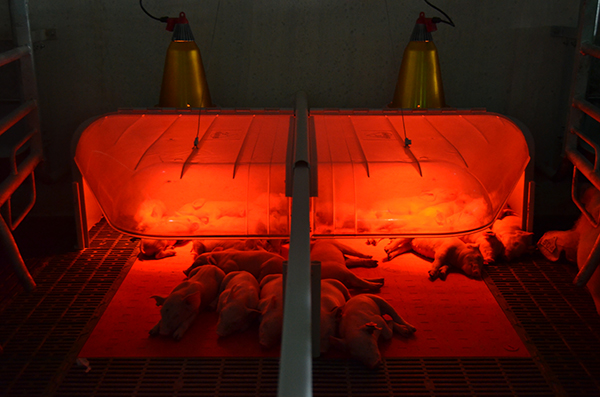
The nests provide a warm and stable environment for the piglets. Photo: Rotecna.
The role of the nest in preventing hypothermia
The nest is one of the most decisive elements for ensuring piglet survival during the winter. Its main function is to provide a protected space, shielded from drafts and with the thermal concentration needed for the animals to stabilise their body temperature from their first hours of life. Models such as Rotecna’s nests have proven particularly effective, as they create a controlled microclimate and help piglets remain grouped and warm.
During the first days, keeping the nest at around 34–35 °C allows newborns to benefit from a warm and stable area, while the room can remain at 18–20 °C, a suitable range for sows. This combination supports the wellbeing of both and prevents unnecessarily increasing the ambient temperature. Focusing heat only where piglets need it results in more efficient energy use, with reductions in farrowing-house energy consumption that may range between 20% and 40%.
Moreover, having a warm and appealing refuge prevents piglets from seeking heat next to the sow’s body, significantly reducing the risk of crushing. To maintain the microclimate in optimal conditions, it is important to adapt nest management to the age of the animals: during the first days it is advisable to keep the lid closed to retain heat, and gradually open it as piglets begin to produce more body heat. This gradual adjustment prevents overheating, improves comfort and contributes to efficient thermal management that protects litter viability.
Complementary management to minimize hypothermia risk
In addition to heating and nests, several management practices help stabilize piglet temperature during the first hours. Immediate drying at birth is one of the most effective, as it prevents heat loss through evaporation and promotes quicker access to the teat. Controlling drafts is also crucial, even if the nest is properly heated, a cold airflow can cause dangerous drops in body temperature.
Finally, ensuring quick access to colostrum is essential. Piglets that suckle early have more energy, more mobility, and better resources to maintain body temperature. This results in lower mortality and greater vitality within the litter.
How proper thermal management reduces losses and improves piglet viability
Hypothermia remains one of the leading causes of mortality in farrowing during winter. However, proper heating management and the use of piglet nests allow the creation of a controlled environment in which piglets can stabilize their body temperature, suckle quickly, and reduce the risk of crushing.
Farms implementing efficient microclimate systems combining heated plates, lamps, and piglet nests, not only reduce losses but also optimize energy consumption and significantly improve animal welfare. Ensuring adequate warmth from birth is, ultimately, a cost-effective, productive, and essential strategy to help piglets thrive during the coldest weeks of the year.