Blog
Blog
How to choose between dry and wet feeding for pigs?
12th February 2026 - News
In pig production, feeding represents around 70% of the production cost of a fattened animal ready for slaughter. Within this percentage, the fattening phase accounts for almost 45%, followed by the transition phase (10%), gestation (10%), and maternity (5%). With these figures, it is evident that any improvement in feed efficiency has a direct and significant impact on farm profitability.
In this context, one of the relevant technical decisions is choosing between dry or wet feeding in the transition and finishing phases of market pigs. Both strategies have advantages, disadvantages, and specific requirements that must be evaluated based on farm management level, environmental control capacity, production phase, genetics, animal weight at entry and exit, feed presentation type, etc.
Minimizing waste and maximizing consumption
In ad libitum feeding systems, regardless of whether a dry or wet system is used, feed efficiency always relies on two fundamental pillars: minimizing waste and maximizing daily intake. Regarding feeder design, ease and precision of adjustment, amount of feed available in the dish, animal access to feed in the dish, number of feeding spaces, and the correct animal/feeding space ratio are decisive factors in both systems.
A poorly designed feeder, with inaccessible corners or imprecise or hard-to-access adjustments, generates feed accumulation that animals do not consume, resulting in waste and economic losses, as well as preventing proper cleaning and disinfection of equipment and posing a biosecurity risk.
The dimensions of the feeder access space must be adapted to the animal’s size in each phase. The bottom of the dish should be sufficient for the animal to access the feed comfortably without putting its feet inside, and the width of the feeding space, in feeders where more than three animals eat in parallel, must be 10% wider than the animal’s shoulder width. In feeders where up to three animals eat, less space is needed, as animals at the ends can position themselves slightly diagonally, and the reference becomes head size instead of shoulder width. This also minimizes waste, as animals eat more comfortably, especially in the final growth phases when their size is larger.
Similarly, excessive competition for feed due to a lack of feeding points increases waste, reduces daily intake, and penalizes growth, especially if the climate control system does not maintain animals in their comfort zone, as they concentrate consumption during the cooler hours of day and night, reducing the time feeders are effectively used.
Dry feeding
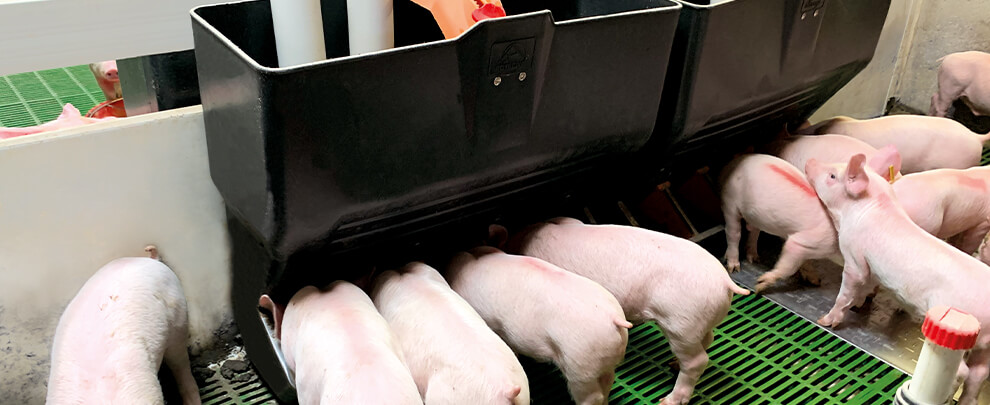
Dry feeding is characterized by dispensing feed without directly mixing it with water in the dish. If the particle size of feed components is not uniform, animals may sort and separate components, maximizing feed waste and preventing a uniform intake of the formulated ration. However, this can be avoided by using pelleted feed.
On the other hand, feed intake speed is slower than with wet feed, so fewer animals per feeding space may be accommodated. This can reduce average daily intake compared to wet systems, but it can be minimized by using granulated feed and placing drinkers near feeders.
In dry feeders, waste control largely depends on correct dish coverage, generally between 25% and 33%. Higher coverage allows animals to extract more feed than they can consume, increasing losses, but once adjusted, it requires little intervention. In addition, dry feed can remain in the dish longer without spoiling.
Dry feeding maximizes the use of drinkers, especially if temperatures inside the barn are high, which can significantly increase apparent water consumption and slurry production compared to wet feeding, especially if drinkers are inefficient. Therefore, it is recommended to use constant-level drinkers, which waste half as much as cup or nipple drinkers and four times less than nipples without cups.
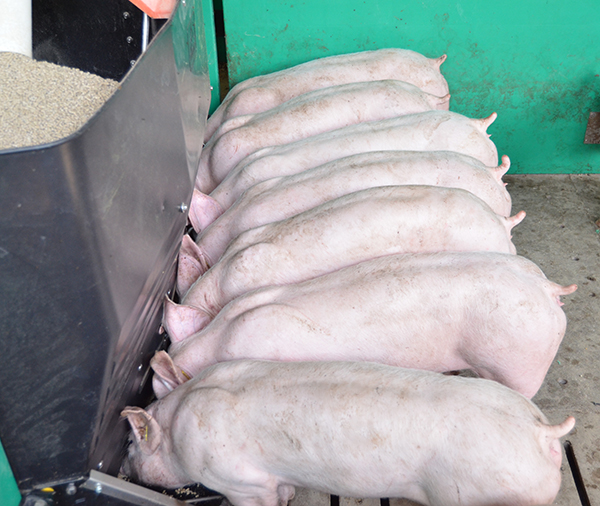
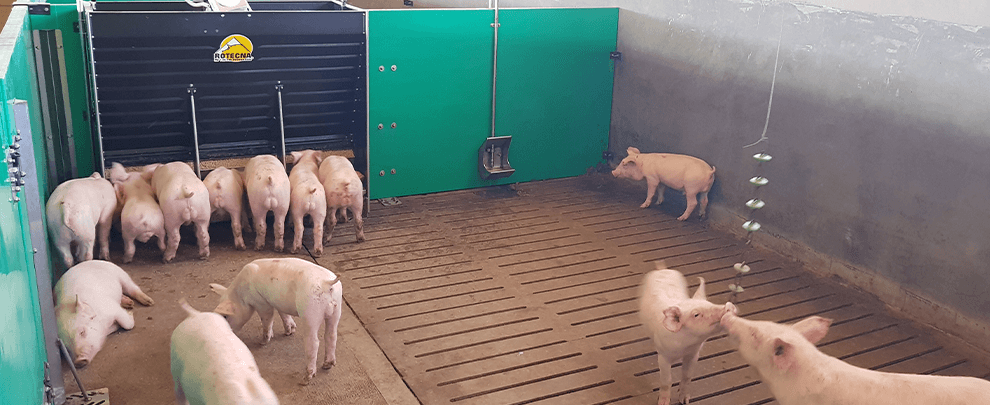
Dry feeding. Photo: Rotecna.
Wet feeding
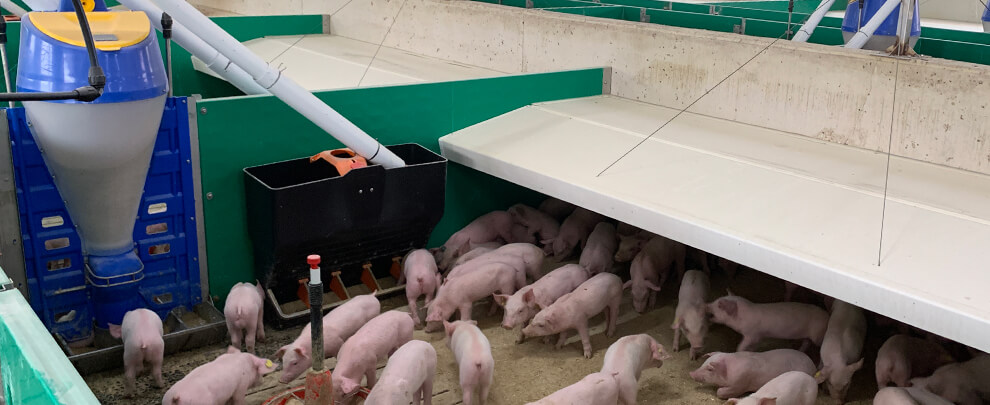
Wet feeding is based on mixing feed and water in the feeder dish, creating a mash. This requires a dispensing mechanism between the hopper and the dish that animals must operate, so it must be reliable, simple, and intuitive, especially for smaller animals, which must learn to use it after weaning.
Wet feeding prevents feed components from separating, even if using flour feed, and animals consume it faster than dry feed. In this type of feeder, proper regulation and water flow are crucial to ensure there is neither excess feed nor water in the dish. This is key for achieving a good feed conversion ratio.
The dish should contain feed without being excessively clean or licked, which would indicate insufficient feed flow and reduce average daily gain. At the same time, avoiding feed accumulation is essential because wet feed quickly deteriorates, loses its organoleptic qualities, and becomes less attractive to animals, especially under high-temperature conditions.
Besides, in wet feeders, it is very important not to have fewer animals than recommended per feeding point, as the feed stays too long in the dish, making it impossible to maintain the correct feed-to-water ratio, leaving too much water in the dish as well. This water excess increases feed waste and energy consumption, especially for animals with lower volumetric intake capacity, becoming a significant issue for post-weaning piglets. Water flow rates should generally be maintained between 0.5 and 0.7 L/min for pigs in transition, and between 0.7 and 1.0 L/min during fattening.
In wet feeders, omitting additional drinkers can reduce total water consumption and help piglets begin feeding, as they have water and feed at the same point. However, by requiring animals to drink where they eat, it is essential to adjust density per feeding point to avoid negatively affecting average daily gain. This is especially important during high temperatures when water consumption increases significantly. In such cases, additional drinkers are recommended, which can be turned off during cold periods for optimal management. Extra drinkers also allow closing water supply to feeders during the final growth phases, helping moderate average daily feed intake and limit fat accumulation in heavy animals, particularly in genetics prone to fattening.
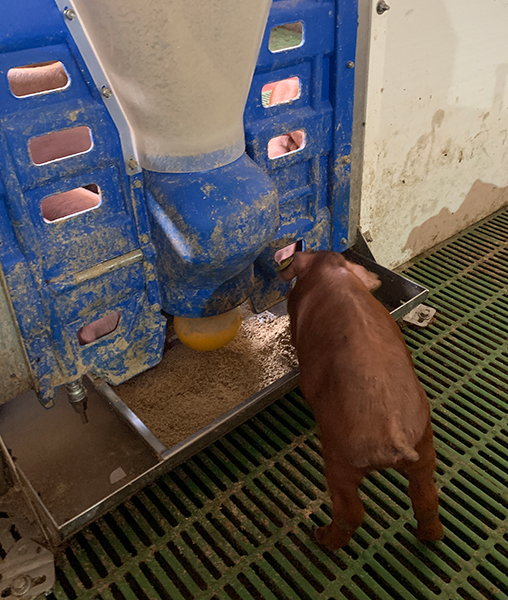
Wet feeding. Photo: Rotecna.
Differences by production phase, weight, and genetics
In newly weaned animals, the absolute priority is a rapid start, as up to 40% of piglets do not consume feed within the first 48 hours post-weaning. In this phase, a well-designed dry feeding system (granulated feed, sufficient feeding spaces, starter support plates, good accessibility, and constant fresh feed supply) usually provides greater management reliability.
For wet feeding to outperform dry feeding, feeders must have a reliable and rapidly learnable mechanism, requiring very precise and frequent management to avoid issues from excess water or prolonged feed presence in the dish. Additionally, because small animals have limited intake capacity, any potential increase in average daily consumption between systems usually does not produce significant differences in this phase. Therefore, the smaller the animals at entry and exit, and especially when using pelleted feed instead of flour, better results are usually obtained with dry systems over wet.
During fattening and finishing, wet feeding shows greater potential, as animals more easily learn to use mechanisms and have higher intake capacity and daily growth. However, this benefit only materializes if regulation is correct and the system is well adapted to climate and farm management. Weight at exit and genetics must also be considered, as exceeding the age of maximum average daily gain may lead to excessive fattening, so limiting intake is advisable, which can be easily done with dry feed. Thus, the smaller the animals at entry and exit, or the lower their tendency to fatten at exit, the better wet systems perform compared to dry systems.
In Wean to Finish systems, where animals remain at the same feeder from 5–6 kg to slaughter weight, versatility is key, especially for heavy slaughter weights. Feeders capable of operating in dry or wet mode, with progressive adjustments, highly intuitive learning mechanisms, and adjustable height according to animal size, allow adapting feeding strategy to each phase without changing feeders.
Influence of climate, management, and production strategy
Environmental conditions and technical level of the farm are key in system choice. In very hot climates and without adequate environmental control inside barns, or on farms with limited monitoring and control capacity, dry systems usually perform better. Conversely, in facilities with good environmental control, well-designed feeders with intuitive mechanisms for animals and trained staff, wet feeding can offer clear advantages in consumption and growth.
How to choose the most suitable system?
As seen, choosing between dry and wet feeding depends on multiple factors that must be evaluated together. Both systems can be highly efficient if applied correctly and adapted to production phase, climate, feed type, and farm management level. Rather than dogmatically choosing one over the other, the technical approach should focus on feeder design, precision of adjustment and water flow, reducing competition among animals, and adapting the system to farm-specific conditions. Whenever possible, versatile solutions should be prioritized to adjust feeding strategy according to animal growth and production circumstances.
In short, efficient pig feeding does not depend solely on whether feed is provided dry or wet, but on how every detail of the system is managed to ensure animals eat more, waste less, and reach their productive potential in the shortest possible time, including sanitary, nutritional, environmental, and genetic aspects.