Blog
Blog

Ingrid Seró: “Water control is not an expense, it is a strategic investment"
19th March 2026 - News
In pig production, parameters such as diet, genetics, and health are precisely controlled, but water remains, in many cases, an undervalued factor. However, its impact on the health, well-being and productive performance of animals is direct and transversal in all phases. In this interview, we speak with Ingrid Seró, veterinarian at the GSP Lleida (Grup de Sanejament Porcí), who explains why water should be considered a strategic pillar in the management of farms, addressing its nutritional and health role; It also tells us about the most frequent errors in its management, the importance of analytical controls and facilities, and its direct influence on the profitability and biosecurity of farms.
In pig production, there is a lot of talk about food, genetics, health, and well-being, but little about water. Is water given the relevance it has in production?
In general, no, although it is increasingly given more importance. Traditionally, water itself has been considered a guaranteed input on the farm and was not a limiting factor. For this reason, in many farms neither their quality nor their consumption is systematically monitored, unlike, for example, food or health, where very extensive controls are carried out. It must be clear that water directly affects both food and health.
Why should we consider water as a decisive element in pig production and not just as another resource?
Water serves both nutritional and health purposes and, very importantly, also acts as a vehicle for medicines, as in antibiotic treatments. In addition, it is essential to clean and disinfect the farm and equipment, and, from a biosafety perspective, we must consider that it can also serve as a potential entry and dissemination route for microorganisms, some of which can be pathogenic to our animals.
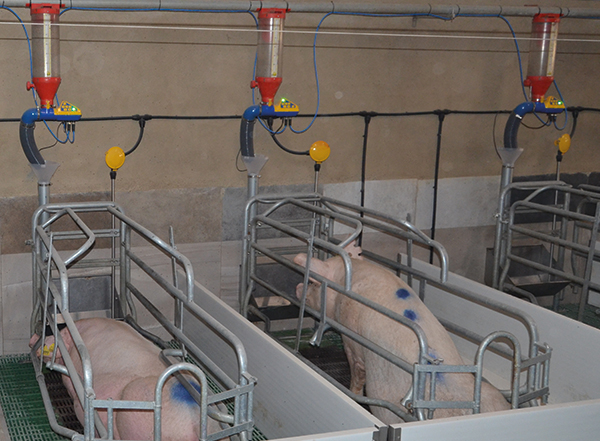
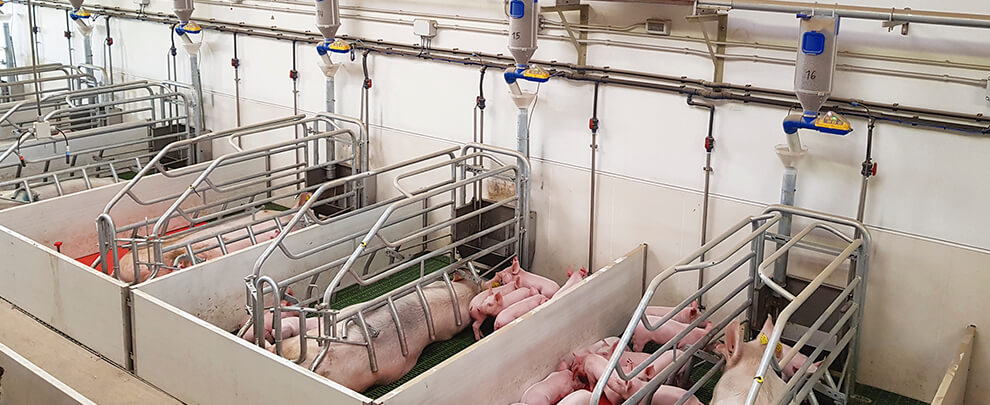
Increased water consumption is observed in breeding sows. Photo: Rotecna.
What key functions does water play in the proper growth of pigs, and why is it essential for their well-being and performance?
Water is essential. Firstly, for the metabolism of the animal itself, for the correct functioning of the different organs and for the thermal regulation of pigs. All of this directly affects the animals' well-being and health. In fact, pigs consume approximately twice as much water as they eat dry food, and this consumption can increase by up to 30% in hotter weather.
How does water consumption vary at different stages of pig growth?
As animals age, their water requirements increase. Thus, there are numerous reference tables on consumption in litres per day, depending on the animals' age. As a guide, we could talk about approximate consumption of 2 to 3 litres/day in piglets and 4 to 6.5 litres/day in fattening. Where greater consumption is observed is in the breeding stock, which, depending on their physiological state, can range from 10 to 15 litres/day, especially during the lactation phase of the sow, when consumption can reach 30-40 litres/day. Therefore, consumption clearly varies with the animals' age and physiological state.
What are the most common mistakes in water management?
The most common mistake is to assume that animals, simply by having access to water, already receive the necessary quantity and quality. To avoid this, it is essential to monitor the amount of water the animals ingest on the farm using flowmeters, which are not yet widely used, and to adjust the drinkers' flow correctly, an aspect that is sometimes not fully verified. Regarding water quality, one of the main errors is misinterpreting the analytics. Although we must always aspire to water qualities close to those for human consumption, we must also recognise that, depending on the production phase, animals are not equally tolerant of microorganisms due to their immature digestive systems, so we must be aware of this when interpreting analytical results.
"The most common mistake is to assume that animals, simply by having access to water, already receive the necessary quantity and quality."
Regarding water quality, which analytical controls are recommended for periodic monitoring?
At least, maintenance should be carried out semi-annually. However, the frequency may vary if, for example, an analysis is unfavourable and corrective measures must be evaluated, or if changes are made in the water treatment, it is necessary to evaluate its effectiveness through complementary analyses. At an analytical level, both microbiological parameters (total coliforms, total germs, E. coli, clostridia...) and physicochemical parameters (pH, hardness, free chlorine, total chlorine, chloride, sulfates, nitrites, nitrates, etc.) must be considered. Royal Decree 3/2023 on the quality of water intended for human consumption serves as the main reference framework in veterinary medicine. Furthermore, it is important to keep in mind that the water sampling point is also key for a correct interpretation of the results. It is advisable to sample at representative points along the animal's actual consumption path, such as the end of the line, the drinkers themselves, the beginning of the line, and the tanks, to evaluate the water's origin.
Do facilities and equipment also need to be checked?
One of the key points to guarantee water quality is the proper condition of the facilities, which, first of all, helps avoid water leaks and prevent the waste of this resource, and ensures that the flow reaching the animals is adequate and not lost along the way. Furthermore, the origin of the water, whether from a network, a well, or a surface source, will greatly determine the types of problems that can happen on the farm, both at the microbiological and physicochemical levels, so the facilities and controls must be adapted to that origin. It is also very important to periodically check for biofilm and mineral scale in the pipes, as these remain obstacles to the animal receiving water in sufficient quantity and quality. We must keep in mind, above all, that, without adequate maintenance, any analytical control program will lose effectiveness.
Why should water be one of the first points to check when health or production problems appear?
In the end, water is a common factor that is distributed throughout the farm and, consequently, affects all the productive phases we have. For example, digestive problems in certain warehouses, or drops in consumption or uniformity within a lot, can originate in water or be aggravated by it as a cofactor. Therefore, treating water as one of the first checkpoints enables rapid, objective evaluation based on sampling, although it is often undervalued.
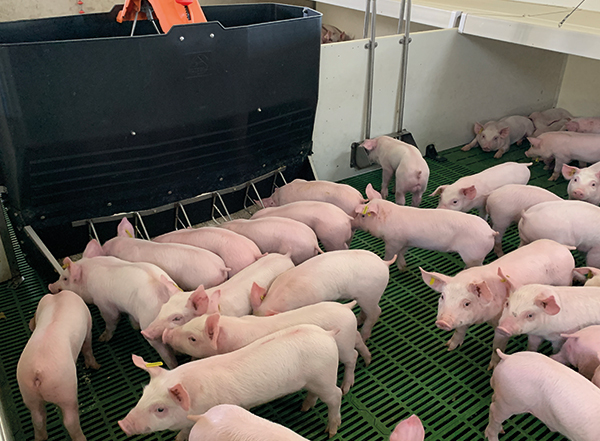
Piglets consume 2 to 3 liters of water per day. Photo: Rotecna.
Precisely, regarding animal health, what impact can poor water quality have?
For example, in piglets, it can cause dysbiosis and diarrhoea by disrupting the microbiota after consuming contaminated water. In fattening pigs, poor-quality or inadequate water consumption can lead to reduced conversion and, depending on the load and the type of microorganisms present, also to digestive problems. In the case of sows, it could cause decreases in consumption and, indirectly, reproductive problems, so that the economic impact would be greater. Furthermore, poor water quality can compromise the effectiveness of drug treatments, leading to unnecessary medication waste. In this sense, on many occasions, a well-planned water analysis makes it possible to explain apparent failures of treatments that, in reality, are not due to the medication itself, for example, but to a water quality problem or the presence of biofilm in the pipes.
At a more general level, should a farm's total daily water consumption be measured?
Yes, without a doubt, because it is a fundamental tool that can guide us a lot, especially when diagnosing on a farm, when we have a problem. Abnormally low consumption could indicate problems with access, quality or loss of palatability, that is, that this water does not taste good for the animal, or that the animals are sick and, consequently, reduce their water intake. On the contrary, excessive, very high consumption may indicate poorly regulated drinking fountains or, for example, the presence of digestive processes.
Finally, what key message would you convey to ranchers about the importance of monitoring water in all production phases?
Water control is not an expense but a strategic investment, because good water management, in the end, will help us improve farm health control, optimise feed use, and maximise the effectiveness of the treatments to the water and, consequently, to reduce productive losses and reinforce biosecurity on farms, which is also very important.