Blog
Blog
Natural or forced ventilation in pig farms
24th February 2026 - News
Ventilation in pig farms is one of the pillars of environmental control and a determining factor in productivity, respiratory health, and animal welfare. The microclimate inside the barn influences average daily gain, feed conversion ratio, and the herd's sanitary stability. Therefore, in the design of a modern pig barn, the decision between natural ventilation and forced ventilation has technical and economic implications that affect performance throughout the farm's entire service life. Both systems follow different principles of air movement and provide different levels of environmental control.
The importance of environmental control
Air inside the barn must be continuously renewed to remove the metabolic heat produced by the animals, reduce the humidity generated by respiration and excreta, and maintain low concentrations of harmful gases. When ventilation is insufficient, environmental load increases, and the incidence of respiratory problems rises, especially in sensitive stages such as weaning and transition.
A poorly managed environment favors the appearance of condensation, undesirable drafts, and temperature fluctuations that affect feed consumption and herd uniformity. The goal is to ensure sufficient air renewal without causing thermal stress, adjusting minimum flows in winter and maximum flows in summer according to live weight and animal density.
Natural ventilation in pig farms
Natural ventilation relies on physical phenomena such as the pressure difference generated by wind and the chimney effect resulting from thermal gradients between the interior and exterior. Fresh air enters the barn through lateral openings or adjustable inlets, while hot air rises and exits through chimneys.
This system stands out for its structural simplicity and practically nonexistent energy consumption. In temperate climates with good external air circulation, it can provide adequate results, provided that the barn is correctly oriented and the design of inlets and outlets allows a homogeneous airflow throughout the entire area.
The main limitation lies in its dependence on weather conditions. On windless days or with extreme temperatures, the renewal capacity may be insufficient. This situation is exacerbated in high-density farms or in productive stages where thermal control is more demanding, such as maternity and weaning. A lack of precision in adjusting the airflow can lead to humidity and gas accumulation or cold drafts that compromise comfort.
The performance of natural ventilation is directly related to the architectural design of the barn. Its height, roof slope, location of air inlets, and level of airtightness determine its actual effectiveness. Thus, a proper technical approach is essential to minimize environmental deviations.
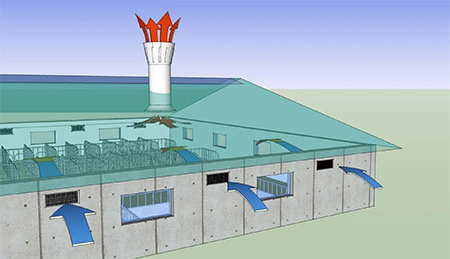
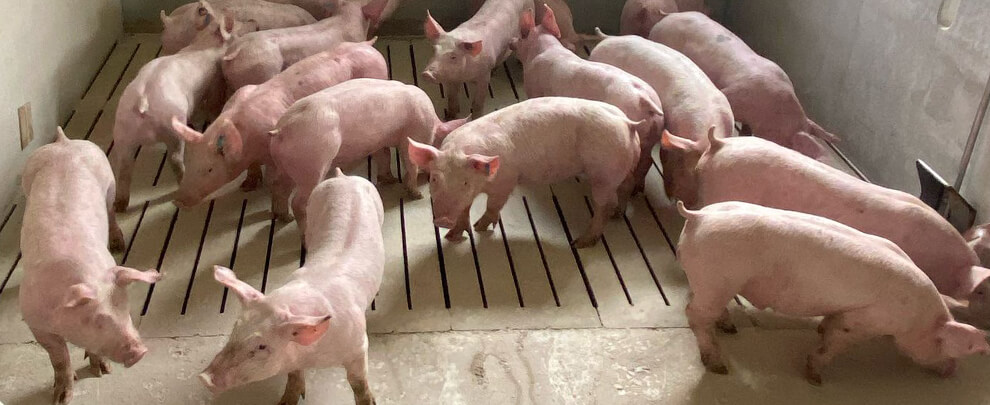
Natural ventilation in pig farms.
Forced ventilation and microclimate control
Forced ventilation generates air movement through fans that extract or push airflow in a controlled manner. This system allows adjusting air renewal according to production needs and external conditions. It can be configured in negative, positive, or neutral pressure, with negative pressure being the most widespread in pig farms due to its efficiency and ease of regulation.
In negative pressure systems, extractors create a vacuum that facilitates the entry of fresh air through adjustable inlets. Proper design of these inlets directs the airflow toward the ceiling to facilitate mixing of cold air before it descends to the area occupied by the animals, reducing the risk of direct drafts.
Positive pressure systems also exist, in which air is pushed into the barn by fans while the exit occurs through openings designed at strategic points. On the other hand, neutral pressure systems combine inlet fans and exhaust fans. They offer a high level of environmental control but with higher energy costs and greater technical complexity.
Forced ventilation provides a high level of control. Using climate controllers and temperature and humidity sensors, the system adapts the airflow in real time. This capability allows stable conditions to be maintained year-round, regardless of external weather conditions. In extreme climates, it can be integrated with evaporative cooling systems or minimum ventilation strategies in winter to preserve heat without compromising air quality. In this sense, although it requires higher initial investment and energy consumption, the improvement in environmental stability and productive performance makes forced ventilation a common solution in highly mechanized and high-density farms.
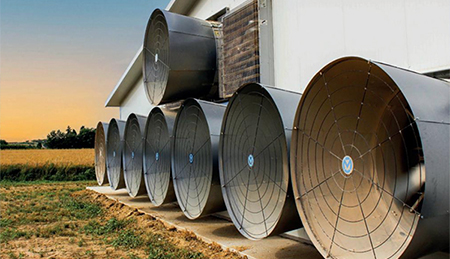
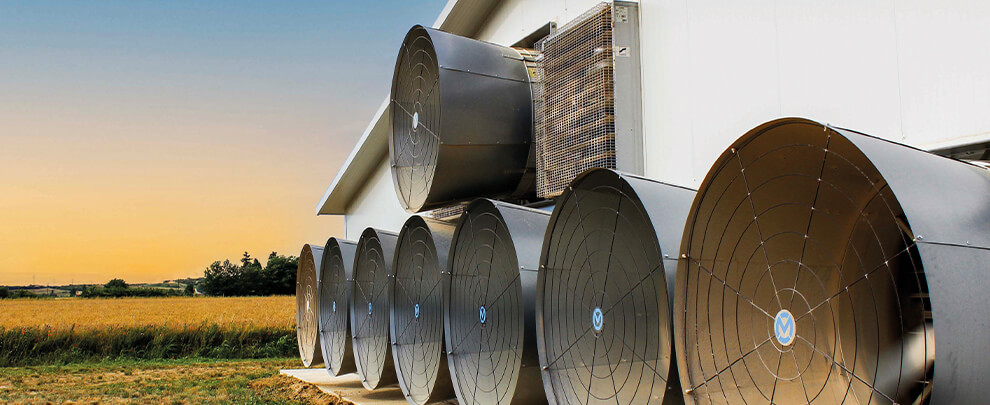
Forced ventilation in pig farms.
Impact of ventilation on productivity and animal welfare
The relationship between ventilation and productivity is direct and measurable. When the microclimate remains within optimal ranges, animals allocate more energy to growth and less to thermoregulation, since thermal stability promotes regular feed consumption and improves feed conversion, reducing weight variability at the end of the cycle. Also, a properly sized ventilation system limits the accumulation of ammonia, dust, and CO₂, factors that affect respiratory health and the incidence of clinical processes. Reducing environmental load decreases sanitary pressure and helps maintain stable production parameters over time.
From the perspective of animal welfare, controlling the indoor environment prevents heat or cold stress, minimizes behaviors associated with thermal discomfort, and improves herd uniformity. In intensive farms, where animal density is high and climatic variations can be pronounced, the ability to precisely adjust ventilation makes a significant difference in technical and economic results.
For this reason, the choice between natural and forced ventilation should be understood as a strategic decision within the overall farm design. The selected system will determine the level of available environmental control and, consequently, the facility's ability to maintain high standards of welfare, production efficiency, and long-term sustainability.