Blog
Blog
The Peruvian pork sector is moving towards professionalisation
12th March 2026 - News
The pork sector in Peru occupies a particular position within the South American livestock panorama. It is a market with a high degree of self-sufficiency and a still limited presence in international trade, making it a sector fundamentally oriented toward the domestic market. In recent years, its evolution has been marked by advances in animal health and institutional efforts to modernise pig production.
In this context, Peruvian pigs are progressively moving towards a more efficient and competitive model, in an environment where traditional farms coexist and where there is growing demand for biosafety, traceability and product quality.
Pig production
Pig production in Peru remains closely linked to rural areas, with family livestock farming still a significant component. According to data from the Peruvian Association of Pig Farmers, there are between 450,000 and 550,000 pig producers in Peru, of whom around 75–80% are engaged in family farming. Consequently, a significant portion of the meat produced is destined for self-consumption, rather than being incorporated into modern slaughter and distribution routes. In this sense, it is estimated that between 85,000 and 110,000 tons of pork are produced annually outside the commercial market. This feature has historically conditioned the structure of the Peruvian pork sector and explains, to a large extent, some particularities of its production, consumption and trade statistics.
However, this traditional context has not been incompatible with progressive improvements in the health framework, which in recent years have contributed decisively to stabilising productive activity. In 2024, 13 regions of the country were already free of African swine fever (ASF), which has enabled reduced health risks in the main producing areas and laid the foundations for greater consolidation of commercial farms.
Recent evolution of the pork sector
In recent years, there has been notable progress in commercial pig farms, which are increasingly technical, operate at larger scales, and are clearly market-oriented. These farms, many of them integrated into industrial projects or in integration schemes, already control close to 70% of commercial pig production, and are consolidating themselves as the main instrument of growth in the sector.
This transformation has been possible, to a large extent, thanks to the support of the Peruvian government, which has reinforced policies to promote more efficient, competitive, domestic pork production aligned with international health standards.
This institutional support has been key to facilitating investments in biosafety, productive management, and genetic improvement, which have been transformed into a positive evolution in productive indicators. In 2024, around 3.15 million pigs were slaughtered on commercial farms, reaching a production of 208,583 tons of pork. The average yield was around 66.2 kg per pig, a figure still low compared to other, more technical markets but indicative of progressive improvement in production efficiency.
As a result of all this, pig production registered approximately 4% growth in 2024, and forecasts suggest this trend could continue or even increase, in line with the ongoing modernisation process.
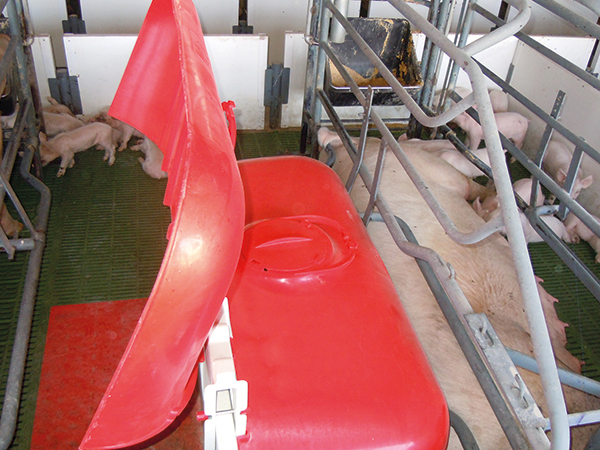
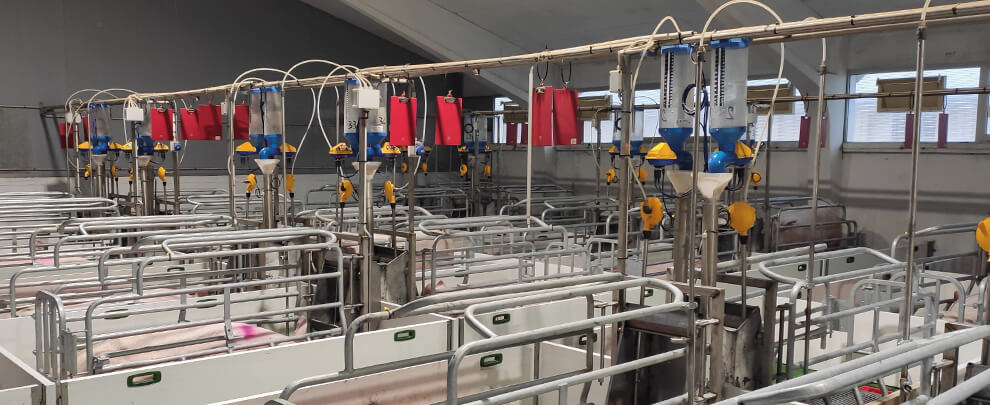
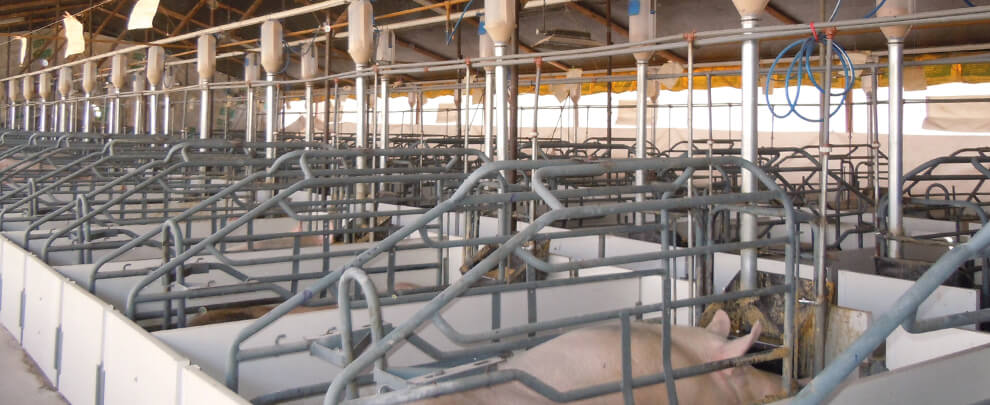
Farrowing ward in Peru equipped with Rotecna products. Photo: Rotecna.
Pork consumption in Peru
Pork consumption in Peru remains moderate per capita, though it shows a clear positive trend. In 2024, total meat and pork consumption was around 226,883 tons, equivalent to about 6.6 kg per inhabitant per year. However, forecasts suggest that this level could double in the medium term, especially in large urban areas such as Lima or Arequipa.
This evolution is explained by both the growth of the urban population and the revaluation of pork within the Peruvian diet, supported by its historical presence in local gastronomy and by communication efforts aimed at positioning it as a safe, accessible, and versatile meat.
Imports and self-sufficiency
The Peruvian pork market is characterised by a high degree of self-sufficiency, close to 92%, which covers most of the national consumption. Domestic production, both commercial and intended for self-consumption, limits the need to resort to the foreign market. In 2023, imports of meat and pork products represented less than 8% of total consumption.
That year, Peru imported 18,292 tons of meat and pork products, worth 48.33 million euros, with a price import medium of 2.63 €/kg. The main suppliers were Chile, Brazil, the United States, Canada and Spain.In contrast, Peru exports virtually no pork, largely because it is not yet completely free of classical swine fever.
In contrast, Peru exports virtually no pork, largely because it is not yet completely free of classical swine fever. However, recent advances in health allow us to anticipate that, in the medium term, opportunities could open up to develop selective exports.
Future and opportunities
The future of the pork sector in Peru involves consolidating the modernisation process of commercial farms, improving productive yields and gradually reducing the burden of self-consumption. The expected growth in domestic consumption, especially in large urban centres, provides a solid basis for the sector’s expansion. At the same time, improving animal health and institutional support open opportunities to strengthen the value chain, develop products with greater added value and move towards more integrated and formalised production. In this scenario, the sector’s ability to incorporate small producers into more structured routes will be a key factor in its evolution over the coming years.
Source: Interporc.