Blog
Blog
How precision livestock farming improves farm management?
26th March 2026 - News
Precision livestock farming in pig farms has become a key tool to optimize daily management, improve production control, and ensure the efficient use of resources. Increasingly, farms are incorporating these systems into their routines, aiming not only for efficiency and animal health but also for a more rational management of all processes.
Advances in digitalization have enabled the integration of systems that record data on animal behavior, feed and water consumption, and environmental conditions. When managed properly, this data allows for early detection of deviations and informed decision-making, providing closer control of each barn and the ability to respond quickly to any incidents.
Monitoring of environment and animal behavior
One of the most widespread uses of precision livestock farming is the continuous monitoring of the barn environment. Sensors installed in the facilities record temperature, humidity, and gas levels, providing constant information on environmental conditions.
In daily management, this data allows for immediate adjustment of ventilation or heating when deviations from recommended values are detected. This control prevents thermal stress and helps maintain stable conditions, especially during critical stages such as farrowing or weaning.
Complementarily, monitoring animal behavior provides essential information: systems that track activity or feeder visits help identify changes in habits, drops in consumption, or reduced mobility, early indicators of health or management issues. Detecting these signals in time enables intervention before productive losses occur.
Precise control of feed and water intake
Control of feed and water intake in pig farms has evolved toward systems that adjust supply according to the actual needs of animals at each production stage. This approach allows for more precise feeding and supports uniform growth within the herd.
In farrowing, systems like Dositronic M enable individualized feeding strategies for each sow. The system distributes the daily ration in multiple portions and allows easy adjustment of feeding levels based on observed consumption. This control promotes higher feed and water intake during lactation, directly impacting milk production and the uniformity of piglets at weaning.
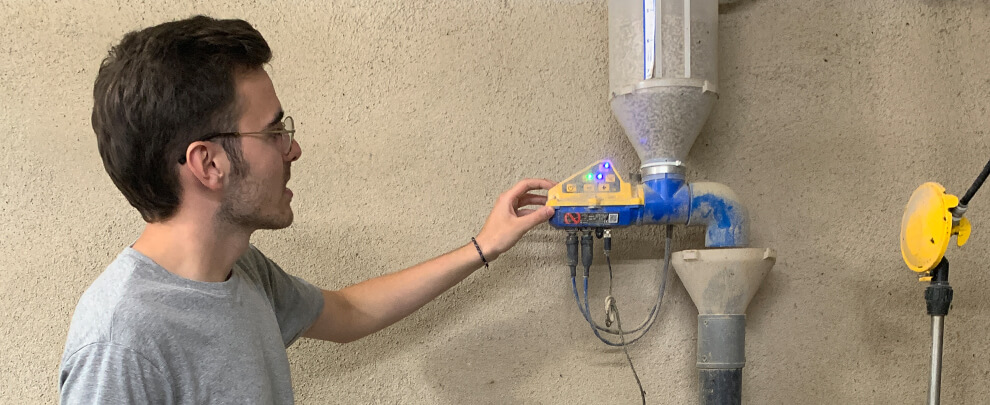
In group gestation, solutions such as Dositronic G feed each sow individually through electronic stations that identify the animal via a chip. Based on this identification, the system automatically dispenses the assigned feed quantity according to the sow’s feeding curve, avoiding competition among animals and allowing better control of body condition throughout gestation.
In the case of feed supply, systems like Evofeed allow for the automated management of the transition between different types of feed within the same room, adjusting the dispensed proportions according to the needs of the batch. This multi-phase feeding control system improves animal adaptation by reducing abrupt nutritional imbalances and digestive problems that can occur when changing from one formulation to another. Furthermore, Evofeed controls the amount of feed dispensed in each room, providing better monitoring of animal consumption and progress without the need for manual mixing, thus saving time and operational effort.
These technologies allow precise adjustment of feed and water intake at every production stage and enable rapid detection of deviations. In daily management, having this information helps maintain consistent consumption, improve feed efficiency, and optimize feed use within the farm.
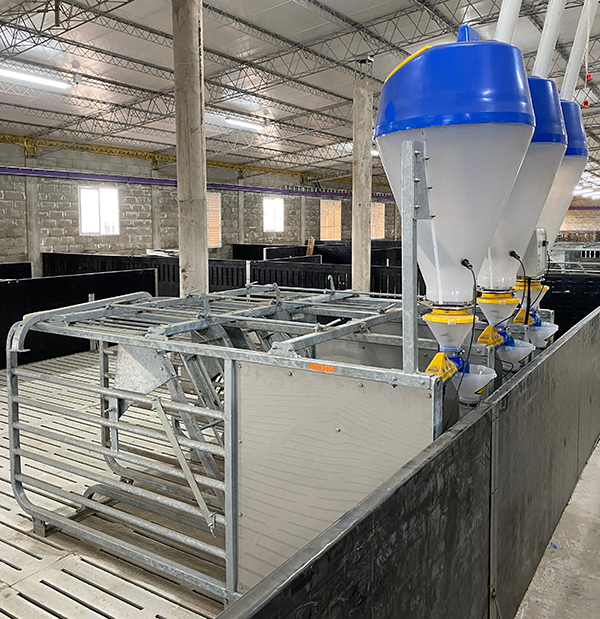
Dositronic G allows each sow to be fed individually. Photo: Rotecna.
Early detection of health issues
Precision livestock farming offers clear advantages in the early detection of health problems. Often, changes in behavior or consumption appear before visible clinical symptoms. For example, sound analysis systems in barns can detect increases in coughing frequency within a herd. This information is useful for early identification of respiratory problems and for assessing the need for veterinary intervention. Similarly, activity and consumption records help identify animals or groups exhibiting abnormal behaviors. This monitoring allows affected herds to be isolated or corrective measures to be applied before the issue spreads.
In daily management, this anticipatory capacity reduces the need for late interventions and improves the effectiveness of treatments. It also enables more rational use of medications, aligned with current strategies to reduce antibiotic usage.
Automation and daily farm management
Automation is one of the most visible elements of precision livestock farming in pig farms. Automatic feeding, environmental control, and data recording systems reduce manual labor and improve time management. In practice, automation allows staff to focus more on supervision and health management tasks rather than repetitive manual work. Centralized data availability enables rapid review of each barn’s status and prioritization of necessary interventions.
Moreover, digital records allow for storing historical information for each herd. These data are useful for analyzing production results and comparing different cycles, facilitating management decisions and future planning.
Integrating automated systems also reduces human errors associated with manual processes. Accurate feed distribution and environmental control result in greater production stability and overall improvement in farm performance.
Sustainability in digitalized pig farms
Sustainability is another area where precision livestock farming provides tangible benefits. Detailed consumption monitoring optimizes the use of resources such as water, energy, and feed, reducing the environmental impact of production. In daily management, precise consumption data help identify inefficiencies and improve distribution systems. This results in reduced losses and increased efficiency in the use of raw materials.
Environmental management also benefits from sensors that monitor emissions or indoor air quality parameters. These data help maintain appropriate barn conditions and improve the balance between productivity and animal welfare.
Current trends point toward increasingly digitalized farms, where information becomes a central tool for decision-making. Precision livestock farming transforms data into concrete actions that enhance production efficiency and strengthen the sustainability of pig production systems.