Blog
Blog
P. Peña: “Investing in farm cleaning is investing in prevention”
26th February 2026 - News
In a context where animal health is a decisive factor in the sustainability and competitiveness of pig farms, cleaning and disinfection are fundamental to biosafety processes. Beyond being part of the daily routine, these approaches constitute the first line of defence against the entry and elimination of pathogens, protecting both animal health and farm productivity. To delve deeper into its importance, we spoke with Patricia Peña, consultancy manager for auditing and training in swine genetic transfer and biosafety centres, who shares our vision and experience on the need to implement effective cleaning and disinfection strategies in pig farms.
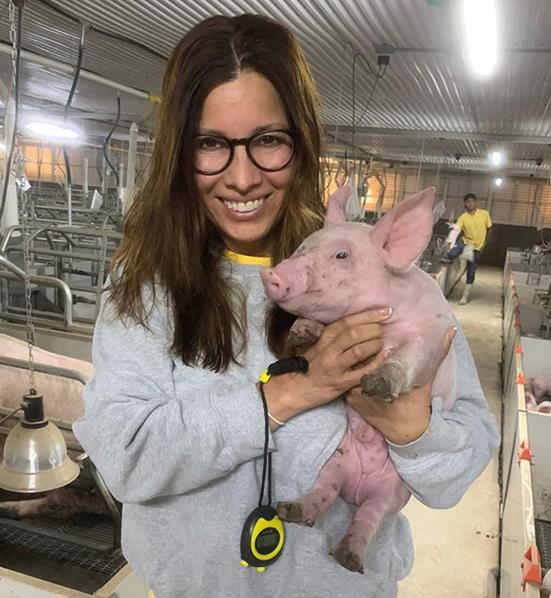
Patricia Peña is a director of biosafety consulting and auditing. Photo: P. Peña.
Why is cleaning and disinfecting our pig farms necessary?
Cleaning and disinfection are essential parts of biosecurity; basically, it is what we know as hygiene, because everything has to be washed and disinfected. Cleaning and disinfection protocols have to be stabilised for everything, be it people, vehicles, facilities, tools, etc., mainly because we have to train staff to carry out that process and have the minimal possible variations for it to work. One always has to follow the procedures. Sometimes steps are skipped, things are seen as clean, and the cleaning procedure is skipped to go directly to disinfection, and this cannot be. Cleaning is basic, regardless of whether the pen looks clean or not, because biofilm exists, something that you do not see. Still, it is there: viruses hide there, and bacteria produce it; consequently, they act more aggressively, protected by it.
What are the benefits of cleaning and disinfection as key biosafety tools?
There are only advantages. Suppose we do not have a clean facility when we fill it with animals. In that case, the health problems that may have existed previously will reappear, so it is better to invest in cleaning than in antibiotics and the other costs associated with an infectious process on the farm. For this reason, it is essential, for example, to have a verification methodology to ensure that the facilities are immaculate and disinfected. Unfortunately, sometimes biosafety is not given the importance it deserves. For a biosafety strategy to work, I always recommend a clear protocol and a biosafety manager who audits all processes. This is a job the farm manager cannot perform because they will be focused on production, objectives, weaned piglets, etc. On the other hand, if we have someone responsible for cleaning, they may decide to postpone filling a maternity ward until the facility is spotless. With this motion alone, we will not directly achieve better profitability from the farm; still, we do guarantee that the animals are healthier and reach weight sooner, or, in the case of females, that they tend to have better reproductive results. These data can affect beneficiaries and the farm's profitability.
What are the most critical areas on farms?
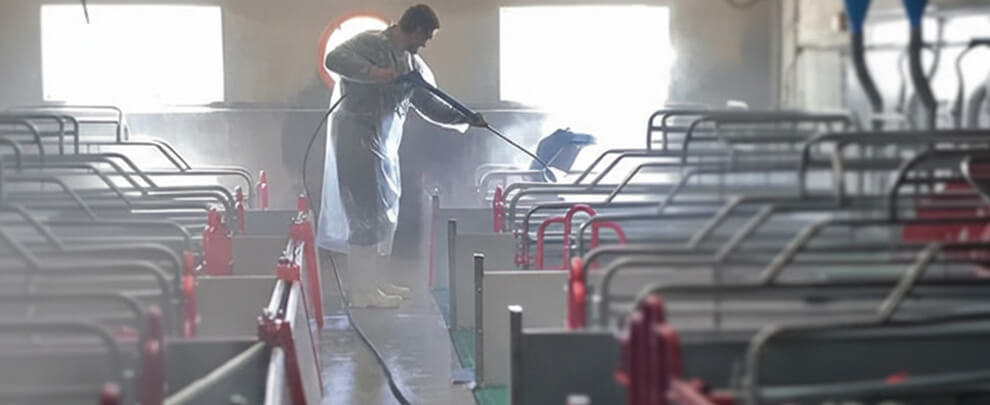
Everything that happens inside the farm. We pay a lot of attention to who enters, vehicle entry mode, etc., but on the other hand, people think nothing happens to what is inside. And this is not the case, because the most critical point of the farms is the facilities themselves: they must be spotless, and every time they are cleaned to make a new call, all the moving parts are dismantled, be they curtains, feeders... You have to perform a deep cleaning: remove dust, cobwebs, and any other organic matter that accumulates, and, if possible, clean under the slats, depending on the type of installation.
Are there cleaning and disinfection protocols to correctly perform these tasks?
Yes, and they must exist on farms. Ideally, to uphold quality cleaning on the farm, there should be an SSOP (Standard Sanitation Operating Procedure). A good SSOP should specify who will perform the cleaning, which tools and disinfectants or detergents will be used, their concentrations, dosages, waiting times, etc., and detail the tasks to be carried out in each phase. For example, during weaning, you have to remove all organic matter, any remains of excrement and urine, dismantle the feeders, unscrew the water drinkers... And, obviously, it's essential to have everything written down in a visual way that is easy to understand.
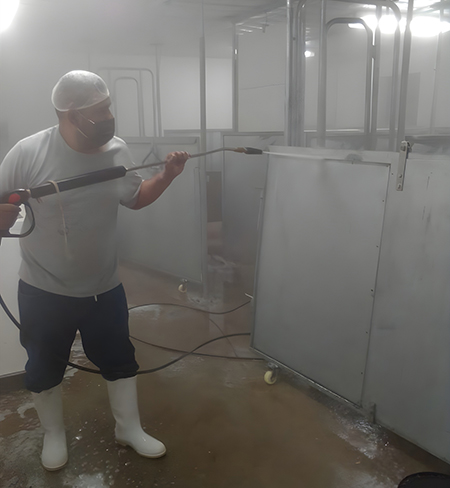
Cleanliness is an essential part of biosecurity. Photo: Patricia Peña.
What role do staff play in the cleaning and disinfecting of facilities?
Their role is essential. Above all, they must be made aware of the dangers and risks posed when facilities are not adequately cleaned. In addition, they must be trained to understand and perform the washing and disinfection processes, use the different tools, and confirm that the facilities are clean. It is essential to invest time in training personnel for this task and not assign it to those who have been on the farm the least or have the least experience, because this is one of the most common mistakes.
Regarding the use of disinfectants, what recommendations should be considered?
There are many disinfectants on the market, and they vary widely depending on use. I would emphasise the importance of assessing farm water quality and conducting bacteriological and physicochemical analyses at least once a year. Therefore, the first step in using disinfectants is to know what type of water we have, whether it is hard or not, etc. That way, we will know which disinfectant to use and how to use it. Then we have to understand what we are facing, what diseases we have or what threatens us, to apply the most appropriate formula. The time the product is left in the repository and the proper use of an adequate concentration to prevent dilution and loss of effectiveness are also noteworthy.
We have talked about cleaning processes, product use, and staff training... What are the most common mistakes made when talking about cleaning?
There are many errors, but one of the most recurring concerns is staff training. Often, new farm employees are sent to wash, thinking it is the most straightforward process, when, in fact, it is one of the most important, because everything begins there. When other errors occur, such as failing to meet the time requirements for each step, failing to verify that all of it has been removed, or failing to wait the required drying time before applying the disinfectant, etc... In this sense, it is essential to coordinate closely with those responsible for maintenance, washing, biosafety, and production to ensure these requirements are met before reintroducing animals and to eliminate viruses and bacteria. Finally, another of the most common mistakes is the use of porous materials in facilities that retain more dirt and are more challenging to clean; to the extent possible, these materials must be replaced with ones with fewer pores, less susceptible to dirt, and more suitable for cleaning.
What challenges remain in this area?
I often talk about the need to raise awareness among staff, but we also need to raise awareness among farm owners. Hence, they ensure they have the necessary resources and invest in cleaning, thereby strengthening biosecurity. While things are running smoothly, we assume everyone is doing a good job and don't really check whether biosecurity measures are implemented adequately until a health problem arises on the farm. That's why we insist that cleaning protocols must be in place and applied consistently, not just when there's an outbreak on the farm. So, the biggest challenge is raising awareness, ensuring that biosecurity is given the importance it deserves, which is significant within the production system. Investing in cleaning and disinfecting farms is investing in prevention.