Blog
Blog
How can we protect respiratory health on pig farms?
16th July 2026 - News
Respiratory health is essential for maintaining productive performance and profitability in modern swine production. However, controlling respiratory diseases is not always a straightforward task. Porcine Respiratory Disease Complex (PRDC) represents one of the greatest health and economic challenges facing the swine industry, as it is rarely caused by a single pathogen but rather by the interaction of multiple pathogens, environmental conditions, and the animals' immune status. Consequently, its control requires a comprehensive approach that combines prevention, management, and biosecurity measures to maintain the balance between the pathogen, the environment, and the host. The ultimate goal is to ensure not only animal health but also productive performance and farm profitability.
Environmental management
Environmental management plays a key role in preventing respiratory diseases. Factors such as air quality, facility design, nutrition, and water supply form the foundation of any comprehensive herd health program. If any of these pillars fail, pathogens encounter more favorable conditions to proliferate, and the animals' immune response may be compromised.
Among all environmental management factors, ventilation is particularly important. Adequate air exchange is essential for maintaining good air quality inside the barn. However, during colder months or periods with significant temperature fluctuations, such as autumn and winter, maintaining indoor temperature often takes priority, leading to reduced ventilation. As a result, harmful gases, especially ammonia, as well as airborne particulate matter tend to accumulate.
Continuous exposure to these irritants triggers increased mucus production as a defense mechanism of the respiratory mucosa. However, when mucus becomes more viscous and accumulates excessively, the mucociliary clearance system becomes less effective, making pathogen elimination more difficult and compromising respiratory function. In addition, this alteration may reduce the penetration of certain antimicrobial treatments into lung tissue, thereby decreasing their effectiveness.
Therefore, maintaining adequate ventilation, together with proper control of relative humidity and air quality, is essential for preserving respiratory health and reducing the transmission of infectious agents, including swine influenza virus.
Immunization of sows and piglets
Vaccination is another fundamental pillar in preventing respiratory diseases such as enzootic pneumonia caused by Mycoplasma hyopneumoniae. To be truly effective, the vaccination strategy should adopt a comprehensive approach, protecting both commercial pigs and the breeding herd.
Everything begins with proper acclimation and immunization of replacement gilts. Administering booster doses during the gilt development phase helps reduce bacterial shedding at farrowing. As a result, sows transmit a lower burden of M. hyopneumoniae to their piglets during the first weeks of life, reducing infection pressure from the outset and facilitating disease control during subsequent production stages.
Vaccination of pregnant sows also plays a key role by promoting the transfer of passive immunity through colostrum. In addition to maternal antibodies, colostrum provides numerous immune components that contribute to the maturation of the piglet's immune system and strengthen its defenses during the early stages of life.
For piglets, one of the most important considerations is selecting the optimal vaccination time. Although vaccinating at weaning simplifies management, the stress associated with this stage may compromise the immune response. Therefore, under certain circumstances, delaying vaccination by a few days may be preferable, provided this decision fits within the farm's health program and does not interfere with other vaccination protocols, such as those targeting porcine circovirus.
Finally, the choice between single-dose and two-dose vaccination protocols should be based on the specific needs of each farm. Factors such as pathogen challenge, disease epidemiology, and the farm's operational capacity will determine the most appropriate vaccination strategy.
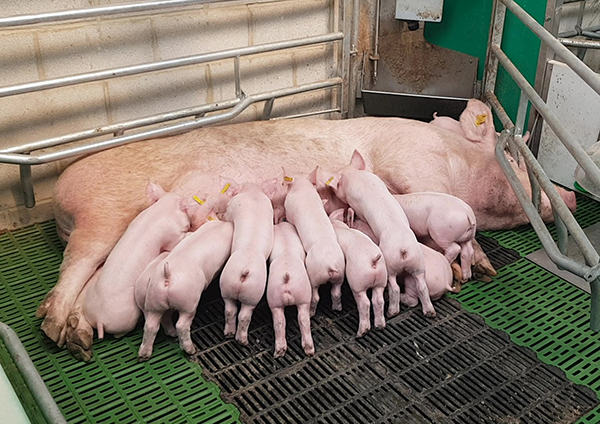
Vaccinating pregnant sows promotes the transfer of passive immunity through colostrum. Photo: Rotecna.
Responsible use of antimicrobials
When preventive measures are insufficient and treatment becomes necessary, antimicrobials should be used responsibly. This does not mean using them less, but rather using them only when indicated and in a strategic, rational, and diagnosis-based manner. To achieve this, any treatment protocol should be supported by an appropriate clinical evaluation and laboratory testing to identify the pathogens involved and determine their antimicrobial susceptibility through antimicrobial susceptibility testing (AST).
Once treatment has been selected, its effectiveness largely depends on correct administration. Dosage should always be calculated according to the animals' body weight and adjusted based on the bioavailability of the active ingredient, as well as actual feed or water intake.
For treatments administered through medicated drinking water, it is essential to verify that dosing equipment and stock solution tanks are functioning properly and ensuring drug stability. Likewise, when medication is delivered through feed, it is critical to confirm that the expected feed intake matches the actual consumption of the group. Otherwise, some animals may receive subtherapeutic doses, compromising treatment efficacy and promoting the development of antimicrobial resistance.
In addition, certain complementary tools can enhance therapeutic success. This is the case with mucolytic agents such as bromhexine, which facilitate the clearance of respiratory secretions and may improve the distribution of certain antimicrobials within the respiratory tract.
Good biosecurity practices
Biosecurity constitutes the first line of defense against the introduction and spread of pathogens on the farm. To be truly effective, it must be supported by rigorous hygiene protocols that are consistently implemented. In this regard, cleaning and disinfection procedures should always follow a well-defined sequence: removal of organic matter, soaking, detergent application, pressure washing, drying, and finally, disinfection.
The effectiveness of this process also depends on the products and procedures used. The use of hot water and foaming detergents improves the removal of dirt, particularly in critical areas such as farrowing and nursery facilities. In addition, periodically rotating the active ingredients of disinfectants helps maintain their effectiveness within a comprehensive hygiene program.
Another key aspect is respecting sanitary downtime between production batches. Although production requirements do not always allow this period to be extended as much as desired, maintaining sanitary downtime for as long as possible helps reduce the environmental microbial load. During this interval, proper drying of the facilities plays a particularly important role, as it limits the survival of numerous infectious agents.
However, no cleaning protocol is complete without verifying its effectiveness. Health audits, microbiological surface testing, and specific hygiene assessments make it possible to confirm that implemented measures are achieving the expected results and to identify opportunities for improvement.
Finally, the success of any herd health program depends largely on the people responsible for implementing it. Continuous staff training in biosecurity, lesion recognition, and necropsy procedures, together with clear and practical protocols, ensures that preventive measures are applied consistently. Furthermore, when this information is integrated with production data, health records, and slaughterhouse findings, farms have a solid basis for making decisions that improve respiratory health and enhance the profitability of the production system.