Blog
Blog
India is making slow progress developing its pig sector
28th July 2026 - News
With 1,463 million inhabitants in 2025, an expanding economy and growing urbanisation, India is one of the emerging economies with the greatest global projection and a highly complex agri-food market. However, the pig sector still remains very underdeveloped within the country's livestock structure, constrained by deep cultural, religious, and food restrictions that slow both production and consumption.
Despite this, certain regions in the north and northeast have consolidated relatively stable pig activity supported by small family farms and, increasingly, more professionalised business models. Furthermore, the expansion of international catering, the increase in tourism, and the growth of high-income urban consumers are beginning to generate market niches for pork products with greater added value.
Pig production
Indian pork production has very little significance within its powerful livestock system, which is largely dominated by milk, poultry, and buffalo production. In this context, the pig occupies a secondary position, and its development is concentrated in certain regions of the north and northeast of the country, especially in Assam, Meghalaya, and Jharkhand, where consumption is more culturally accepted.
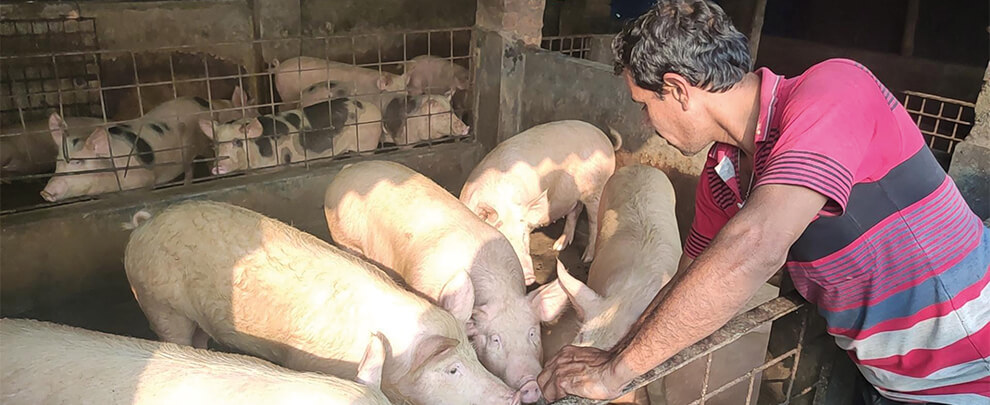
The productive structure is mainly based on small family backyard farms, although in recent years a gradual shift toward more professionalised commercial farms has been observed, which are estimated to accommodate about 2.6 million pigs and produce around 261,360 tons annually. However, some estimates raise total production from 350,000 to 420,000 tons, including output from thousands of small farms scattered across the country.
Pork consumption
Pork maintains a very limited presence in the Indian diet. It is estimated that total consumption barely exceeds 263,000 tons per year, which places per capita consumption below 0.2 kilos per inhabitant per year, one of the lowest levels among the world's large economies.
The reasons for this situation are multiple. On the one hand, India concentrates the largest number of vegetarians and vegans on the planet, since more than 25% of its population follows meat-free diets. Furthermore, significant religious and cultural restrictions dominate, along with ongoing prejudices about the healthiness and purity of the pig.
On the other hand, the country's meat consumption is clearly oriented towards other proteins. Chicken accounts for approximately 52% of total consumption, followed by lamb at about 35%, while buffalo and beef also account for significant proportions.
Pork consumption is concentrated in certain ethnic and religious communities, especially in northeastern states, and is also gaining ground in urban segments with high purchasing power. Likewise, international restaurants, hotels, and gourmet spaces drive a selective demand for premium products, often imported.
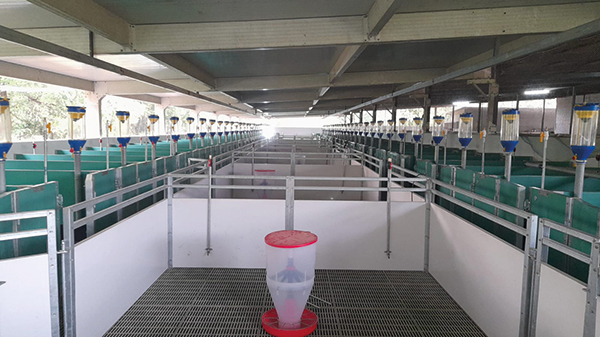
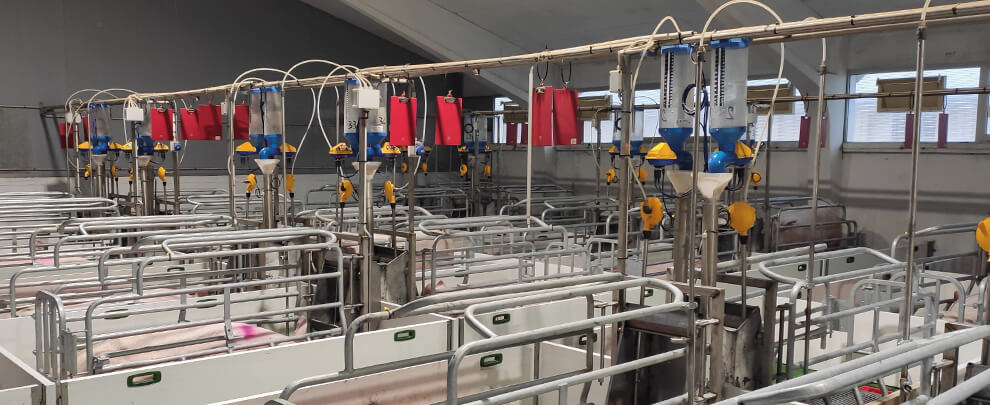
Installation for transition pigs in India with Rotecna equipment. Photo: Rotecna.
Market
India's pork foreign trade remains low, largely due to the country's high level of self-sufficiency, estimated at 99.57% in 2025. This scenario significantly limits dependence on imports, while exports are practically irrelevant and have lost weight after the health impact of ASF. Consequently, commercial activity focuses almost exclusively on small imports destined for specific market niches.
In this context, Spain has begun to gain presence. In 2025, the Spanish pork sector exported 132 tons of meat and processed meat to India, valued at 548,000 euros, with an average price of 4.15 euros per kilo. Spanish sales mainly included fresh or frozen meat (64.4% of volume), sausages (18.9%), offal (9.1%), meat preparations (6.1%), and cured hams (0. 8%).
Although volumes remain small, Spain already ranks as the third largest supplier of pork to the Indian market, with a 7.1% share of imports, only behind Russia and Belgium. However, market access remains complex. High tariffs, geographic distance, logistical costs, regulatory requirements, and limited knowledge of the Spanish product make broader commercial implementation more difficult.
Future of the Indian pig sector
In the short and medium term, the Indian pig sector will remain constrained by significant structural limitations. Cultural and religious restrictions, the limited tradition of pork consumption, and the high degree of self-sufficiency hinder significant market expansion, suggesting slow, highly localised growth. However, certain factors could favour a gradual evolution of the sector over the coming years. Urbanisation, rising incomes, and the expansion of international restaurants are generating new consumption habits in some urban environments, especially for higher-quality, added-value products.
In this context, the recent trade agreement between the European Union and India, signed in January 2026, could contribute to a progressive opening of the agri-food market. Although pigs will continue to have a reduced weight within the Indian livestock system, development opportunities are beginning to emerge in specific consumption niches.
Source: Interporc.