Blog
Blog
Key strategies to reduce the impact of slurry on swine health
02nd June 2026 - News
Pig slurry management is a structural component of the swine production system, with direct implications for animal health, welfare, and overall farm efficiency. Its impact does not depend solely on the volume generated, but above all on how its management is integrated into the daily dynamics of the farm.
In many farms, a significant share of issues related to air quality, increased stress levels, or the emergence of certain respiratory diseases is associated with poorly optimised slurry management. This does not mean it is the only contributing factor, but it is one of the most influential in the balance of the indoor environment.
Addressing this aspect from a technical perspective goes beyond simply solving a problem: it involves controlling the conditions under which decomposition processes occur, reducing animals’ exposure to volatile compounds, and stabilising the facility environment.
Indoor environment control and emission reduction
The time pig slurry remains inside facilities is one of the most critical factors in gas generation. As its accumulation increases, anaerobic fermentation processes intensify, releasing compounds such as ammonia, hydrogen sulphide, and carbon dioxide. These gases not only affect air quality but also increase the irritant load on the animals’ respiratory system.
From a practical standpoint, reducing this impact requires action on both management frequency and ventilation. In high-density farms, even small adjustments in the frequency of manure evacuation can have a noticeable effect on the stability of the indoor environment. Likewise, adjusting ventilation to avoid dead zones and improve air exchange helps dilute critical concentrations, especially during periods of higher thermal load.
Another relevant aspect is humidity control. A humid environment favours gas persistence and complicates the removal of metabolic heat. Therefore, the combination of adequate ventilation and frequent slurry management acts synergistically on environmental quality.
Facility design, management, and optimisation technologies
Facility design directly influences slurry behaviour. Systems with poorly sized pits, retention zones, or insufficient slopes tend to accumulate organic matter unevenly, intensifying decomposition processes and making control more difficult. In contrast, designs that promote continuous flow and homogenisation reduce critical emission points.
In practical terms, this translates into decisions such as optimising pit geometry, avoiding dead corners, and ensuring evacuation capacity is adapted to animal density. Maintenance also plays a key role: small blockages or solid build-ups can alter hydraulic performance and increase environmental issues.
At a technological level, the automation of slurry management has represented a major advance. Automatic flushing systems, level sensors, and solid–liquid separation solutions enable more precise control of the process. Phase separation, in particular, reduces the active organic load in the liquid fraction, decreases fermentation, and facilitates both storage and subsequent land application. It can also improve logistical efficiency by reducing volumes and optimising transport.
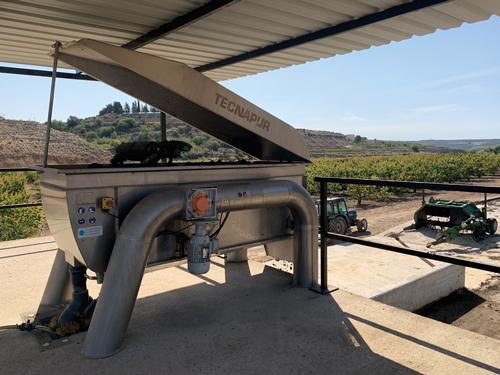
Solid-liquid separator. Foto: Rotecna.
Biosecurity, animal welfare, and productivity
The accumulation of organic matter in the animals’ environment increases microbial pressure and creates favourable conditions for the proliferation of potentially pathogenic microorganisms. This directly affects farm biosecurity, especially in intensive systems where animal density is high and contact with the environment is constant.
From an animal welfare perspective, air quality and environmental stability are key factors. High gas concentrations, strong odours, or humid conditions generate chronic stress, which alters normal animal behaviour. This may result in reduced feed intake, greater batch variability, and poorer adaptation to production phases.
In production terms, these effects gradually translate into key performance indicators such as average daily gain, feed conversion ratio, or growth uniformity. Although it is not always possible to isolate a single cause, technical evidence shows that environmental improvement has a direct impact on overall system efficiency.
For this reason, slurry management must be integrated into farm health and production programmes, not as an isolated element, but as a structural factor of performance.
Integrated approach to improving efficiency
Reducing the impact of pig slurry requires a combined approach that integrates operational management, facility design, and environmental control. No single measure is sufficient without a coherent overall strategy.
The best-performing farms typically apply a set of incremental improvements: increased management frequency, ventilation adjusted to actual load, well-designed facilities, and decision-support technologies. This approach stabilises the indoor environment, reduces disease pressure, and improves production efficiency.
In an increasingly demanding production context, the ability to control these factors precisely becomes a competitive advantage. Pig slurry management thus ceases to be a secondary aspect and becomes a real lever for technical and economic optimisation within the swine farm.