Blog
Blog
What benefits does having pregnant sows in groups bring us?
17th September 2019 - News
Oscar Toledano. Marketing Coordinator at Rotecna.
When, in 2001, new animal welfare legislation was approved for the Member States of the European Union, applicable to new farms from 2005 and to all existing farms from 2013, those affected rushed to inform ourselves about it.
Among other things, we were told that gestating sows had to be housed in groups from the fourth week after insemination until the week prior to farrowing. Many argued that the new law would lead to an increase in production costs, resulting in a significant loss of competitiveness for EU pig producers. After more than five years of widespread implementation, it has been shown that this was not the case; in fact, productivity has increased significantly, thereby reducing costs. How was this achieved?
It was thought that keeping sows in groups would increase aggression between animals and the number of abortions, leading to fewer farrowings and a reduction in average sow productivity.
1st LESSON
With proper design and sufficient space availability in the pens, sows do not produce less, quite the opposite, they produce more. Improved animal welfare and better physical condition have led to increased prolificacy without reducing fertility at farrowing, resulting in a lower production cost per weaned piglet.
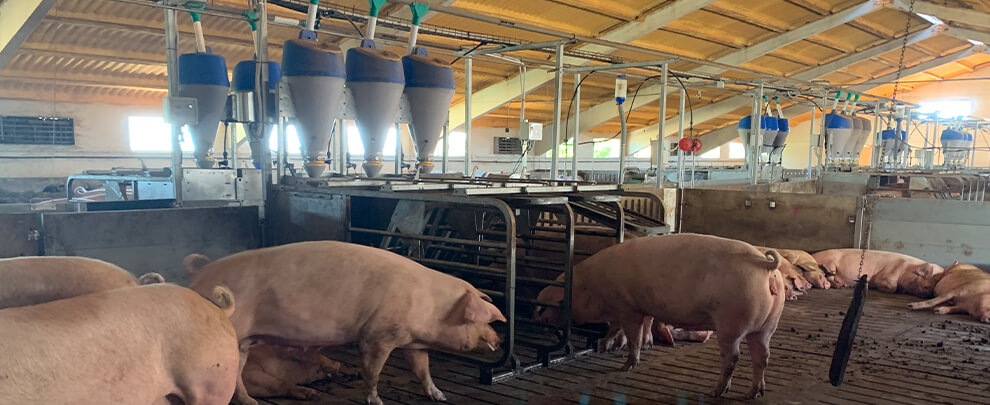
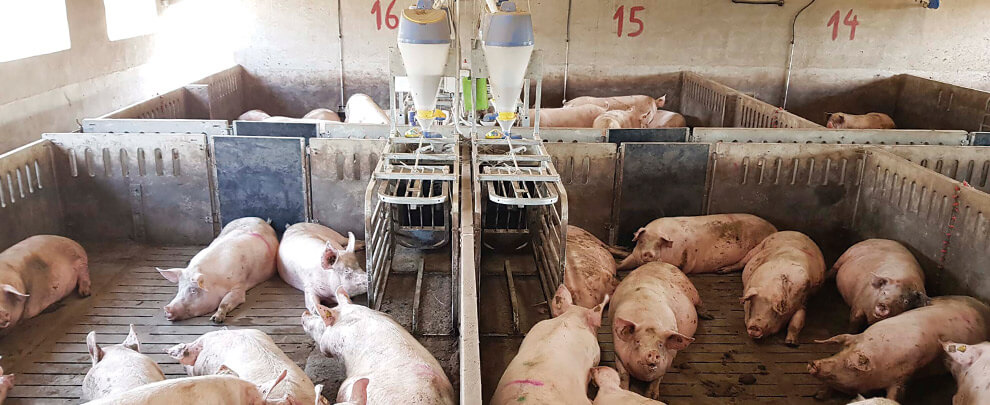
It is important to properly define resting, dunging, and feeding areas so that animals have sufficient space. The minimum area stipulated by legislation appears to be adequate (1.64 m² per gilt and 2.25 m² per multiparous sow, with a 10% increase for groups of fewer than six animals and a 10% reduction for groups of more than 40).
In addition, static groups (made up of animals from the same batch) are easier to manage than dynamic groups (made up of animals from different insemination batches), as they allow for smaller groups of animals of similar size and parity. Dynamic groups work well if they are large enough so that hierarchy is not excessively marked and animals can be moved without problems, following a proper protocol for handling pregnant sows.
It was also thought that feeding sows in groups would increase competition for feed and result in irregular feeding, not adjusted to the individual needs of each animal. This would lead to lower piglet birth weights in underfed sows, as well as problems in the farrowing unit. At the same time, overall feed consumption would increase due to higher energy expenditure, overfeeding, and increased waste caused by excessive competition at feeding.
2nd LESSON
With appropriate feeding systems and management, sows can eat calmly without competing. Total feed intake is similar to that of individual housing systems, and any increase in consumption is more than offset by the quantitative increase in production.
In simultaneous feeding systems, it is important to feed sows several times a day to avoid dispensing large amounts at once, which could cause animals that finish eating earlier, due to different feeding speeds, to disturb those still eating.
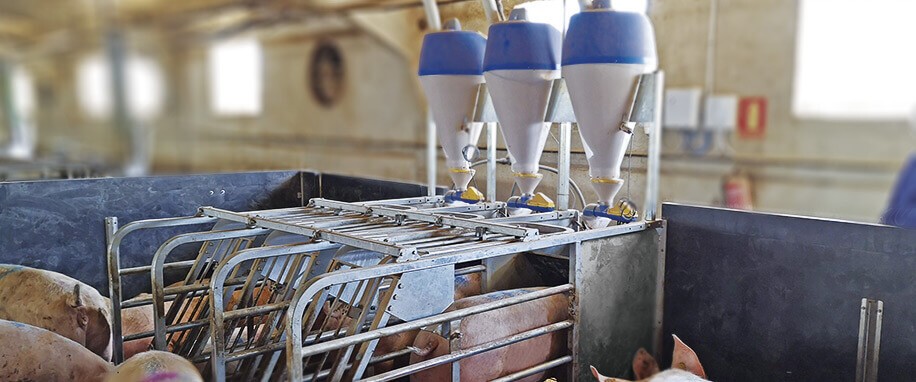
It is important to provide separation between feeding places, at least for the head and shoulders. Slow-drop systems can cause problems in adjusting the correct feeding speed, as fast-eating animals may become nervous if feed is delivered too slowly and may disturb other animals in the group.
Simultaneous feeding systems only allow the same amount of feed to be given to each animal in the pen, so it is important that animals are grouped according to their feed requirements and size. For this reason, groups cannot be very large.
Individual feeding systems using electronic chip recognition are the only ones that allow feed to be adjusted to each individual animal. They also make it possible to form large groups, maximize productive results and individual control, and minimize waste. These systems require animals to be trained to use them.
It may have seemed that the decision was made arbitrarily by politicians influenced by public opinion unfamiliar with the realities of the sector, without taking its needs into account. However, the European Commission drafted the new directive after numerous consultations with different organizations involved in the sector, both public and private, and based on the results of experiments conducted by various research groups.
It is important that we all continue to work together so that this remains the case, and that decisions are made on a scientific basis and for the benefit of everyone, consumers, producers, and animals alike.
3rd LESSON
A problem is always an opportunity for improvement. Unfortunately, progress rarely occurs without the appearance of an external force that drives change.
There is a tendency to overvalue one’s current position because leaving the comfort zone is uncomfortable, but that is the way to grow. In fact, one of the reasons European pig farming has reached such high levels of productivity and sustainability is its search for solutions to problems such as labor shortages, lack of land, high raw material prices, high energy costs, greater population concentration, and local consumer demands for extremely high standards of health and food safety. This has turned it into a model to follow for anyone seeking to develop a sustainable, high-performance pig production system.