Blog
Blog
What factors determine air quality on pig farms?
19th November 2026 - News
Air quality on pig farms affects animal welfare, respiratory health and staff working conditions. Although ventilation plays a key role in air renewal, it is not the only factor determining the environmental conditions inside a pig house. The concentration of certain gases, relative humidity and temperature must also be taken into account. Understanding these parameters and monitoring their evolution makes it possible to assess indoor conditions and detect potential deviations before they affect the animals.
Air quality does not depend solely on ventilation
Ventilation renews indoor air, removes excess heat and humidity, and limits the accumulation of certain gases. However, a properly functioning system does not, by itself, guarantee suitable environmental conditions. Air quality results from the interaction of different variables related to housing characteristics, stocking levels and animal management.
Stocking density, production stage, housing design and outdoor conditions can all influence the composition and distribution of air inside a pig house. For this reason, assessing the environment involves more than checking that fans are working or reviewing the settings programmed into climate control systems. It is necessary to understand the conditions the animals actually experience and how these change throughout the day.
Which indicators help assess air quality?
Assessing environmental conditions on a pig farm requires monitoring several indicators. Among these, the concentration of gases such as ammonia (NH₃) and carbon dioxide (CO₂) provides relevant information about indoor air quality.
Ammonia is generated mainly through the transformation of nitrogen compounds present in manure. Its concentration can vary depending on environmental and management conditions. When levels become elevated, it can irritate mucous membranes and the respiratory tract, making its control important for both animal health and staff working conditions.
Carbon dioxide, meanwhile, comes mainly from animal respiration and can also be generated by certain heating systems. Its concentration is a useful indicator for assessing air renewal, particularly when interpreted in relation to pig house occupancy and ventilation operating conditions.
Alongside these gases, temperature and relative humidity complete the environmental assessment. Both variables affect thermal comfort and must be adapted to the animals' needs according to their production stage. High humidity can encourage condensation on surfaces, while unsuitable temperatures can cause heat stress and affect animal behaviour.
The combined interpretation of these parameters provides a more comprehensive picture than looking at each one in isolation. Knowing the temperature inside a pig house is not enough if, at the same time, gas concentrations are elevated or humidity levels are unsuitable.
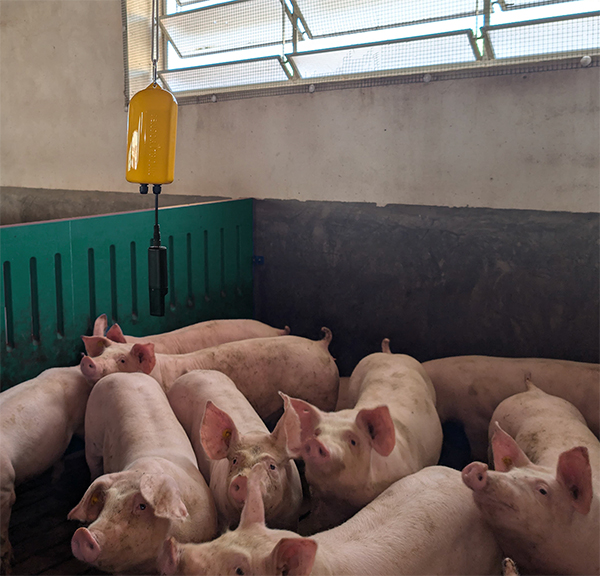
Environmental sensors allow for real-time monitoring of temperature, humidity, CO₂, and NH₃. Photo: Rotecna.
Why is a single measurement not enough?
Environmental conditions on a pig farm are constantly changing. They can vary throughout the day depending on outdoor temperatures, housing occupancy, animal activity and equipment settings. As a result, a single measurement may provide an incomplete picture of the air pigs breathe during the rest of the day.
The continuous monitoring of environmental parameters makes it possible to track these variations, identify patterns and detect deviations that might otherwise go unnoticed during routine checks. It also helps link specific changes to the operating conditions of the facilities and determine whether adjustments have achieved the expected results.
Another important aspect is sensor placement. Measurements must reflect the conditions experienced by the animals, so sensor locations should take into account the height of the housing areas and potential environmental differences between different zones within the same pig house. In addition, equipment maintenance and calibration are essential to ensure reliable readings.
Environmental monitoring to improve farm management
The use of sensors and monitoring systems makes it easier to track environmental conditions without relying exclusively on on-site checks. These tools allow users to access records, identify variations and receive alerts when certain parameters exceed established limits.
In this area, Rotecna's SensoriTronic monitors different environmental conditions using wireless sensors for temperature, humidity, carbon dioxide and ammonia. Data is collected in real time and can be accessed through a Web App platform available on different devices. It also allows users to configure alerts and receive notifications when established values are exceeded, making it easier to detect potential deviations and take action when necessary.
Having access to these records also makes it possible to analyse changes in environmental conditions over time and relate them to other aspects of farm operations. In this way, information goes beyond individual readings and becomes a tool for gaining a better understanding of how facilities perform and supporting management decisions.
Air quality should be part of routine monitoring on pig farms. Combining the control of key environmental indicators with monitoring tools makes it possible to understand actual housing conditions, detect deviations and take more informed action. In this way, environmental control goes beyond adjusting ventilation and becomes an ongoing monitoring process aimed at improving animal welfare and day-to-day farm management.