Blog
Blog
How to prevent diarrhea in piglets and improve their digestive development
05th May 2026 - News
Diarrhea in piglets is one of the most significant health challenges in the early stages of pig production. Its impact goes far beyond the clinical episode, as it affects batch uniformity, increases treatment costs, and compromises the animal’s growth potential.
Although it is commonly associated with enteric pathogens such as Escherichia coli, rotavirus, or Isospora suis, in field conditions its occurrence is almost always the result of a combination of infectious pressure, digestive immaturity, and management failures.
Understanding this issue requires approaching it as a dynamic process in which the piglet’s intestine acts as the central axis balancing nutrition, environment, and immune status.
Causes of diarrhea in piglets
During the first days of life, piglets have an immature digestive system, still undergoing functional development and highly sensitive to any disturbance. At this stage, the intestine must not only adapt to nutrient digestion but also establish its microbiota, a process that begins immediately after birth and largely depends on the environment and the sow as a primary source of microorganisms.
This initial balance is critical, as the piglet simultaneously depends on two processes: the absorption of immunoglobulins from colostrum for protection and the colonization of its intestine by environmental microorganisms. When this balance is disrupted, stability is lost and pathogen proliferation is facilitated.
At this point, bacteria such as enterotoxigenic E. coli alter intestinal fluid secretion, while rotavirus reduces absorption capacity by damaging intestinal cells. In addition, pathogens such as Clostridium perfringens or Cystoisospora suis damage the intestinal mucosa, intensifying functional impairment.
As a result, there is a rapid loss of water and electrolytes that can progress within hours. However, the severity of the condition does not depend solely on the infectious agent but also on the piglet’s condition. When colostrum intake is insufficient, immunity is limited and the animal becomes especially vulnerable at a stage when it still lacks effective defense mechanisms.
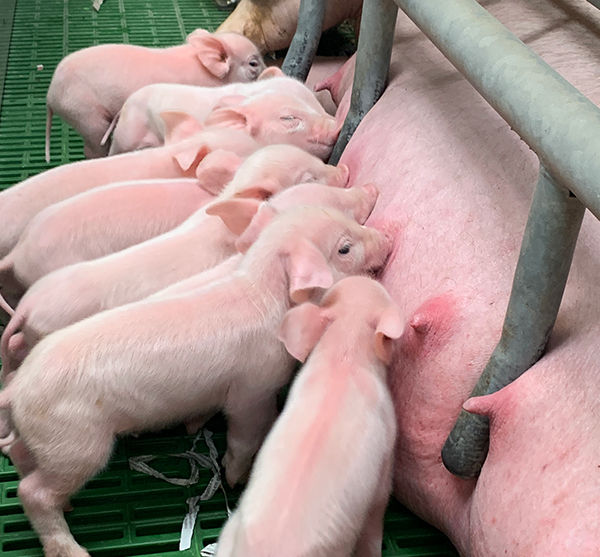
In their first few days, piglets have a digestive system that is sensitive to disruptions. Photo: Rotecna.
Nutrition as a key driver of digestive stability
Within this context, nutrition becomes the main modulating factor of intestinal health. In the first hours of life, colostrum intake not only ensures immediate energy supply but also establishes the immunological foundation that determines the piglet’s resistance to digestive infections.
As the piglet grows, the digestive system must adapt to a major change: the transition from maternal milk to solid feed. This process, particularly intense at weaning, involves enzymatic and microbiological reorganization that can lead to intestinal instability if not properly managed. At this stage, feed quality and digestibility play a decisive role, as they influence the speed of gastrointestinal adaptation.
In well-managed farms, this transition is not abrupt but gradual, allowing the intestine to maintain its functional balance. When this does not occur, intestinal dysbiosis becomes a direct predisposing factor for post-weaning diarrhea.
The importance of the environment
While nutrition defines the piglet’s physiological base, the environment acts as a constant modulator of its metabolic and immune stability. Temperature control is one of the most critical factors, as cold conditions reduce enzymatic activity, decrease feed intake, and promote functional immunosuppression.
This effect is intensified during weaning, a stage in which the animal is already exposed to nutritional and social changes. Thermal or environmental stress does not act in isolation but amplifies intestinal vulnerability associated with dietary transition. Under these conditions, microbiota balance becomes more unstable, increasing the likelihood of opportunistic pathogen proliferation.
Hygiene also plays a key role. A high microbial load in farrowing areas increases infection pressure from the first hours of life. Conversely, proper cleaning and room preparation significantly reduce pathogen exposure and promote a more balanced intestinal colonization. In this regard, facility design and optimization of conditions during the transition phase, as highlighted by technical approaches in the pig sector, help reduce stress and improve piglet stability at one of the most critical stages of development.
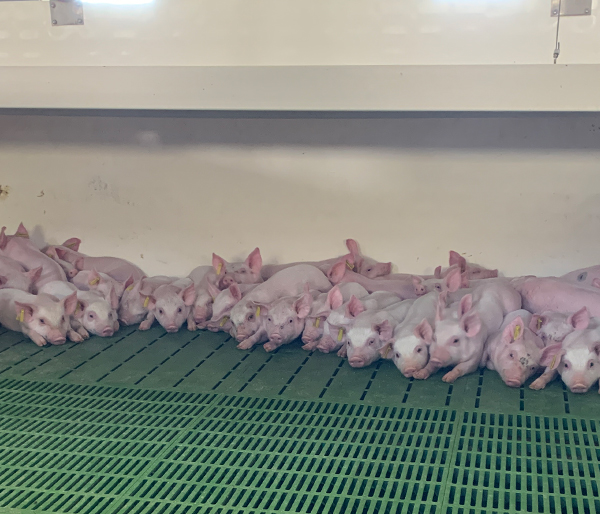
Maintaining good environmental conditions improves the piglet's stability. Photo: Rotecna.
Biosecurity
Once the piglet’s intestine is influenced by its development, nutrition, and environment, environmental infection pressure becomes the decisive factor. Biosecurity makes it possible to act directly on this aspect by reducing the presence and transmission of pathogens on the farm.
Access control, proper animal flow management, and the implementation of all-in/all-out systems help limit the persistence of microorganisms between batches. This strategy is particularly relevant for enteric pathogens capable of surviving in the environment for extended periods.
Cleaning and disinfection therefore take on strategic importance, not only as hygiene measures but as tools to reduce infection pressure on the most vulnerable piglets. At the same time, proper internal management reduces horizontal transmission, one of the main mechanisms for the spread of diarrhea in intensive systems.
Integration of factors
Preventing diarrhea in piglets depends on the overall consistency of the production system. Intestinal health relies on a dynamic balance in which immunity, microbiota, nutrition, environment, and infection pressure continuously interact.
When piglets receive adequate passive immunity, develop in a clean and stable environment, and undergo a well-managed digestive transition, the intestine is able to maintain its balance even during critical stages. Conversely, any imbalance in these factors tends to escalate rapidly due to the limited adaptive capacity of piglets in early life. Therefore, in pig production, preventing diarrhea is not about reacting to the problem, but about anticipating it through system stability and precise control of the factors that influence intestinal health on the farm.