Blog
Blog
One year of ASF in Spain, lessons and challenges for the pig sector
26th November 2026 - News
The detection of African swine fever (ASF) in Spain has tested the pig sector's response capabilities and once again placed biosecurity at the top of its priorities. The outbreak, located in the Collserola area, has led to restrictions being imposed in 19 municipalities, although no cases have been reported on domestic pig farms to date. Even so, twelve months on, its consequences have been felt in the market, exports and animal health management. Joaquim Segalés, Albert Finestra and Miguel Ángel Higuera analyse the evolution of the disease, the lessons learned and the challenges the sector will have to face to return to normality and reduce the risk of future crises.

Joaquim Segalés, Albert Finestra and Miguel Ángel Higuera.
One year on, where does the ASF situation stand?
Twelve months after the first cases were detected, ASF remains present in wildlife, with 448 positive wild boar confirmed as of 19 November 2026. From an epidemiological perspective, Joaquim Segalés, professor at the UAB (Autonomous University of Barcelona), considers the situation to be “moderately positive”, within the negative context of having ASF in the country. In this regard, he highlights that the geographical spread of the disease has been relatively slow and contained, a result he attributes to the combination of active and passive surveillance, the delimitation of the infected area, population control, movement restrictions and strengthened biosecurity measures. “Despite the numerous cases detected in wildlife, no outbreaks have been reported on domestic pig farms, reflecting an effective animal health response and good protection of the pig production sector,” he points out.
This geographical containment of the outbreak is also the main indicator Albert Finestra, veterinary advisor to pig farms, uses to assess the response. “Twelve months after the outbreak was declared, the disease has not spread beyond the infected area, and no intensive white pork production farms in the region have been affected,” he explains. Nevertheless, he warns that the results achieved must not lead to a relaxation of the measures in place. In his view, farmers’ perception of the risk has gradually diminished over the past few months, and the initial concern has given way to a certain degree of normalisation. “People have not forgotten the problem, but their concern is now more focused on its potential impact on the market than on the fact that a disease of this severity is present in the region,” he notes.
This declining perception of risk is particularly concerning given the potential scenarios for which the sector is still not sufficiently prepared, such as the virus entering an intensive pig farm. “We have gained some experience as a result of the outbreak, but not enough. What would happen if the disease entered a production farm? Have procedures been established for carrying out the culling of a farm with 2,000 pigs if necessary?” Finestra asks.
In addition to these operational challenges, scientific uncertainties remain regarding the behaviour of the virus. On this point, Segalés recalls that wild boar play a key role in the virus’s persistence and local spread, both through contact between infected animals and through the environmental contamination that carcasses and their remains can cause. “Although the spread is generally relatively slow when the disease remains in wildlife, the virus can persist in the environment for long periods, making eradication more difficult,” he explains. He adds: “Furthermore, the exact mechanism by which it entered Spain remains unknown, although the evidence points to an introduction linked to human activities.”
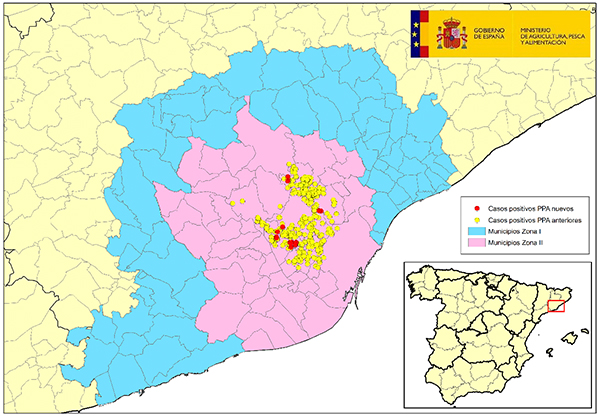
Detailed location of the cases of wild boars detected in restricted zone II.
Source: Department of Agriculture, Branches, Fishing and Food.
The economic and commercial impact of the disease
While the animal health assessment presents some positive aspects, the economic outlook has been less favourable. ASF emerged at a time when the pig market was already under pressure, both in Spain and across the rest of Europe and worldwide, further aggravating commercial difficulties. Miguel Ángel Higuera, director of ANPROGAPOR, stresses that these two factors must be distinguished to understand the impact of the crisis: “Some of the current economic difficulties are directly attributable to ASF, while others stem from the market situation itself, which was already experiencing a period of tension. Both factors have combined and worsened the sector’s economic outlook.”
This situation is directly reflected in producers’ accounts. According to the latest figures, the selling price of pigs currently stands at between €1.16 and €1.17/kg, while the average production cost in Europe, according to SIP data, is around €1.42/kg. For an animal weighing 116 kg liveweight, this difference represents losses of between €35 and €36 per pig produced. Although pressure on margins eased slightly during the summer, the average accumulated between January and October 2026 stands at around €25 in losses per animal.
Beyond prices, one of the main effects of the disease has been the disruption of international trade. Its presence in wildlife has led to restrictions in certain export markets, even though the domestic pig population remains free of the virus. In this context, sanitary regionalisation has become an essential tool for maintaining exports from disease-free areas. Spain has made significant progress in this regard, particularly thanks to the agreement reached with China, which has established a regionalisation protocol that other countries have taken as a reference. However, important markets such as Japan, Mexico, Malaysia, Taiwan and Thailand remain closed.
For Higuera, regaining access to the Japanese market is one of the main commercial priorities, given Japan’s importance as an importer of pork and pork products. Mexico is also a relevant destination, although it accounts for a smaller share of Spanish exports. However, reopening these markets poses animal health challenges, as some countries maintain a blanket ban following any detection of ASF and do not recognise regionalisation. In this context, Spain must demonstrate that the disease is geographically contained and that surveillance and control measures are working effectively. “We must provide these countries with regular, detailed information on the epidemiological situation regarding ASF and the measures we are implementing. Building trust is essential to securing their acceptance of our sanitary regionalisation measures,” Higuera states. Progress towards this goal requires coordination between the Ministry, the autonomous communities and the production sector, verification of test results obtained outside the affected area and strict compliance with the European eradication plan.
Biosecurity and surveillance, ongoing challenges
The first year of the outbreak has highlighted the importance of maintaining constant surveillance of wildlife. Among the priority measures implemented, Segalés highlights early case detection, systematic searches for carcasses and their prompt removal. These actions have been essential in reducing the risk of transmission. They must be accompanied by continued population control and habitat management measures, particularly in areas where initial animal densities were high. “No single measure is sufficient on its own. It is essential to maintain surveillance efforts and the sustained management of wild boar populations and, above all, the rapid removal of carcasses,” Segalés emphasises. At the same time, he considers it necessary to monitor indicators such as a sustained reduction in cases, a gradual decrease in the affected area and the absence of spread into new areas to determine whether the outbreak is genuinely under control.
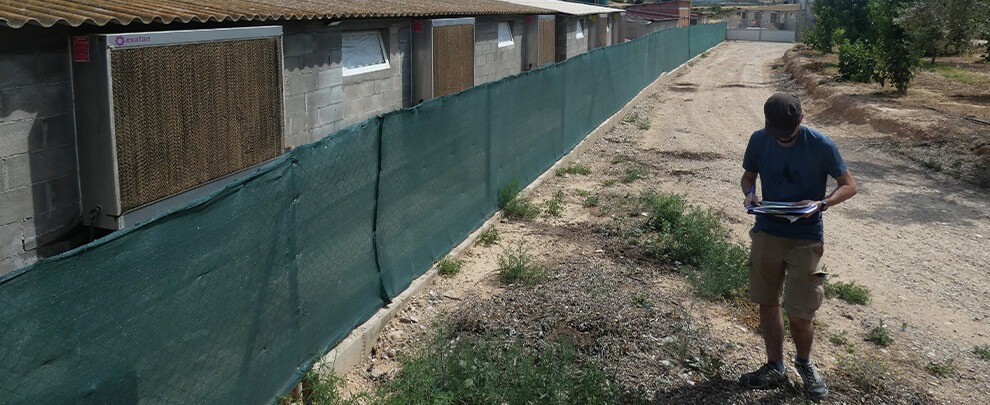
Beyond measures targeting wildlife, prevention also requires maintaining strict protection measures on pig farms to prevent the virus from reaching domestic animals. Avoiding any direct or indirect contact between wildlife and domestic pigs, controlling access for people and vehicles, and ensuring proper cleaning and disinfection are essential measures. However, Finestra believes that too many mistakes are still being made in their implementation: “We are seeing failures in farm access procedures, such as entering without following the established protocols, as well as in carcass collection, where the separation between clean and dirty areas is not being properly maintained,” he explains. He therefore considers it a priority to reinforce the distinction between these two areas and ensure that procedures are effectively followed. He also points to the need to improve controls on the movement of live animals through a more rational policy that reduces the risk of disease spreading between regions.
Alongside these preventive measures, Finestra considers it essential to strengthen the capacity to detect and diagnose any suspected health issue. “It is better to carry out a test that ultimately returns a negative result than to allow a disease to go unnoticed and continue spreading,” he states. In this regard, he recommends that the procedure should always begin by notifying the farm’s attending veterinarian, who can then assess whether to carry out a differential diagnosis that includes notifiable diseases.
In addition to technical procedures, managing an animal health emergency requires all stakeholders to work in a coordinated manner. On this point, Finestra believes there is still a considerable gap between the authorities, veterinarians and the production sector, despite the fundamental role each plays in the response. “I feel there is a lack of more fluid and continuous communication between all the stakeholders involved,” he notes.
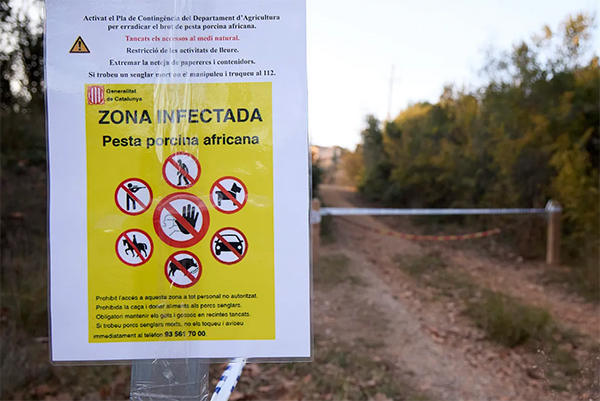
Prevention and surveillance are essential to contain ASF and protect the pig sector.
What challenges lie ahead for Spain’s pig sector?
The assessment of these twelve months raises challenges that go beyond the immediate management of the outbreak. From a scientific perspective, important questions remain unanswered regarding the persistence of the virus in the environment and the routes through which it entered Spain. To advance research in these areas, Segalés highlights the role of advances in diagnostics and genomic sequencing, which can improve virus detection and help reconstruct transmission chains. Among the tools currently being developed are portable molecular tests, such as PCR systems and LAMP isothermal techniques, which could facilitate on-site diagnosis and reduce response times. However, the main objective remains the development of safe and effective vaccines for both wild boar and domestic pigs. “They would represent a substantial shift in current control strategies, which are based primarily on surveillance, biosecurity and wildlife management,” he points out.
The crisis has also highlighted the need for financial mechanisms to protect farms that, despite having healthy animals, face trade restrictions because they are located within an affected area. In this regard, Higuera believes that the situation has exposed existing shortcomings in protection against market disruptions. He stresses that “we must consider scenarios in which, despite having healthy animals, farms face difficulties selling them or suffer negative economic consequences as a result of trade restrictions”. ANPROGAPOR is therefore working on developing tools to cover these situations and provide farmers with greater protection against future animal health emergencies.
Along the same lines, Higuera calls for protection against trade restrictions to be complemented by direct support measures for producers, such as facilitating access to credit and easing financial burdens. “We are aware that providing a direct, non-repayable grant to the entire pig sector is practically unfeasible. That is why we are proposing more specific and realistic measures to support farmers during these difficult months,” he explains. Among these, he proposes a European programme for voluntary, compensated withdrawal from production for those who decide to cease their activity. Such a measure could help prevent a prolonged crisis without financial support from accelerating sector consolidation and undermining the competitiveness of Spain’s pig industry.
According to Finestra, the main animal health lesson from this crisis is that no disease is foreign to our territory: “Diseases spread, cross borders and we must be prepared to deal with them.” He therefore calls for strengthening animal health surveillance and maintaining efforts in animal health and biosecurity, even in a challenging economic climate. “All efforts aimed at improving animal health, strengthening biosecurity to prevent diseases from entering farms, and eliminating or controlling those already present are essential,” he concludes.
This call to maintain preparedness beyond the immediate emergency summarises many of the lessons learned from the crisis. Twelve months after the first cases were detected, the outbreak has tested the sector’s surveillance systems, response capacity and coordination, with significant production and commercial consequences. Regaining ASF-free country status will now be one of the main objectives. To achieve this, Spain must comply with European regulations, which require one year without detection of the virus in sick animals or fresh carcasses. All of this reinforces the need to turn the lessons learned into lasting improvements in prevention, surveillance and preparedness for future animal health threats.