Blog
Blog
Trends in equipment for gestating sows
28th May 2026 - News
Designing a gestation barn is no longer simply about arranging pens or sizing spaces. Increasingly, a more fundamental issue is taking precedence: how infrastructure influences sow behaviour, the organisation of daily work, and the stability of the production system. What for years was understood primarily as a construction-related decision must now be approached from a far more strategic perspective, in which equipment directly affects variables linked to animal welfare, operational efficiency, and reproductive performance.
This shift in approach is driving new trends in equipment for pig gestation, with solutions aimed at improving feeding control, reducing competition between animals, and creating more homogeneous environments within the barn. In this context, the Site 1 design emerges as an infrastructure model intended to facilitate management, optimise resources, and promote more stable conditions during one of the most sensitive phases of the production cycle.
Intelligent feeding redefines group gestation
Among the most relevant trends in pig gestation equipment, the evolution of individual electronic feeding is redefining the way body condition in gestating sows is managed. The challenge in group gestation systems has always been to strike a balance between housing that promotes animal welfare and nutrition tailored to the actual needs of each animal. In this context, technologies based on artificial intelligence are beginning to play a central role.
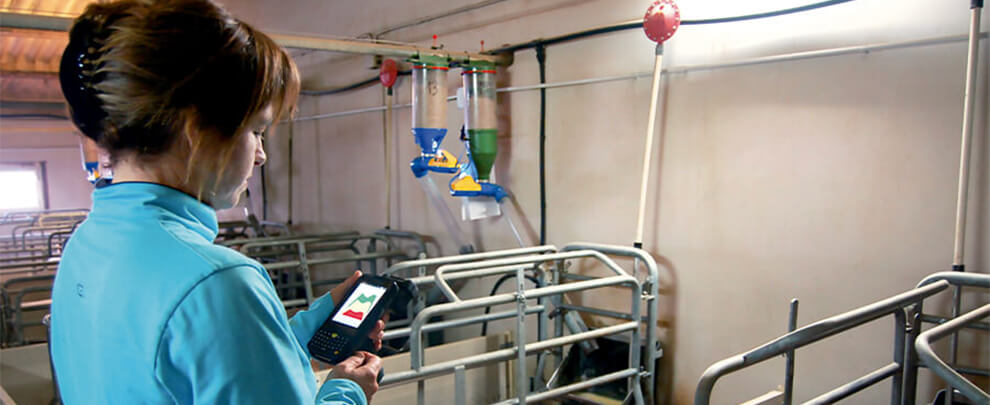
This is where technologies such as Bodycheck begin to gain relevance. Integrated into electronic feeding systems such as Dositronic G, this artificial intelligence-based system analyses the body condition of gestating sows through image analysis and automatically adjusts the feeding curve on an individual basis. Each animal is electronically identified when accessing the feeding station and receives a ration adapted to its physiological condition, enabling more precise nutritional control throughout gestation.
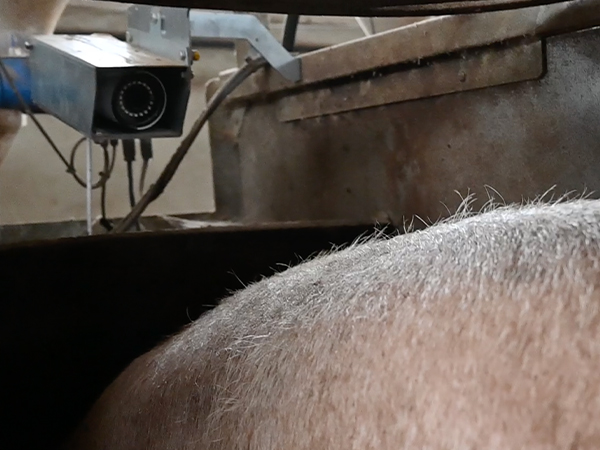
Bodycheck analyzes the body condition of pregnant sows using imaging. Photo: Rotecna.
Interest in this type of solution responds to a very specific need within group sow gestation: preventing excessive deviations in body condition that may affect reproductive performance or group uniformity. A sow that is too thin or overweight may experience reproductive difficulties, lower physiological stability, or poorer performance during lactation. By reducing reliance on subjective visual assessments, the system provides greater monitoring capacity and supports more consistent decision-making throughout the cycle.
Beyond the nutritional component, this trend reflects a broader shift in the design of swine facilities: increasingly connected infrastructures capable of integrating data on feeding, body condition, and behaviour to support more precise decisions. During gestation, where small accumulated variations can affect reproductive performance, having continuous information helps improve operational control and supports more stable batch management.
More hygienic materials and structures adapted to biosecurity
Another consolidated trend in swine facility design is related to material selection. Polypropylene panels, moisture-resistant partitions, and surfaces designed to facilitate cleaning are part of an approach aimed at strengthening biosecurity on pig farms.
The objective is to reduce critical points where waste may accumulate or sanitary risks may increase, while simplifying cleaning routines. This aspect becomes even more relevant in gestation areas, where sanitary stability directly influences reproductive performance and sow longevity. In this context, durable and easy-to-clean materials, as well as solutions designed to facilitate daily maintenance and strengthen swine biosecurity without complicating management, are becoming increasingly important.
At the same time, gestation barn infrastructure is evolving toward spaces with greater adaptability. Configurable pens, modular divisions, and more functional handling areas make it possible to reorganise internal flows according to specific production needs. This flexibility facilitates adjustments without the need for major structural interventions.
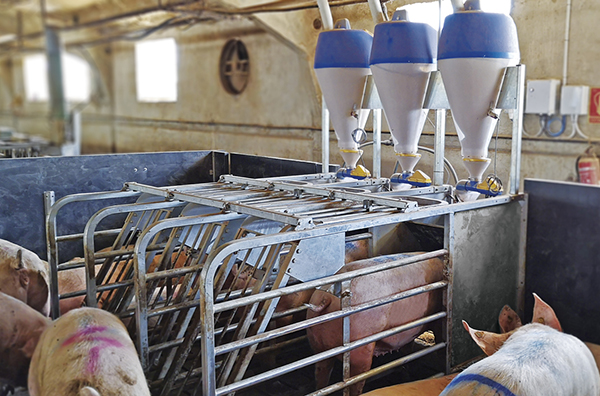
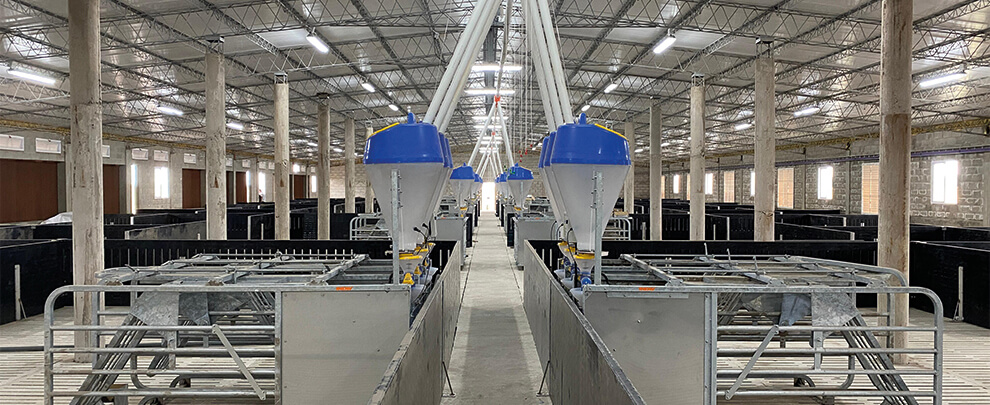
Gestation barn with Dositronic G and polypropylene panels. Photo: Rotecna.
The barn environment gains prominence in gestation design
Among current trends in pig gestation equipment, the barn environment is becoming increasingly relevant. Temperature, ventilation, and humidity have always been part of management practices, but the approach is beginning to change: it is no longer solely about maintaining general parameters within an acceptable range, but about creating more homogeneous and stable conditions for the entire group.
In group gestation areas, small environmental differences can alter sow behaviour more noticeably than may appear. Areas with draughts, excessively humid spaces, or less comfortable zones tend to modify resting and movement patterns within the pen. When certain areas are used less or generate greater competition for space, access to feed and water may also be affected.
For this reason, barn design is beginning to incorporate solutions aimed at improving air distribution, reducing thermal contrasts, and fostering a more uniform environment. The location of feeding points, the type of partitions, ventilation, and the organisation of spaces are increasingly understood as interconnected elements, particularly during phases where comfort influences sow behaviour and physiological status.
At the same time, the use of environmental monitoring systems capable of recording variations in temperature, humidity, or air quality in real time is gaining ground. The ability to detect deviations before they have a visible impact allows for a greater level of control and more precise management adjustments.
Infrastructure designed to produce with greater control
Current trends in pig gestation equipment show a clear evolution toward facilities capable of integrating animal welfare, automation, and operational control within a single strategy. The priority is no longer solely to produce more, but to do so with greater stability, reducing hidden losses and improving day-to-day management.
The design of gestation barns reflects precisely this transition: infrastructures conceived from the perspective of real sow management, where space, feeding, environment, and technology work in a coordinated manner. In an increasingly demanding sector, barn design is beginning to be understood as a factor directly linked to profitability and the sustainability of the production system.