Blog
Blog
What benefits does environmental enrichment provide in pig farming?
12th May 2026 - News
Growing attention to animal welfare on pig farms, together with increasingly demanding regulatory and market requirements, has positioned environmental enrichment in pig farming as a management tool with a direct impact on animal health, behaviour, and productivity. Far from being considered a secondary element, the design of the environment in which pigs are housed has a decisive influence on batch stability, stress reduction, and the prevention of behavioural problems that may compromise the farm’s technical performance.
Environmental enrichment and pig behaviour
The pig is a species highly motivated to explore its environment, with a highly developed oral and tactile activity that, under natural conditions, translates into continuous rooting, foraging, and manipulation behaviours. When this type of behaviour is restricted by environmental uniformity, behavioural frustration accumulates and tends to manifest itself in the form of stereotypies or unwanted interactions between animals.
Environmental enrichment in pig farming acts as a functional compensatory tool by providing stimuli that allow this exploratory motivation to be channelled appropriately. The most immediate consequence is a reduction in social tension within the group, together with greater stability in the overall behaviour of the batch. This effect has direct implications in productive terms, as an animal with balanced behaviour shows lower variability in growth and better adaptation to the management system.
Animal welfare and stress reduction
The concept of animal welfare in pig production is closely linked to the environment’s ability to prevent states of chronic stress. When animals do not have access to appropriate stimuli, the physiological stress axis remains activated for prolonged periods, affecting the immune system, energy metabolism, and productive efficiency.
The incorporation of environmental enrichment elements helps modulate this physiological response, promoting a more stable state and reducing the incidence of behaviours associated with frustration. This improvement in the animal’s internal balance translates into greater resistance to disease, a reduction in injuries, and more efficient nutrient utilisation, all of which directly impact the farm’s technical performance.
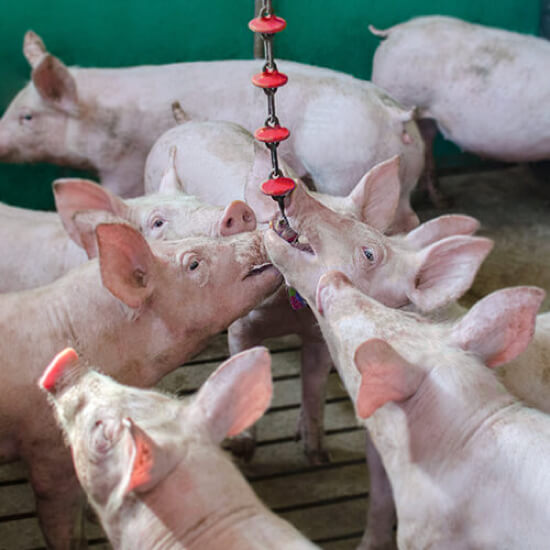
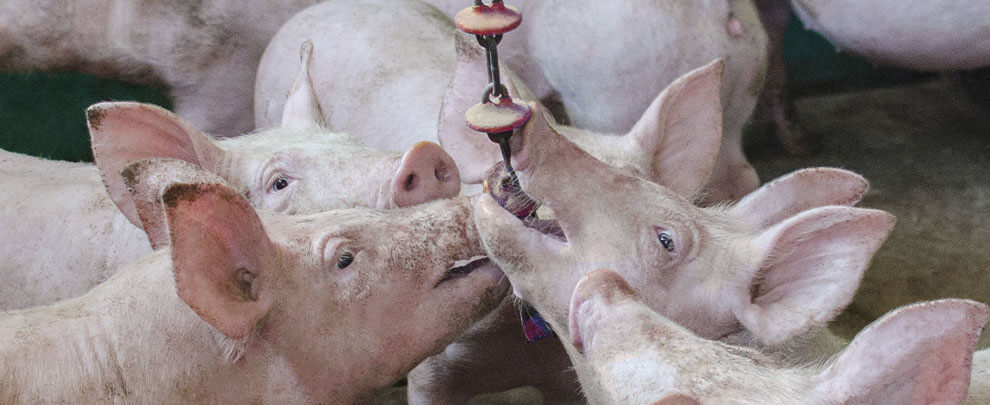
The anti-stress chain stimulates the pig's oral and exploratory behavior. Photo: Rotecna.
Environmental enrichment strategies
The effectiveness of environmental enrichment on pig farms depends largely on proper planning and integration into daily management. It is not an isolated intervention, but rather a structured system that must be adapted to the specific needs of each production stage and housing conditions. Its success lies in the system’s ability to stimulate and sustain the animal’s interest over time, encouraging continuous interaction with the environment while minimising undesirable behaviours arising from exploratory frustration.
First, environmental design plays a fundamental role. The distribution of space, the availability of differentiated areas, and access to enrichment materials directly condition the intensity of the animal’s interaction with its surroundings. A functional design should facilitate the expression of exploratory behaviour without interfering with routine management practices or compromising system hygiene. Furthermore, the proper placement of enrichment elements is essential to encourage continuous use and ensure that animals can interact with them easily and safely.
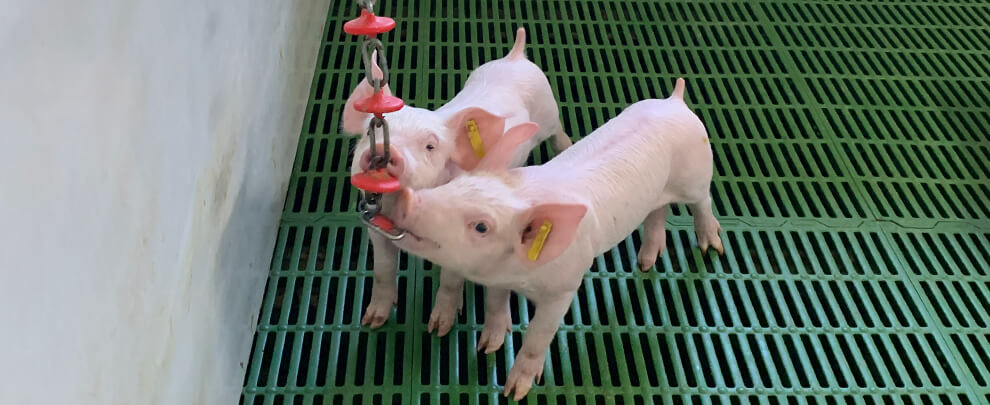
Regarding materials, their selection should meet criteria of safety, durability, and stimulation capacity. Elements such as straw, wood, ropes, or manipulable devices specifically designed for pig production offer different levels of sensory complexity, making it possible to adapt enrichment to the group’s needs. Among the most widely used tools is the anti-stress chain, a resource extensively implemented on pig farms due to its ability to stimulate pigs’ oral and exploratory behaviour, particularly during phases with a higher risk of redirected behaviours such as tail biting or ear biting. These types of devices promote constant interaction with the environment and help channel manipulative behaviour towards a safe and accessible element.
However, the most determining aspect of these strategies is the dynamic management of enrichment. Animal habituation to stimuli is a critical factor that progressively reduces the system’s effectiveness if no renewal or variation is introduced. Therefore, rotating materials, modifying their arrangement, or introducing new elements becomes an essential practice to maintain the pig's interest and behavioural response over time. Static or unattractive enrichment quickly loses its stimulating capacity, making it necessary to understand environmental enrichment as a continuous process within farm management, closely linked to behavioural observation. Assessing the degree of interaction, identifying signs of boredom, or adjusting available elements according to the production stage are essential aspects of maintaining a functional environment adapted to the animal’s real needs.
The impact of environmental enrichment on productivity
The consistent application of environmental enrichment on pig farms has effects that go beyond the individual welfare of animals and extend to the overall efficiency of the production system. The reduction of aggressive behaviours and injuries decreases the need for veterinary interventions, while improved group stability promotes more homogeneous growth.
From a productive perspective, this stability translates into better feed conversion ratio and more efficient use of available resources. At the same time, stress reduction contributes to more sustainable systems by reducing dependence on pharmaceutical treatments and improving the overall health resilience of the herd.
Ultimately, environmental enrichment becomes integrated as a structural component of management on pig farms, where environmental design and behavioural management become determining factors in achieving more efficient, balanced, and sustainable systems over time.