Blog
Blog
Five ways to avoid tail biting
14th April 2026 - News
Óscar Toledano. Rotecna Sales Manager
Tail biting is one of the biggest current challenges for European pigs. It is not a new problem, but it has become urgent for a clear reason: European and Spanish legislation is moving towards the effective prohibition of tail docking, making it increasingly difficult for farmers to take advantage of the exceptions that allow them to raise tailed animals. This entails profound changes in management and, above all, raises a series of reasonable doubts: Is it really viable to raise animals with intact tails without having more problems and greater mortality? What extra costs will it entail? Will they pay more for a pig with an intact tail?
The good news is that it is viable. Countries like Sweden have been producing pigs with whole tails for almost 40 years, and Denmark, Germany and the Netherlands are currently advancing rapidly thanks to incentives and technical support. Even so, it is not easy, and appropriate measures must be taken. But before reaching practical solutions, it is worth reviewing what the legislation really entails and how it affects the day-to-day life of our farms.
For years, Directive 2008/120/EC has established that tail docking cannot be routine and can only be performed when there are proven injuries and after the application of documented preventive measures. In addition, the farmer must record what measures he has taken to avoid it (enrichment, ventilation, density, etc.).
In Spain, this regulation is mainly implemented through Royal Decree 1135/2002 and subsequent amendments. Although the Supreme Court declared null and void the amendments concerning the available floor space for animals introduced by Royal Decree 159/23, which aimed to strengthen the national strategy on intact tails, and the Ministry of Agriculture has prepared a draft to repeal Royal Decree 809/2025, which classifies farms into three types according to their status regarding tail docking, the basic principle does not change: routine tail docking is not legal, and the sector must take measures to move toward production systems with intact tails. Therefore, tails cannot be docked by default, and intervention is only allowed if it can be demonstrated that preventive measures have been taken and have not worked. This leads us to comply with what the legislation requires regarding stocking densities, climate control systems, types of housing, and the number of drinkers and feeders, manipulable materials and the assessment of their use, as well as keeping records of incidents and environmental parameters, documenting any lesions that appear, etc. In any inspection, the key question will be: what have you done to prevent tail docking, and how have you documented it?
Legislation does not require perfect results, but it does require serious and documented preventive management.
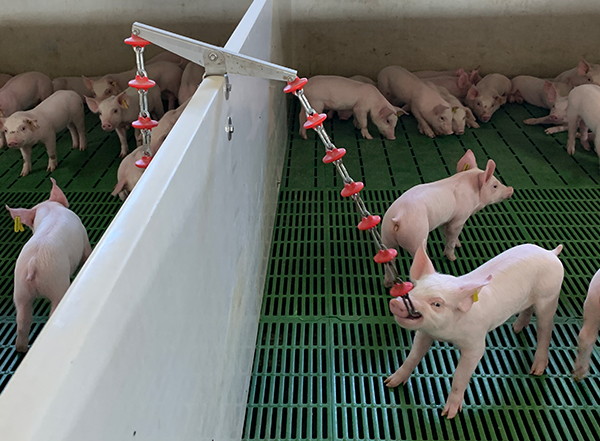
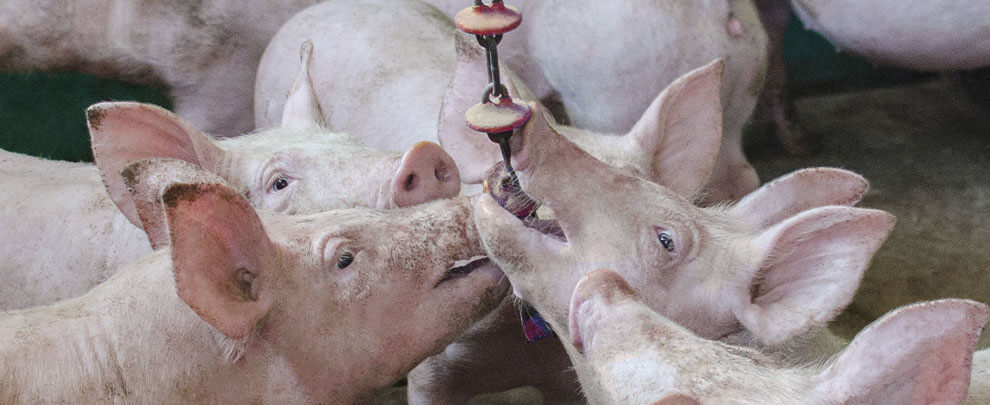
Having manipulable materials available reduces tail biting. Photo: Rotecna.
Why does tail biting appear?
It is not a disease, but a symptom. The tail bite is not an accident; it is the visible expression that something is not working in the interaction between the environment, animals, and management. The most common triggers at the farm level are:
- Lack of manipulable material.
- Air currents, cold ones or excess temperature.
- Humidity and/or uncomfortable soils.
- High density.
- Competition for space, water or food.
- Sudden changes in the environment.
- Poor distribution of animals.
- Lack of detection of the beginnings of this behaviour.
A system that focuses only on whole tails works if you act on the causes, not the symptoms. Below are the five most effective measures applicable within the farm.
Appropriate environmental enrichment
Enrichment is not decoration; it is a prevention tool. For it to work, the materials provided must be manipulable and chewable and placed at more than one point per pen and at different heights. In addition, they must be renewed periodically and checked to ensure the animals do not lose interest in them. Farms that apply adequate enrichment, such as the combination of a mobile chew toy and a straw dispenser, significantly reduce the incidence of bites.
Correct environmental control
Heat stress is one of the biggest bite triggers. Extreme temperatures must be avoided, drafts eliminated, and animals provided with dry, warm rest areas. We must observe where the animals are placed (they indicate the areas that are not comfortable for them) and take appropriate measures. Other very important aspects are good insulation of the buildings and the use of appropriate equipment. Transition and finishing farms that improve the environmental control system significantly minimise tail-biting incidents.
Adaptive density and well-distributed space
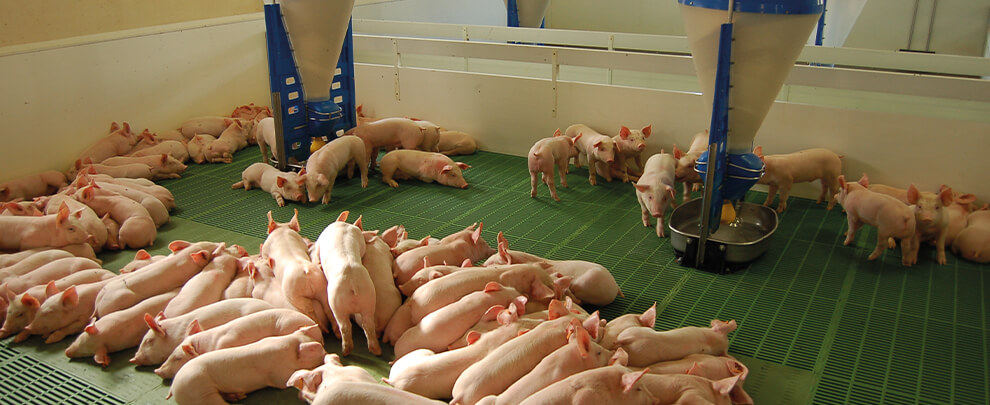
Density determines behavior, and when animals are raised with whole tails, the space available per animal must be increased compared to the legal one (0.65 m2 up to 110 kg once RD 809/2025 is repealed and the determined minimum densities remain in force. in RD 1135/2002) by 5 or 10 % (the more limitations there are in terms of other aspects of comfort, more space will be needed). Additionally, narrow passages or funnel areas should be avoided, and all animals should be able to lie down simultaneously without interfering with access to food or drink. A well-designed, well-distributed layout of the different spaces (food, drink, rest, and dirty area), and an adequate number and placement of drinkers and feeders are key aspects. A suitable space not only prevents fights but also exploration of the partner's tail.
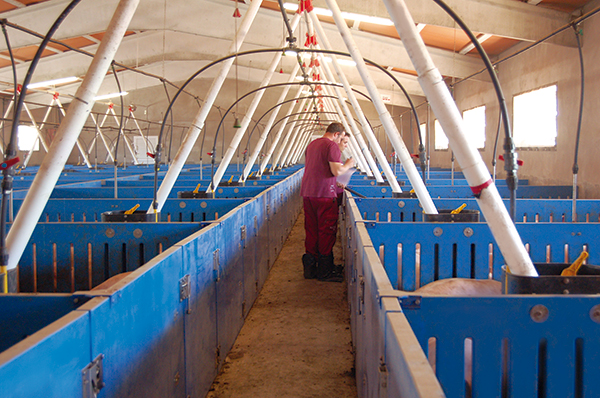
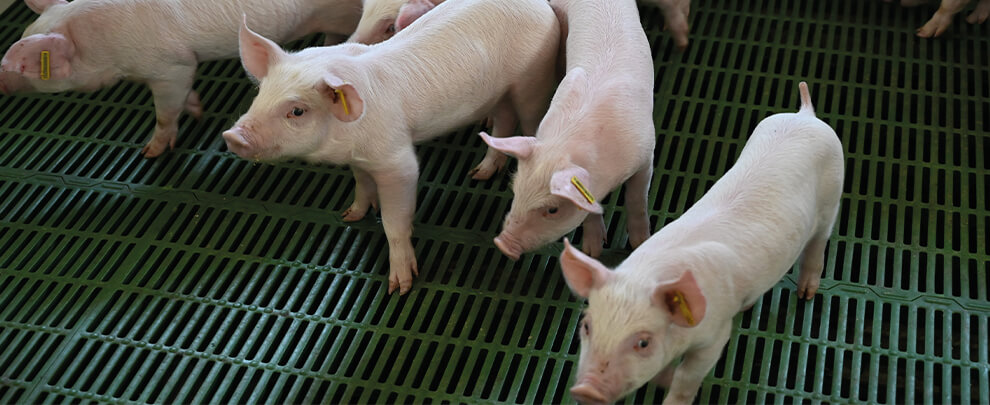
Daily monitoring allows for the detection and prevention of tail-biting outbreaks. Photo: Rotecna.
Active observation of animals
The problem must be detected before it spreads. Early detection is one of the strategies with the greatest return, since specific animals are usually the ones who initiate biting tails. Some warning signs include tense, upright tails; nervousness; exploration or chasing each other; red dots on their tails; or changes in rest patterns.
One must check the tails daily, observe the animals' behaviour, ensure they have water and feed without restriction, and record any incidents. An active surveillance system prevents most bouts.
Immediate management of the first cases
When the first bitten pig appears, it is very important to act as soon as possible: identify and isolate the biter and separate the bitten animal to a quiet pen (both measures at the same time reduce the density in the problematic pen), introduce extra enrichment into that pen and review the environmental control system. Experience shows that, if action is taken within the first 24 hours, the outbreak does not become widespread. It is not easy, but it can be achieved.
In addition, reducing tail bites reduces abscesses and penalties in slaughterhouses, thereby improving the carcass's commercial value. In fact, the industry is beginning to offer extra bonuses for pigs raised with intact tails. In 2025, in Denmark, a national program was launched that pays around 7 euros per pig with an intact tail. In Germany, Tönnies, one of the largest pork processors in Europe and the world, has just announced a premium of 10 euros per pig with an intact tail.
This shows that the market is willing to pay. Furthermore, as we already know, animal welfare is not an exepense, but an investment, because, apart from these incentives, the measures necessary to raise animals with whole tails, well implemented, have an impact on other health parameters, efficiency and performance, that have an economic impact, much higher than the extra cost of the equipment, space and management that these systems imply.