Blog
Blog
What factors reduce profitability on a pig farm?
22nd May 2026 - News
Not all production losses in pig farming are equally visible. Issues such as a disease outbreak, reduced growth rates, or increased mortality require immediate action because their consequences are clear and measurable. However, there is another type of loss that is much harder to identify: those that do not trigger alarms, do not visibly disrupt farm operations, and can therefore persist for months without being questioned.
These are small operational inefficiencies that, when viewed in isolation, hardly seem relevant. Slight feed wastage, poorly adjusted water flow rates, environmental differences within the same building, or suboptimal daily routines are not usually perceived as real threats. The problem arises when all these small deviations accumulate. What seems insignificant on a day-to-day basis can end up considerably eroding a farm’s margin.
Where does a pig farm lose money without realizing it?
Invisible losses rarely have a single origin. More often, they are spread across different points in the production system, especially in those processes that are part of the daily routine and therefore stop being critically reviewed.
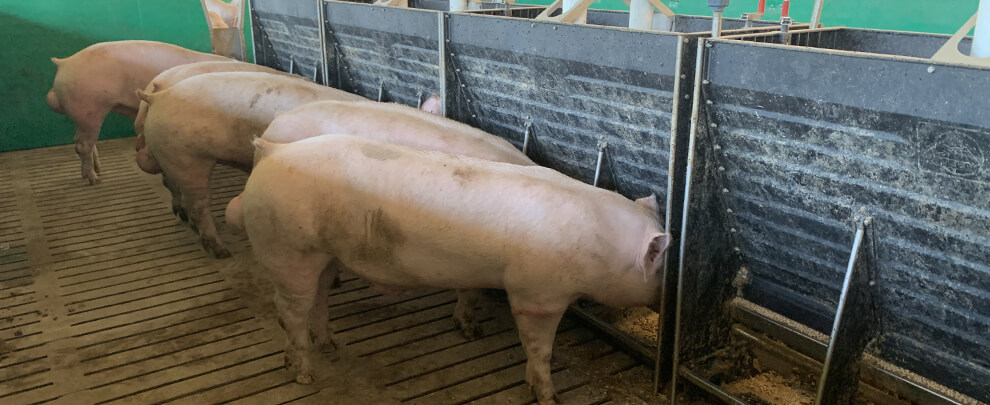
One of the best examples is feeding. In pig production, feed represents one of the largest production costs, yet part of the waste often occurs without being obvious. This is not necessarily about major errors, but rather small imperfect adjustments such as feeders that dispense more feed than necessary, settings that are not adapted to the production phase, or animal behaviour that causes some feed to end up outside the consumption area. The effect is usually misleading. Total feed intake appears correct and the animals continue to grow, so there is no clear warning sign. However, part of the feed is not actually converted into growth, which ultimately increases the cost per kilogram produced.
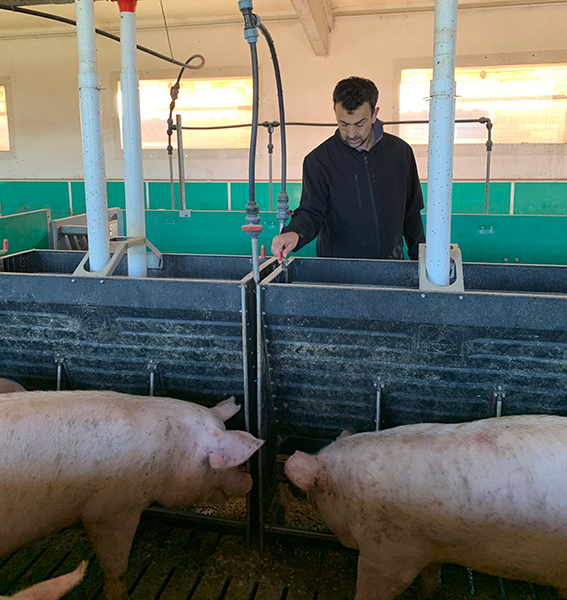
Feeders must be properly regulated to avoid wasting feed. Photo: Rotecna.
A similar situation occurs with water. A small leak or an incorrect adjustment in drinker flow may seem like a minor detail, but its consequences often go far beyond direct consumption. Excess moisture alters the barn environment, affects comfort, and can lead to less stable sanitary conditions. In addition, water is one of the most useful indicators for early detection of changes in animal behaviour or health. When the system loses precision due to small leaks or constant variations, the ability to anticipate potential problems is also reduced.
Invisible losses are not limited to physical resources either. On many farms, part of the profitability is eroded by small operational processes that are rarely questioned. Unnecessary movements, duplicated routines, or inefficient procedures consume working time every day. These are minutes that seem irrelevant when viewed individually, but whose accumulated effect becomes significant, especially in a context where labour is increasingly limited.
How barn environment affects growth without being noticed
There is a widespread belief that if the average temperature in the barn is correct, the environment is under control. In practice, the situation is often much more complex. Within the same room there can be significant differences in ventilation, air circulation, humidity, or temperature. These are small variations that go unnoticed in general records, but which animals do perceive. The result is the formation of micro-environments that do not provide the same conditions to the entire group.
When this happens, behaviour begins to change. It is common to observe animals grouped in certain areas, pen spaces that remain consistently empty, or uneven resting patterns. These are early signs that the environment is not equally favourable for all animals. Although these imbalances rarely create an obvious problem, they can progressively affect feed intake, comfort, and animal stress levels. A pig that rests poorly or spends less time at the feeder does not usually show a sudden drop in performance. It simply grows slightly less. And when that small difference persists over weeks, it eventually has a real productive impact.
Moreover, the environment does not act in isolation. It also influences access to water and feed. In less comfortable areas, some animals reduce the time spent near key resources, generating small inequalities that become amplified over time.
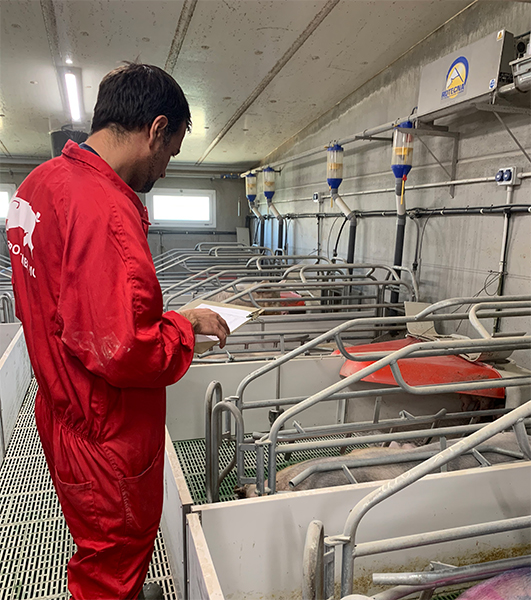
Data complements observation to detect invisible patterns and variations. Photo: Rotecna.
How to reduce micro-inefficiencies before they affect profitability
Invisible losses in pig farms have a particular characteristic that explains why they are so difficult to manage: they do not interrupt normal farm operations. Production continues as usual, animals keep growing, and overall indicators do not show alarming deviations. This superficial stability allows small inefficiencies to become embedded in daily routines until they are no longer perceived as something that needs attention.
The problem arises when this “normality” persists over time. Small imbalances in feeding, minimal variations in water access, environmental differences within the same barn, or suboptimal management routines rarely have an immediate impact on their own. However, their cumulative effect eventually translates into more sensitive variables such as production efficiency, time required to reach target weights, or, especially relevant, batch uniformity. Animals that start with small differences or develop under slightly unequal conditions tend to amplify those variations throughout the production cycle, leading to less homogeneous final outcomes.
Reducing these inefficiencies does not necessarily require major investments or deep transformations of the production system. In many cases, improvement begins with restoring constant attention to processes that, due to their routine nature, are no longer questioned. Systematically reviewing basic elements such as feed system calibration, water supply accuracy, environmental uniformity within the barn, or the consistency of work routines can help detect deviations before they become established.
In addition to this approach, it is important to look beyond averages. Average consumption or growth may appear correct, but often hides internal differences that explain issues such as lack of batch uniformity. For this reason, it is increasingly important to complement daily observation with data that allows patterns to be identified, areas within the barn to be compared, and variations that are not visible at first glance to be detected.