Blog
Blog
What factors reduce feed waste?
16th April 2026 - News
Feed represents, by far, the main production cost on a pig farm. It accounts for between 60 and 65% of total costs, with approximately 15% corresponding to the feeding of breeding sows, 10% to transition feeding, and around 45% to costs associated with the finishing phase. Therefore, any improvement in feed utilization has a direct impact on profitability.
Reducing feed waste does not only mean avoiding visible losses, but ensuring that animals consume the appropriate amount under optimal conditions to maximize daily intake. The less time animals take to reach the required weight, the greater the production efficiency. However, feed waste is not usually caused by a single factor, but by the combination of several elements related to management, environment, and pig equipment used on the farm.
Feeder design: a determining factor
One of the most influential aspects in reducing feed waste is feeder design. Elements such as pan shape, dispensing system, and ease of adjustment directly influence the amount of feed lost.
A poorly designed feeder or one with inaccurate adjustments encourages animals to extract more feed than they can actually consume or causes feed to accumulate in inaccessible areas. These situations generate economic losses and complicate cleaning and disinfection tasks, while also increasing health risks on the farm. In contrast, systems that incorporate rounded pans, anti-waste rims, and precise adjustment mechanisms allow correct feed flow regulation and reduce waste from the earliest production stages.
It is also important to consider the possibility of working with or without water in the feeder. Not all systems allow water supply to be shut off without affecting the operation of the dispensing mechanism. Some models maintain good flow control even in dry conditions, while others may promote excessive feed extraction if not properly adjusted. Therefore, the choice of feeder type should be made considering the productive characteristics of each farm.
Properly adjusting pan coverage
Regulating the feed level in the pan is a simple practice with a very significant impact on waste control. In dry feeding systems, the recommended pan coverage usually ranges between 25% and 33% of its capacity. Higher coverage allows animals to manipulate large quantities of feed, causing it to fall outside the feeder. Conversely, insufficient coverage limits intake and reduces average daily gain.
In addition, when the volume of feed dispensed is excessive and animals cannot consume it quickly, especially in wet systems or under high environmental temperatures, the feed remains too long in the pan and begins to oxidize. This oxidation reduces palatability and causes a decrease in daily intake, generating the opposite effect to the intended one. Therefore, it is essential to periodically review feeder adjustment and adapt it to the age, weight, and production stage of the animals.
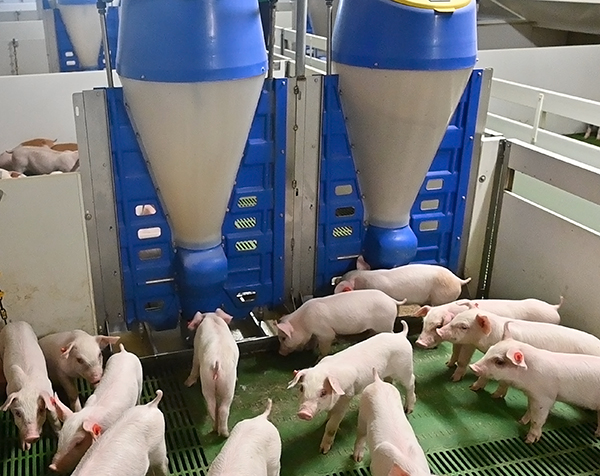
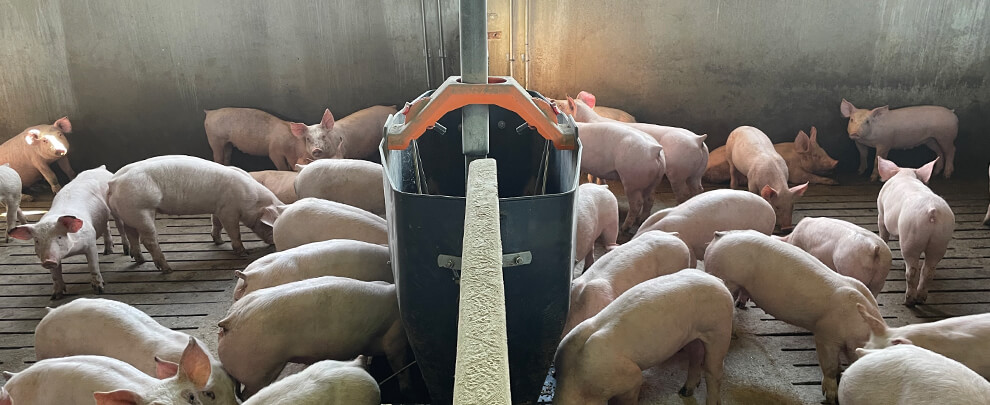
Maintaining a 25–33% coverage on the plate optimizes consumption. Photo: Rotecna.
Adapting space and the number of animals per feeding space
The relationship between the number of animals and feeding spaces plays a key role in feed efficiency. An insufficient number of feeding spaces creates competition among animals, increasing nervousness and encouraging excessive feed manipulation. This behavior results in greater waste and reduced batch uniformity.
On the other hand, adequate feeding space facilitates simultaneous access and reduces stress, improving both intake and feed utilization. The correct animal-to-feeder ratio must be adapted to the size and production stage of the livestock.
For example, during weaning, piglets move from ingesting milk many times a day in small quantities to sharing feeders with other animals, making it essential to increase the number of feeding spaces during the first weeks. Facilitating this transition reduces competition and promotes faster adaptation to the new feeding system.
Ensuring proper access to feed improves intake and minimizes losses from the earliest production stages.
Controlling feed quality and presentation
The physical form of feed directly influences its utilization. Irregular particle size or the presence of excessively fine particles promotes feed selection by animals, increasing waste and reducing the nutritional homogeneity of the diet.
Maintaining the organoleptic conditions of the feed is equally important. The use of lids on hoppers helps preserve feed under optimal conditions, especially in warm or humid environments. These lids reduce feed exposure to moisture, minimize dust formation, and help maintain feed quality for longer periods.
Furthermore, reducing dust levels in the barn not only improves feed quality but also positively affects the respiratory health of both animals and workers.
Automation and multi-phase feeding
The incorporation of automatic feeding systems represents a significant advancement in reducing waste. These systems allow precise adjustment of the amount of feed dispensed according to the weight and age of the animals, preventing excess and improving batch uniformity. In addition, multi-phase feeding facilitates adapting the diet to the nutritional requirements of each stage, reducing losses and improving feed conversion ratio. This approach enables more precise consumption management and improves feed conversion, contributing to more efficient and sustainable production.
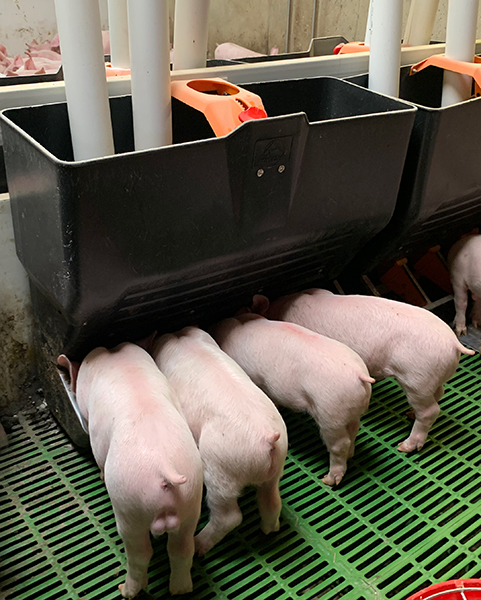
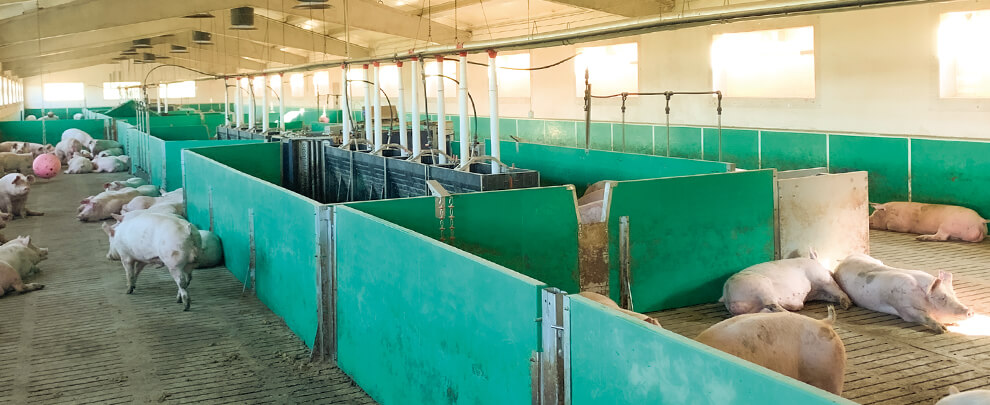
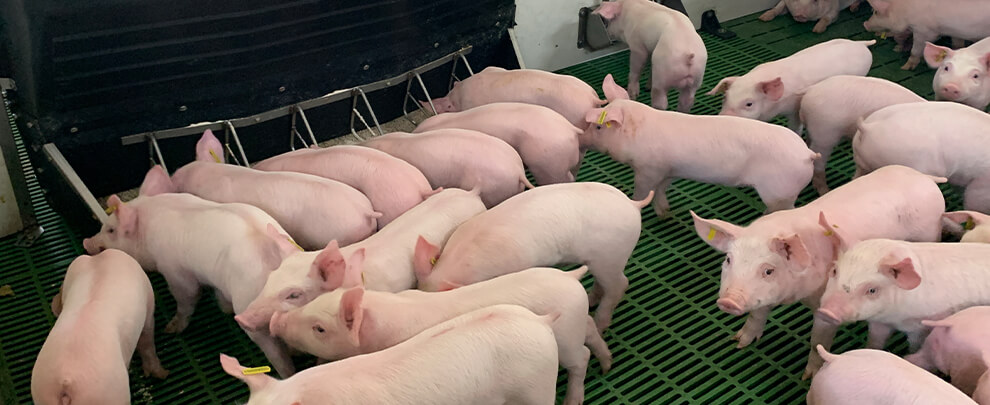
A suitable feeding area allows for simultaneous access for the animals. Photo: Rotecna.
The role of water in feed consumption
Although often overlooked, water supply directly influences feed consumption and utilization. The addition of water in the feeder can increase ingestion speed and promote daily intake, especially in heavier animals. However, flow rate must be carefully regulated. When it exceeds 0.5–0.7 liters per minute during weaning or 0.7–1 liter per minute during finishing, excess water may accumulate in the pan.
This excess negatively affects feed conversion ratio, promotes feed waste, and increases the volume of slurry produced on the farm. Therefore, it is essential to periodically verify drinker adjustment and adapt the system to environmental and production conditions.
An investment that translates into profitability
Reducing feed waste should not be considered only an immediate cost-saving measure, but a global production improvement strategy. The combination of proper feeder design, correct regulation of feed and water flow, appropriate management of the number of animals per feeding space, and the use of pig equipment adapted to each production stage allows optimization of consumption and improvement of feed conversion rate.
These improvements result in lower cost per kilogram produced and greater farm competitiveness. In a context where efficiency and sustainability are increasingly important, controlling feed waste becomes one of the most effective tools to ensure the long-term economic viability of pig farms.