Blog
Blog
Why is it important to control biofilm in water lines?
15th September 2026 - News
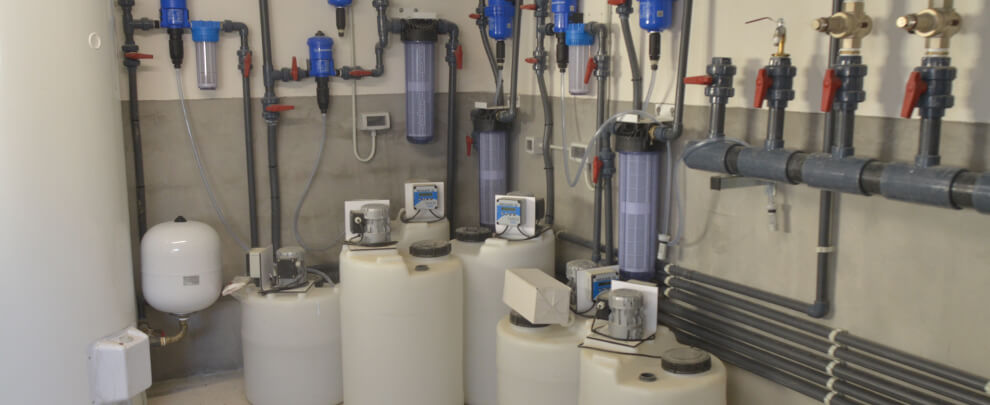
Water is an essential element in pig production, and its quality is closely linked to animal health and welfare. However, ensuring good quality at the point of entry does not necessarily mean that the water maintains the same conditions throughout its entire journey. Before reaching the animals, it passes through tanks, filters, pipes, connections and drinkers that can affect its hygienic conditions. Therefore, water control should also take into account the condition of the entire system responsible for storing and distributing it.
One of the problems that can occur in these systems is the formation of biofilm, a layer made up of microorganisms that adhere to the internal surfaces of pipes and become embedded in a matrix that they produce themselves. This structure can favour the persistence and accumulation of microorganisms at certain points in the network, making their removal and the microbiological control of the water more difficult. Although the presence of biofilm does not in itself mean that the animals will become ill, it is a factor that should be controlled as part of the hygiene and health prevention programmes on a pig farm.
How does biofilm form in water lines?
Biofilm formation is a progressive process. Microorganisms present in the water can adhere to the internal surfaces of the lines and, when they find favourable conditions, begin to multiply and form a structure that remains attached to them. The presence of organic matter and nutrients, certain temperatures, and areas where water flows slowly or remains stagnant can facilitate this process.
On a pig farm, this means that a line may appear perfectly clean from the outside while accumulations are present inside. Furthermore, the problem does not necessarily affect the entire system in the same way. Sections with lower water circulation, changes in diameter, connections, branches and the ends of lines may have different conditions and favour the accumulation of materials.
For this reason, controlling water quality also requires an understanding of the route the water takes within the farm. Identifying points where there may be less water renewal or where organic matter may accumulate makes it possible to establish a more effective maintenance strategy and take action before visible problems appear.
Why can biofilm affect pig health?
From a health perspective, one of the main reasons for controlling biofilm is that it can become a reservoir for microorganisms within the water distribution system. Because they remain attached to surfaces and are protected by the biofilm matrix, these microorganisms may be more difficult to eliminate than when they are freely suspended in the water. In addition, some of this material may detach and re-enter the water flow, affecting the microbiological quality of the water reaching the animals.
This is particularly relevant because water is consumed daily and in significant quantities. If persistent microbiological contamination is present in the network, water can become an additional route of exposure to certain microorganisms. However, it is important to clarify that biofilm is not, in itself, a direct cause of disease. The occurrence of health problems depends on multiple factors, including the microorganism involved, its load, the age and condition of the animals, their immunity, environmental conditions, feed and management.
Therefore, biofilm control should be understood as one more measure within a broader health strategy. Keeping water lines clean helps reduce potential microbiological reservoirs and makes it possible to control one of the elements that forms part of the animals’ environment on a daily basis.
In addition, the accumulation of materials inside the lines can cause operational problems. Deposits can reduce the effective diameter of pipes, contribute to blockages and alter drinker flow rates. If the water supply is inadequate, water consumption may also be affected. Thus, biofilm control involves both hygiene and health considerations and the proper functioning of the system.
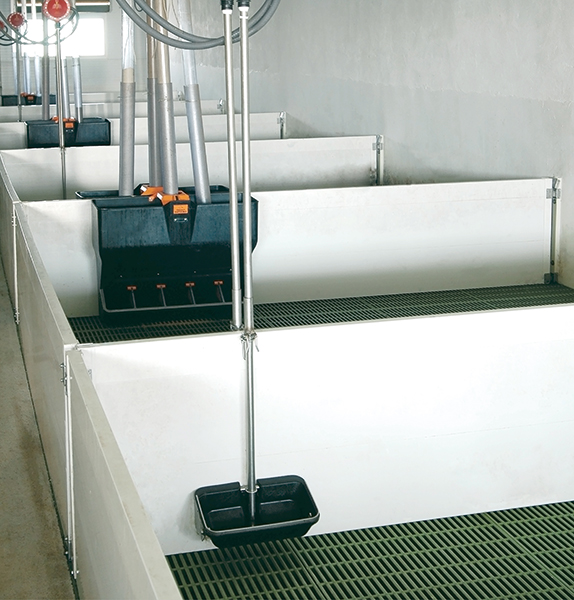
It is advisable to check the entire water system, from the tanks to the points of use. Photo: Rotecna.
Which parts of the system should be checked?
To control biofilm, it is not enough to inspect the drinkers. It is advisable to follow the entire route of the water, starting with tanks and reservoirs, where sediment and organic matter can accumulate, and continuing through filters, pumps, valves and pipes until reaching the points of consumption. Connections, elbows, branches and changes in diameter require particular attention, as they can create different flow conditions and favour the accumulation of materials. It is also advisable to check sections where water remains stationary for extended periods and, especially, the ends of lines, where water renewal may be lower.
Drinker operation is also a practical indicator. Regularly checking flow rates and detecting differences between points can help identify blockages or changes in the network. These checks should be complemented by periodic microbiological analyses, which make it possible to monitor changes in water quality and detect changes that are not always visible.
A good practice is to establish an inspection route that always follows the same order, from the tank to the last drinker, recording any incidents detected. In this way, water control becomes part of the farm’s routine maintenance rather than depending solely on the appearance of a problem.
How can biofilm be prevented and removed?
Prevention requires a combination of cleaning, disinfection and regular maintenance. Tanks and lines should be cleaned to remove accumulated sediment and organic matter before applying a disinfectant, as the presence of dirt can hinder its action and reduce the effectiveness of the treatment.
During these procedures, it is essential to respect the concentrations, contact times and conditions of use specified for each product. It should also be ensured that the solution reaches the different parts of the circuit and that the corresponding rinsing is carried out when necessary. One-off cleaning can reduce existing accumulation, but it will be much more effective if it is integrated into a regular programme adapted to the characteristics of each system.
After cleaning, the objective should be to prevent the conditions that favour biofilm formation from occurring again. Keeping tanks clean, checking filters and pipes, reducing stagnant areas and regularly inspecting drinkers helps keep the system in good condition. Microbiological monitoring also makes it possible to assess changes in water quality and evaluate the effectiveness of the measures applied.
Ultimately, controlling biofilm is not only a matter of cleaning pipes, but also part of the farm’s health management. Understanding the system, identifying its critical points, monitoring the microbiological quality of the water and establishing appropriate cleaning and disinfection protocols makes it possible to reduce potential reservoirs of microorganisms and maintain suitable conditions in the water that the animals ultimately consume. Because when it comes to pig health and prevention, water is also part of the health strategy.