Blog
Blog
5 ways to reduce water use on our fattening farms
21st July 2026 - News
Oscar Toledano. General Manager of Rotecna
In recent years, water has gone from being a cheap and seemingly unlimited resource to becoming one of the critical factors of sustainability and profitability in intensive pig production. On many farms, water no longer represents only the direct cost of supply and the treatments it requires; each litre wasted increases slurry volume, storage requirements, and management costs. Under usual conditions, 70 to 90% of the water used in fattening warehouses ends up forming a direct or indirect part of the slurry.
Reducing water consumption does not mean restricting access or compromising animal welfare. In fact, the most efficient farms are also usually those that best manage available water, avoiding waste and correctly adapting the drinking and feeding systems to the animals' actual behaviour.
If we consider the water used directly on the farm (drinking, cleaning, and refrigeration), the approximate distribution of the total water consumption per pig produced is as follows:
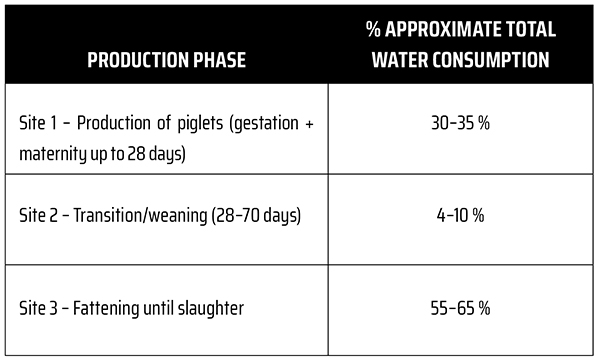
The conclusion is clear: the fattening phase accounts for most of the total water consumption. Under typical intensive production conditions in Spain, an animal in fattening uses approximately 600-800 litres of water throughout the cycle, although poorly regulated farms can exceed 1,000 litres per animal, mainly due to waste.
Generally, an animal in fattening consumes between 2 and 3 litres of water via drinkers for each kilo of feed ingested, although this ratio can increase considerably in summer or in poorly regulated facilities. A 120 kg animal can easily exceed 8-10 litres per day in hot conditions or when waterers are incorrectly adjusted. The problem is that an important part of that water is not even ingested by the animal and is lost.
Below are the five most effective measures that could be implemented at the farm level to reduce water use and waste in fattening warehouses without harming productivity or animal welfare.
1. Correctly choose the type and position of the waterer, and regulate it appropriately
The measure with the greatest economic return is also usually the simplest: properly adjusting nipple drinker flow rates. On many farms, drinkers operate at excessive flow rates due to a lack of regulation, overly high pressure, or the absence of regular maintenance checks.
In fattening pigs, the most common guideline range is approximately 0.7-1 L/min. Above these values, wastage increases rapidly, especially in poorly positioned nipple drinkers without catch cups. It is very common to observe animals playing with water, or systems in which a large portion of the flow ends up directly on the slat. Each litre lost increases the slurry volume and worsens environmental conditions.
Flow review should be performed at least once per batch, using a graduated container and a stopwatch. Surprisingly, a few small corrections can reduce several litres per pig per day without affecting actual consumption.
Not all drinking systems generate the same level of waste. Nipple drinkers without a catch cup tend to result in more water waste, especially when installed too high, as this forces the animal to raise its head excessively, causing water to spill onto the floor. Those who are too low favour play and continuous manipulation. Tilt is also important: while upright pacifiers tend to waste more, systems with a tilt of about 45° improve utilisation. In heavy pigs, the height must be readjusted during the production cycle, since a properly designed installation at the beginning of the bait can become inefficient a few weeks later.
Properly maintained drinkers with catch cups significantly reduce wastage (by up to 50%) compared with conventional nipple drinkers, although they require more cleaning and maintenance.
Finally, constant-level drinkers deliver by far the best results: up to 50% lower apparent water consumption than catch cups and 75% less than nipple drinkers without catch cups. On the one hand, they facilitate learning and water intake in younger piglets; on the other hand, they prevent waste caused by continuous animal manipulation. In addition, if a tilting bowl system is used, the hygiene issues associated with fixed-bowl drinkers are avoided.
2. Improve preventive maintenance and detect leaks before they are visible
Not repairing a large leak in time has a very significant impact on apparent water consumption, since 80 to 140 L/min, 5 to 8 m3/hour, come out of a 1” pipe from a standard installation in a free outlet. Therefore, each hour without intervening represents a cost of 12 to 20 € for transporting slurry (considering that, in Spain, the average cost of transporting it less than 5 km from the warehouses is about 2.5 €/m3).
But even small, continuous leaks represent high hidden costs. A nipple drinker with a slight drip may seem irrelevant, but it can waste more than 30 litres per day, which flows directly into the slurry pit, so it does not trigger an immediate alarm and can go unnoticed for long periods. A very useful indicator is to monitor water consumption when the buildings are empty.
The most efficient farms monitor water consumption continuously through weekly inspections, consumption records, comparisons across areas (the more sectorized the system, the better the control), and analysis of deviations. The ideal way is to do it automatically, using digital water meters connected to an alarm system that can also predict health setbacks if these problems are detected.
3. Use correctly regulated wet-dry feeders
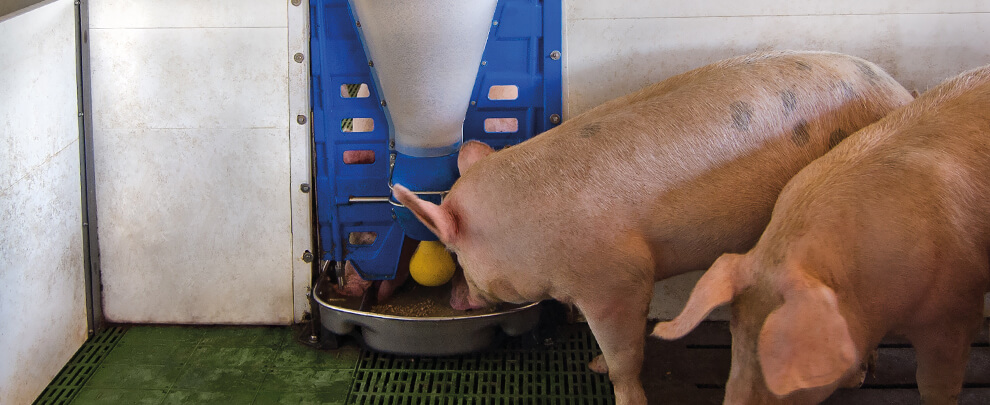
Using feeders without built-in water increases drinker use, which can increase waste, especially if the drinkers are inefficient. Furthermore, dry-wet systems can improve consumption and facilitate ingestion, especially in hot environments; however, if poorly regulated or unable to meet peak water demand, they can be a significant source of waste. water and food.
In warm environments, it is advisable to use extra waterers, since demand increases and, if additional waterers are unavailable, competition for the feeder also increases, affecting the well-being, consumption, and productive performance of the animals.
One of the most common mistakes is assuming that more water in the feeder means better consumption. If the dish has excess water, the feed ferments, the animals play with the mixture, waste increases, and the slurry volume skyrockets. In dry-wet systems, the goal is not to generate “soup” but to provide a fresh, consumable mixture. Correct regulation depends on the food's granulometry, environmental temperature, and the animal's genetics and weight.
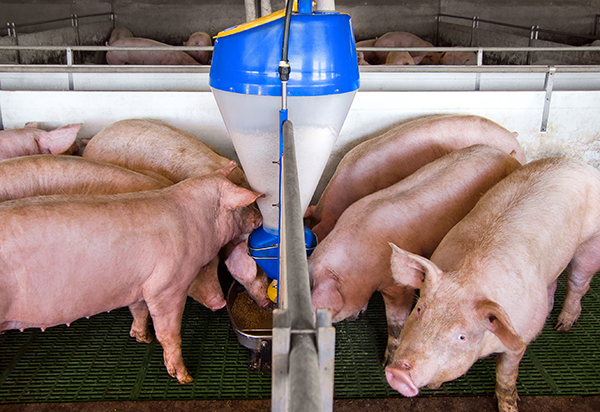
Wet-dry feeders can improve water consumption and facilitate feeding. Photo: Rotecna.
4. Minimise the use of washing water
Another aspect often overlooked is the impact of separator type on cleaning water consumption. It should be noted that washing usually consumes 20 to 50 L per place per cycle, which represents 5 to 10% of total consumption. Partitions made of smooth plastic panels require considerably less water and time for washing than metal or concrete separators.
Concrete has a more porous, rough surface, to which organic matter, biofilm, and dry remains adhere more easily, requiring longer soaking time and higher washing pressure. Furthermore, disinfection cannot be as effective as that performed on plastic. In the case of metal rod separators, especially if there are rusty areas, joints, or complex geometries, the difficulty of cleaning also increases.
On the contrary, plastic panels have less-adherent, more homogeneous surfaces, which enhance the removal of dirt and significantly reduce the water and time required for cleaning and disinfection. In addition, they are better sanitised, and the volume of slurry generated decreases.
In modern farms with high turnover, this difference can yield water savings of up to 50% in washing and disinfection, along with a significant reduction in labour time of up to 20%.
5. Control thermal stress and behaviour associated with heat
Heat distorts water consumption in fattening pigs, as when temperatures exceed the comfort zone, panting increases, feed intake decreases, and pigs dramatically increase water intake and water-related behaviour at drinkers. The problem is not only that pigs drink more, but also that, if the drinker allows it, the animal uses water as a cooling mechanism. This then leads to nipple drinkers being continuously activated, pigs playing with the water, fully wet areas, and a very significant increase in slurry output, especially when the type of drinker and its placement are not appropriate.
In these cases, ventilation and thermal control with refrigeration systems can be water-saving tools, since farms that control the environment by minimising heat stress achieve higher consumption rates and better feed conversion rates. On the other hand, they can also reduce total water consumption, since, depending on the type of drinker used, non-productive consumption is avoided.
When choosing a cooling system to minimise water consumption, its water use should be evaluated, and it should be ensured that it is in good working order. In any case, it should be borne in mind that under conditions of severe heat, if drinkers are well designed, properly sized, and correctly positioned, cooling systems may use more water than the reduction in water intake at drinkers. However, their main objective is not to save water, but to maintain thermal comfort, productivity, and animal welfare.
Reducing water consumption in a finishing ward is not about restricting access or pushing the limits of animal welfare. The most efficient farms are often precisely those that provide more comfortable environments and better-adjusted systems. Many of these improvements do not require major technological investments, but rather a combination of observation, maintenance, and good management practices.
In a context of increasing environmental, energy, and regulatory pressure, water-use efficiency will cease to be a simple technical detail and become a strategic indicator of competitiveness in the pig industry.