Blog
Blog
E. Mainau: "Reducing pain during farrowing begins with working from the gestation"
14th July 2026 - News
In recent years, pain has become a central issue in animal welfare, especially in intensive production systems, where its evaluation and control have a direct impact on both animal welfare and productive results. To delve deeper, we spoke with Eva Mainau, a researcher in animal behaviour and welfare, who analyses the role of pain at critical moments, such as farrowing, and the management strategies that can help minimise its impact on sows and litters.

Eva Mainau, researcher in animal behavior and welfare. Photo: E. Mainau.
What real impact does pain during farrowing have on sow production outcomes and piglet survival?
First, it is important to remember that any painful event is stressful. In the case of farrowing, although it is a physiological process, it also involves pain and, therefore, has productive consequences. At a physiological level, when there is pain or stress, a release of endogenous opioids occurs, they inhibit the secretion of oxytocin, a fundamental hormone during farrowing. Thus, the higher the levels of pain and stress, the greater the inhibition of oxytocin release. This is what causes consequences, both for sows and piglets. Oxytocin plays a role in maternal behaviour, so its reduction increases the likelihood of more nervous or aggressive sows and less frequent breastfeeding. In addition, it influences milk production, so a decrease in it harms litter growth. Finally, it partakes in uterine contractions. If these are reduced, more problems may arise during farrowing, resulting in a higher number of stillborn piglets.
In a gestation ward, what signs should alert staff that a sow is suffering from excessive pain during farrowing?
The sow that is giving birth relatively calmly should be lying on its side. If you start to see sows that stand up, are uncomfortable, or constantly change sides, this is a clear, relatively easy indicator. Another indicator is the increase in the interval between births. It is laborious because you have to check at least every hour. So, on large farms, what usually works well is to write down how many piglets have been born in each interval. Other specific pain-related behaviours we have seen during farrowing and that require continuous observation include the sow lying down, pressing her hind leg steadily toward her abdomen, and arching, as sows tend to arch more as pain increases.
What factors prior to farrowing increase the risk of complications, and which ones can be controlled through management?
To reduce the risk of pain during farrowing, we must start working from gestation, ensuring that sows reach that point with adequate body condition and without excess fat, as this can lead to problems. Another relevant aspect is to prevent the entry of sows just before farrowing. It is necessary that, when changing rooms, the animal spend at least a week in the farrowing pen to adapt to the new environment. It must be taken into account that, in the first birth, many sows have not previously been in a cage (perhaps during insemination, and in some cases not even that). It is also important to provide enrichment materials so the sow can engage in nesting behaviour, which is considered important. This behaviour is intrinsic, and it is common to observe sows manipulating bars or the ground. If they are provided with material, this behaviour is better expressed. Likewise, it is essential to establish clear guidelines for feed and water consumption. In the case of hyperprolific sows, they work with higher feeding levels before giving birth, since they usually have longer and more demanding births, and it is necessary to avoid a negative energy state. Finally, systematic hormonal management is discouraged. Previously, it was common to synchronise births, but, as far as possible, natural births are recommended, as this has a positive impact on their development. Once labour has started, it is important to be very precise in administering oxytocin.
When it is necessary to intervene manually in farrowing, what practices help reduce the sow's pain and stress?
Every farm must have very clear protocols in farrowing pens. A common criterion is that, if the interval between births exceeds 50 minutes, intervention is necessary. However, the first step is not necessarily to apply oxytocin: the first step is to ensure that the birth canal is sufficiently dilated; Otherwise, the application of vetrabutin hydrochloride, a muscle relaxant, is recommended. If the canal is dilated and the problem is a lack of uterine contractions, then oxytocin can be applied. However, from a wellness perspective, it is recommended to use an oxytocin analogue, carbetocin, which has a longer half-life and better mimics the action of endogenous oxytocin. In this context, it is very important that, during farrowing, additional personnel be available to observe and support management, as this is a critical period in which such supervision can make a significant difference.
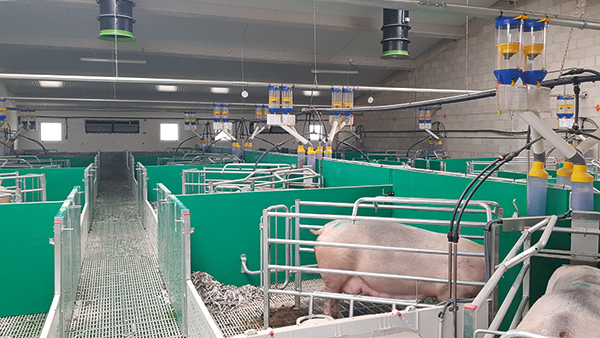
It is recommended that sows be moved to farrowing pens a week early to facilitate their adaptation. Photo: Rotecna.
Nowadays, to what extent can sow farrowing be monitored with technology?
Currently, there are no fully implemented commercial systems that enable automatic, reliable monitoring of problems during farrowing. However, experimental solutions based on artificial vision are being developed using cameras installed in gestation wards. These systems allow algorithms to be trained from images and videos to identify behavioural patterns and generate early warnings. In this context, at AWEC, we are working on the DeepCare4Pigs project, subsidised by ACCIÓ. The project has focused on three main lines: predicting the onset of labour by generating alerts; detecting potential complications during labour to facilitate intervention without constant check-ups; and identifying the optimal time to open the semi-freedom cages, when the sow is calmer, and the risk of crushing is reduced.
What are the most common management mistakes still observed in farrowing units that can increase pain during farrowing?
I think management around farrowing is improving significantly, and staff are becoming more careful with the animals. Perhaps more specific treatments still need to be applied to control pain, not in all sows, but in those that have had very long births or have had a high number of dead piglets. In these cases, the administration of non-steroidal anti-inflammatory drugs (NSAIDs) should be considered, both postpartum and at the beginning of labour, if it is anticipated that the sow may have complications. This approach is yielding good results in sow recovery and piglet growth.
Finally, how can a farm objectively assess whether it is actually improving pain management in gestation?
The simplest approach is to analyse piglet mortality around the time of farrowing. Assessing growth can be more complex, since piglets are not usually weighed systematically. Another way is to record the sow's feed intake. Farms with automatic feeding systems have greatly improved in this regard, enabling more precise monitoring of recovery. In this regard, one key indicator is whether the sow consumes the full feed dose. Together, these three factors constitute strong indicators of the evolution of pain management in gestation.