Blog
Blog
How to prepare pig farm facilities between batches?
29th October 2026 - News
The departure of one batch and the arrival of the next provide an opportunity to review the condition of the facilities, check that equipment is working properly and correct deficiencies that may go unnoticed during daily operations. Proper planning of these tasks helps make the most of the sanitary downtime, reduce incidents and ensure that the facilities are in suitable condition to receive the new animals. To achieve this, it is important to coordinate cleaning and desfinfection, repairs and technical checks so that the available time is used efficiently without compromising room preparation.
Planning tasks before the batch leaves
Preparing the facilities begins before the rooms are empty. Reviewing the incidents recorded during the previous production cycle makes it possible to identify problems that need to be addressed and anticipate the resources required to resolve them. Based on this information, tasks can be organised according to priority, responsibilities assigned and a realistic schedule established that covers both routine work and potential repairs. This planning is particularly useful when several people or teams are involved in the process, as it helps coordinate activities and prevents certain tasks from being left unfinished due to a lack of communication.
Not all incidents have the same impact on farm operations. Failures related to water supply, feeding, ventilation or animal safety must be prioritised, as they can directly compromise housing conditions as soon as the room is occupied again. Other interventions can be scheduled according to their urgency, provided they do not interfere with subsequent tasks or require work that has already been completed to be repeated. Keeping a record of incidents and outstanding tasks makes organisation easier and helps track which problems have been resolved and which require a more lasting solution.
Inspecting equipment and repairing damage
Once the rooms are empty, it is easier to access equipment and housing components to check their condition and identify damage. Inspections should be adapted to the characteristics of each production stage. In farrowing rooms, particular attention should be paid to farrowing crates, protective elements and heating systems for piglets, while in nursery and finishing units, it is important to check the condition of pen dividers, feeders and drinkers. Beyond identifying broken or deteriorated components, these checks should verify that mechanisms are working correctly and that there are no obstacles that could make the daily handling of animals more difficult.
Feeding and water supply systems require specific inspections, as any deficiency can affect animals' access to essential resources. For feeders, it is advisable to check that adjustment mechanisms are working properly and identify potential blockages. In water lines, leaks, the condition of drinkers and water delivery to the different points must be checked. Ventilation systems should also be inspected, including fans, air inlets, sensors and control systems. Checking these components before the batch arrives makes it easier to resolve problems and reduces the risk of having to carry out repairs once the facilities are occupied.
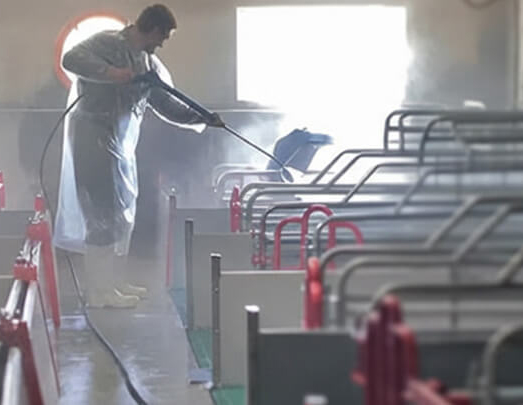
Pre-cleaning makes disinfecting the rooms easier. Photo: Rotecna.
Coordinating cleaning with repairs
Cleaning and disinfection are essential parts of preparation between batches, but they must be coordinated with maintenance work to avoid duplicating efforts. Organic matter must be removed and surfaces cleaned before the disinfectant is applied, following the manufacturer's instructions regarding concentration, contact time and conditions of use. However, if repairs that generate dust, dirt or waste are carried out after these tasks have been completed, part of the process may need to be repeated. For this reason, whenever the work schedule allows, maintenance activities that could make the facilities dirty should be carried out first, leaving the final stages of cleaning and preparation until afterwards.
The schedule must also allow sufficient time for drying, which will vary depending on the time of year, and for checking that the rooms meet the required conditions before the animals arrive. Leaving all tasks until the last minute can leave little time to resolve an unexpected breakdown or complete planned work properly. By contrast, distributing tasks and establishing a clear sequence helps make better use of the sanitary downtime and prevents rushing from compromising preparation quality. The specific sequence must be adapted to the type of facility, the products used and the protocols established by the farm.
Checking that the room is ready to receive the animals
Before the new batch arrives, a final inspection on facilities should be carried out to confirm that all work has been completed and that no outstanding issues could affect animal management. This check should cover the overall condition of the facilities, cleanliness and drying, as well as the operation of essential equipment for water and feed supply and environmental control. The aim is not simply to confirm that tasks have been marked as completed, but to verify that the room is genuinely ready to operate normally from day one.
To facilitate this final inspection, it is useful to have a checklist for each room recording the work carried out, the incidents identified and the resolution of outstanding problems. In addition to improving coordination between workers and farm managers, this record helps identify breakdowns that recur between batches and assess whether a permanent solution is needed. If the same piece of equipment repeatedly fails, analysing the cause can prevent further interventions and reduce incidents during subsequent production cycles.
Preparing facilities between batches therefore involves much more than cleaning rooms before they are occupied again. Making use of this period to inspect equipment, repair damage and organise the necessary work helps anticipate problems and improve work coordination. Proper planning, combined with a final inspection of the facilities, helps reduce unexpected issues and ensures that each batch starts under suitable housing and operating conditions.