Blog
Blog
Pest control on pig farms: a guide to rodents and flies
22nd October 2026 - News
Pests rarely give any warning signs at first. A rodent gnawing on a cable in the gestation room, a cloud of flies in the farrowing unit corridor in the middle of July, or feed residue accumulating at the base of a silo may seem like isolated problems. However, taken together, they are signs that biosecurity on the pig farm may be weakening. Pest control on pig farms is often treated as a seasonal task, only addressed when the problem has already become obvious. Taking this approach means losing much of its preventive effectiveness.
Rodents and flies on pig farms find the conditions they need to thrive within the facilities themselves, from food and water to shelter and decomposing organic matter. Their control therefore depends not only on the use of specific products, but also on facility design and maintenance, cleaning routines, and the existence of a structured pest control plan, with designated control points, assigned responsibilities, and records. This article reviews the health risks associated with pests, the signs that help detect their presence early, and the measures an effective prevention programme should include throughout the year.
Why pests pose a health and economic problem on pig farms
Rodents and flies can act as pathogen vectors between buildings, batches and even farms, contributing to the spread of diseases in pigs. They have been associated with pathogens such as Salmonella, Leptospira and Brachyspira hyodysenteriae. Furthermore, their ability to move between dirty and clean areas makes them a difficult route of entry to control through standard pig farm biosecurity protocols, which mainly focus on people, vehicles and animals. As a result, a building that rigorously complies with access control measures may still have vulnerable points, such as an unprotected ventilation grille or an inadequately sealed silo.
In addition to these health risks, pests also have economic and operational consequences. Rodents consume and contaminate feed, damage insulation materials and pipework, and may gnaw through electrical wiring, potentially causing equipment failures and even fires. Flies, meanwhile, cause discomfort to both animals and workers. Their proliferation may also indicate moisture problems or shortcomings in slurry management and cleaning that require attention. In both cases, the effects on animal welfare and production performance may develop gradually, making it difficult to identify their origin and take action before the problem becomes more serious.
Rodents: risks, hiding places and signs of their presence
Rats and mice need three things to settle on a farm: food, water and a quiet place to nest. Pig farms provide these conditions in feed stores, silo areas, false ceilings, insulation gaps, electrical cabinets and the areas around buildings where vegetation or materials accumulate. Less frequently visited areas tend to pose a greater risk, so inspections must go beyond the usual working areas and include corners that often go unnoticed during day-to-day operations.
Detecting rodents early is essential to prevent their population from increasing. Signs to look out for include droppings along walls and near feeders, spilled or gnawed feed, damaged sacks and cables, footprints on dusty surfaces, grease marks along skirting boards, and burrows around the farm perimeter. It is also important to consider when sightings occur: seeing rodents in broad daylight may indicate that the population has reached a high level, as these animals are generally nocturnal and tend to avoid exposure when sufficient hiding places are available.
Rodent prevention on pig farms should focus first on making it difficult for rodents to enter and eliminating food sources. Sealing access points and gaps, keeping a vegetation-free strip around buildings, storing feed in closed silos or containers, and removing spills daily all help make the facilities less attractive before baiting becomes necessary. When intervention is required, using tamper-resistant bait stations that are properly numbered and marked on a site plan helps organise control measures and assess their effectiveness. These stations should be inspected at established intervals, and the active ingredient used should be changed when necessary, following technical recommendations to maintain treatment effectiveness and manage the risk of resistance.
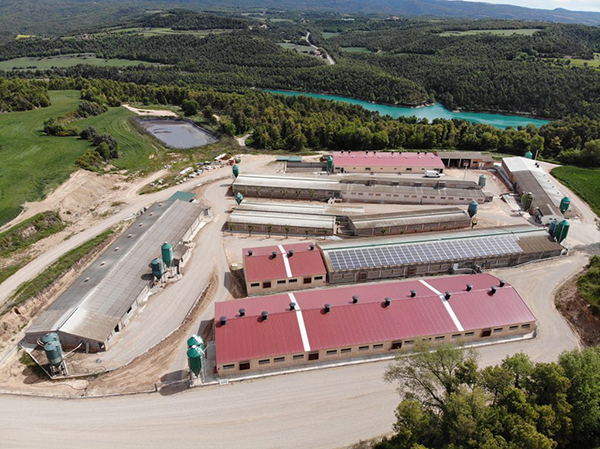
Keeping the area around the warehouses clean and tidy helps prevent pests. Photo: Rotecna.
Flies: what encourages them and how to reduce their population
On pig farms, fly control should begin by identifying and eliminating the breeding sites where larvae develop. Accumulations of slurry or manure, spilled feed that ferments, leaking drinkers, persistently damp floor areas, and placental remains or dead animals awaiting removal provide ideal conditions for reproduction. When temperatures are high, the development cycle can be completed within a few days, explaining why fly populations increase particularly in spring and summer. However, in heated buildings, flies may remain present for longer periods.
Keeping fly populations under control requires a combination of preventive measures against flies and specific treatments. This means keeping walkways dry, repairing water leaks promptly, emptying pits at appropriate intervals, removing carcasses daily, and frequently cleaning areas where feed accumulates. When necessary, these measures should be supplemented with larvicides applied to breeding sites, adulticides with rotation of active ingredients, and traps or adhesive strips that help monitor fly presence and assess pest pressure.
The design and maintenance of pig farm facilities also play an important role in prevention. Floors with good drainage, feeders that minimise feed wastage, properly adjusted drinkers that prevent splashing, and easy-to-clean surfaces reduce the areas where damp organic matter can accumulate. As a result, small improvements in facility design or maintenance may prove more effective in the long term than repeatedly applying treatments without addressing the underlying causes of fly proliferation.
How to design a pest control programme
A pest control plan for pig farms should be treated as a dynamic tool, with assigned responsibilities, a schedule of activities and a recording system. It should be based on a farm layout identifying risk areas and the location of bait stations or traps, all properly numbered. It should also specify who carries out inspections, how often they take place and how the results are recorded. If the data show an increase in captures or bait consumption in a particular area, it is important to target that hotspot and identify the underlying causes rather than intensifying treatment across the entire farm.
The application of biocidal products should be carried out by trained personnel or authorised companies, following the appropriate guidelines for active ingredients, dosages and application intervals. It is also essential to document every intervention to assess its effectiveness and maintain a record of the measures implemented. Since pig farm biosecurity regulations include pest control measures, having an up-to-date programme and the corresponding records also helps demonstrate compliance during inspections. In addition, each sanitary empty period provides an opportunity to inspect vulnerable areas of the facilities, such as gaps, grilles, doors, insulation and storage areas, and correct any deficiencies that could facilitate the entry or shelter of rodents and insects.
Ultimately, pest control on pig farms is more effective when integrated into daily farm management and based on prevention, rather than being limited to responding once the problem becomes visible. Having facilities that are easy to clean and maintain, keeping feed storage areas tidy, and properly managing water and slurry are essential measures for reducing the conditions that encourage rodents and flies to proliferate. The programme should also be reviewed periodically, at least once a year, in consultation with the veterinarian and the technical manager, to assess results and adapt measures when necessary. This approach helps keep pest pressure at low levels and reduces the need for emergency interventions.