Blog
Blog
The welding of Rotecna panels guarantees their strength and durability
23rd June 2026 - Studies
In the livestock sector, the reliability of the materials used in pig farms is a determining factor in guaranteeing both animal welfare and the durability of the facilities. Rotecna panels used as separators within farms are subject to particularly demanding conditions: sudden attacks from animals, constant pressure from their weight or behaviour, and specific impacts that can test their structural resistance.
These panels must not only withstand high stresses but also maintain their performance over time without deformation or failure. In this context, ensuring its resistance is essential to avoid incidents on the farm and interruptions in its operational continuity.
Rotecna custom panels are manufactured from 1200x1000 mm unit panels, which are connected using hot-plate welding. Although the unitary panel meets very high-quality standards, the welding process can significantly affect the assembly's final resistance. If carried out properly, this joint can, instead of being a critical point of the structure, have even greater resistance than the panel itself.
It must be noted that the final weld is influenced by multiple factors, including small variations in the raw material, deviations in the injection process, storage conditions, and adjustments to the welding process itself. Given this fact, to guarantee good welding, exhaustive control and continuous optimisation of all the parameters involved are necessary.
With this objective, Rotecna has a specific resistance testing program to oversee the behaviour of the welded panels and ensure their final performance.
Goals
The main objective of the testing program is to identify the combination of material and welding parameters that maximise the structural resistance of the custom panels, thereby ensuring they meet requirements throughout the manufacturing process. This involves not only testing the different configurations and parameters, but also understanding how the different process variables interact.
Among the key aspects analysed are:
- The pressure applied during the different phases of welding, the temperature of the hot plate, and the contact and melting times. These factors, which may seem independent, actually have a direct relationship with the quality of the joint and, therefore, with the final resistance of the product.
- The variability of the process. Given that external factors are difficult to control to 100%, such as slight differences between batches of material or environmental conditions, it is essential to define an optimal parameter range that guarantees consistent results. This ensures that panels meet minimum requirements, regardless of specific manufacturing conditions.
- Early detection of possible weak points in the production process. Aspects such as the actual temperature of the hot plate, the condition of its non-stick coating, the proper alignment of the pieces, or the quality of the panel cut can significantly influence the final result and, therefore, must be systematically controlled.
In short, the objectives of the tests are not limited to achieving good specific results, but must also establish a solid foundation that allows working with confidence, repeatability, and reliability in day-to-day production.
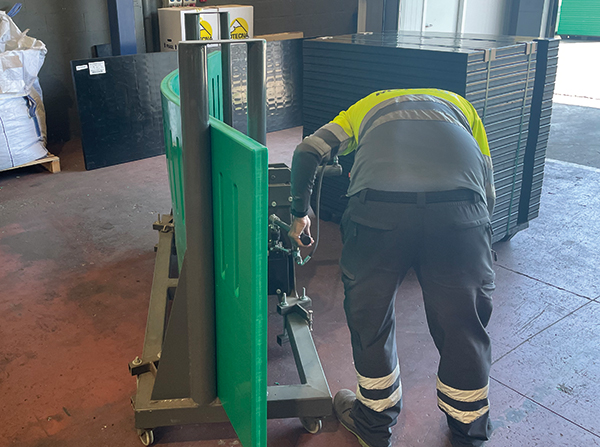
Strength tests on the welds of Rotecna panels. Photo: Rotecna.
Testing process
To accurately analyse the behaviour of welded panels, Rotecna uses its own specialised testing equipment. This system allows for the measurement of two key aspects:
- The panel's deflection in response to applied force.
- The maximum resistance up to the breaking point.
The test procedure is clear and direct: the welded panel is subjected to progressive loading until it breaks. This type of destructive test is especially useful because it allows us to identify the product's true limit and understand how it behaves under extreme conditions, similar to or even higher than those encountered on a farm.
To ensure the reliability of the results, the study includes 45-50 tests with different combinations of welding parameters. This sampling volume is key to avoiding conclusions based on distinct or random results.
In addition, tests are carried out with different batches of material, for example, panels of different colours or compositions, and with various welding machines. In this way, it is guaranteed that the results are representative of the productive reality and applicable to all manufacturing conditions.
The results of each test are systematically recorded and analysed, often using visual tools such as colour coding to group the highest values for each parameter and identify trends. This approach allows us to clearly see which combinations improve resistance and which do not provide significant benefits.
This data-driven methodology not only facilitates decision-making but also allows for the establishment of objective criteria for process optimisation.
Conclusions
The results obtained from the trials are very relevant. Firstly, they allow defining the minimum resistance values that a part must meet to be validated. In this regard, a demanding criterion has been adopted to ensure a high level of quality.
From this rationale, the analysis of the tests and the progressive adjustment of the parameters allow achieving very significant improvements in the panels' resistance. In some cases, the values obtained practically double the established minimum limit, which represents a notable increase in the product's safety margin.
These improvements result from systematic efforts to identify optimal parameter combinations. Detailed test monitoring enables the detection of patterns and trends that are key to optimising the welding process and implementing improvements.
As a result of this program, a monitoring and maintenance protocol has been developed that enables any anomaly to be detected immediately. Together, the procedure contributes to ensuring the reliability of Rotecna panels, eliminating the risk of failure in real-use conditions and providing clear added value to the final product.