Blog
Blog
Five ways to improve biosecurity through design
05th November 2026 - News
Óscar Toledano. General Manager, Rotecna
Animal health is one of the factors that most influence the production and economic performance of a pig farm. The gap between producers with the highest and lowest production costs has widened in recent years, particularly due to differences in health status and the incidence of diseases such as PRRS. These factors lead to significant losses as a result of increased sow replacement rates, poorer reproductive performance, higher mortality rates in farrowing, nursery and finishing units, slower growth, poorer feed conversion ratios, higher veterinary costs and an increase in carcass condemnations at the slaughterhouse.
When we talk about biosecurity in pig farms, we usually think mainly about protocols: showering before entering, changing clothes and footwear, cleaning and disinfecting vehicles, controlling visitors or establishing quarantine periods. All these measures are essential, but a very important part of a farm’s biosecurity is decided long before the first animals arrive, when choosing where and how to build it.
External biosecurity aims to prevent pathogens from reaching and entering the farm, while internal biosecurity seeks to reduce their spread once they have entered. The location, layout of the facilities and the way animals, people, vehicles, feed, materials, carcasses, slurry and even air move around the farm will determine our ability to achieve this throughout the farm’s entire working life.
For this reason, a high-biosecurity farm should be designed following a logical sequence: first reduce exposure, then prevent entry and, finally, limit the spread of pathogens.
Let’s look at the five main aspects to consider in order to achieve this.
Choosing a suitable location
The first biosecurity barrier on a farm is not the perimeter fence or the shower, but the location where we decide to build it. A facility located in an area with a high density of pig farms, surrounded by other farms and close to roads with heavy livestock transport traffic, faces a very different level of risk from a more isolated facility. Therefore, before choosing a location, we should assess the density of farms in the area, the number, size and distance of nearby farms, their health status, the roads used to transport animals, and the proximity of slaughterhouses and other pig gathering points, as well as the topography and prevailing winds.
The importance of distance is particularly evident when dealing with pathogens that can spread between farms through different routes, such as insects, rodents or dust, and even over long distances through airborne transmission. In the case of PRRS, under certain conditions, infectious PRRSV has been recovered from the air at distances of approximately 9 km from an infected population.
This does not mean that animals located at that distance will become infected, or that there is a distance beyond which the risk disappears. The strain, the amount of pathogen released, humidity, temperature, solar radiation, topography and, especially, wind direction and speed have a considerable influence on airborne transmission. What it does demonstrate is that, on farms with a high health status, we should not limit our assessment to the nearest farms. As a practical assessment criterion, when planning a new high-health-status breeding farm, it is reasonable to carry out a detailed analysis of farms and the main health risks within a radius of at least 5 km. In genetic nuclei, multiplication farms or facilities with particularly high health value, this assessment should be extended to approximately 10 km.
Distance should not be considered in isolation either. Several large farms located upwind may pose a greater risk than a smaller farm located closer by but usually downwind. Therefore, rather than looking for a magic separation distance, we need to assess the actual health pressure in the surrounding area.
We should also investigate where slurry from nearby farms is applied. Recent studies have found a higher incidence of PRRS outbreaks when slurry was applied to nearby fields, particularly within the first 1.6 km, although an association was also observed at greater distances. These findings do not establish a safe separation distance, but they indicate that, around a high-health-status breeding farm, particular attention should be paid to areas where slurry from other farms is applied, especially if it comes from PRRS-positive farms or farms with an unknown health status.
The presence of wildlife and the possibility of contact with it must also be assessed. The risk associated with wild boar has become particularly important in relation to African swine fever (ASF). For this reason, the perimeter fence must act as a genuine physical barrier, be properly maintained and prevent wild animals from accessing the facilities, storage areas, feed or potentially contaminated materials.
When the available level of isolation is insufficient, particularly on breeding farms located in areas with a high density of pig farms, it may be advisable to incorporate air filtration systems. Filters reduce the risk associated with this transmission route, but they do not compensate for deficiencies in transport, loading facilities, the entry of animals, people, materials or feed.
Location also has one characteristic that sets it apart from practically all other measures: once the farm has been built, it cannot be changed. For this reason, health risk should carry similar weight to access to water, electricity and roads, as well as the availability of labour or land for slurry management, when selecting a site for a new farm.
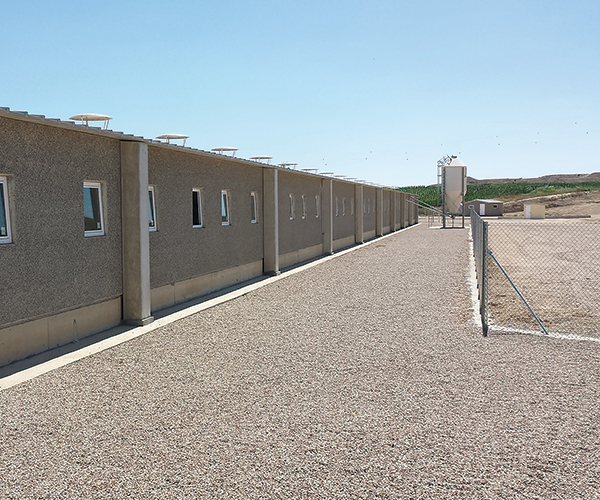
The perimeter fence must act as a genuine physical barrier. Photo: Rotecna.
Designing the flows before the buildings
When planning the layout of the different buildings on a farm (rearing, gestation, farrowing, nursery units, etc.), we should first map out how the farm’s six main flows will move between them: animals, people, vehicles, feed and materials, carcasses and slurry, and air.
Each of these flows can carry pathogens in a different way and therefore requires specific control measures. Once they have been mapped, we need to analyse where they intersect. The fewer crossings there are between routes with different levels of health risk, the better.
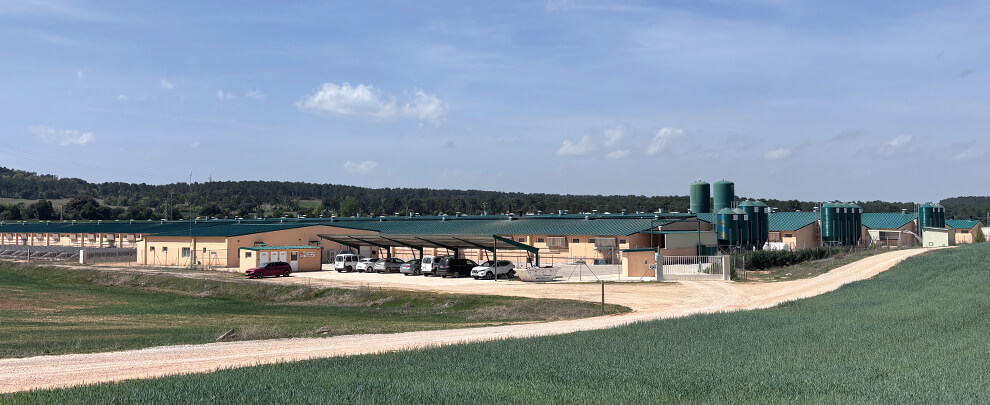
The perimeter fence must clearly separate the outside of the farm from the inside, and the number of access points should be kept to a minimum and properly controlled. Whenever the characteristics of the site allow it, it is particularly useful to have an external access road from which different vehicles can reach only the specific point assigned to them. Employees’ vehicles should go to the car park; feed trucks to the silos; livestock transport vehicles to their loading facilities; carcass collection vehicles to their collection point; and slurry tankers directly to the storage area.
Not all these vehicles pose the same level of risk. Vehicles involved in transporting animals, carcasses or slurry may have previously been in contact with other farms or locations where large numbers of pigs are gathered. Therefore, the highest-risk vehicles should be the ones that come closest to the farm’s clean area the least.
The same approach should be applied inside the farm. Animals should move forward according to the production sequence, avoiding backtracking and crossings between animals of different ages or health statuses, while favouring all-in/all-out systems whenever possible.
Air must also be considered a flow. For example, in a filtered facility, installing good filters is of little use if there are doors, stopped fans, cracks or other points through which unfiltered air can enter. Therefore, before building a farm, correctly drawing six lines on the site plan may be more important than starting by drawing its walls.
Keeping out everything that does not need to enter
Every vehicle, person or material that crosses a farm’s perimeter represents a potential route for introducing pathogens. For this reason, one of the simplest rules we can apply during the design stage is: if it does not need to come in, it should stay outside.
Whenever possible, silos should be positioned so that they can be filled from outside the farm’s biosecurity perimeter, preventing feed trucks from having to drive along internal roads.
Something similar applies to carcasses. The problem is not solved simply by placing the carcass container away from the buildings if, to deposit a dead animal, a worker has to leave the clean area and then return to it. Carcasses should be removed through a transfer point that physically separates the clean area from the dirty area. One particularly interesting solution is to use a change in ground level, with the dirty area positioned at a lower level. The system must allow carcasses to be transferred from inside the farm to a storage or transfer point accessible from outside, preventing collection vehicles from entering the farm and avoiding contact between their drivers and personnel working in the clean area. If possible, storage systems should be used that allow a larger volume of carcasses to accumulate, reducing the frequency of collection by external transport vehicles.
Slurry pits and storage systems should follow the same principle. Tankers used to remove slurry should have an independent access point that prevents them from driving along internal roads. Particular attention must also be paid to pumps, hoses and other equipment that may be used on different farms.
Certain meters, tanks, generators, electrical panels and other equipment requiring regular maintenance can also be positioned so that they are accessible without having to enter the farm’s biosecure core. Even the motors and control panels for feeding, climate control and cleaning systems can be installed in dedicated corridors, allowing external maintenance personnel to carry out their work without entering the clean area where the animals are housed.
Every entry point we eliminate through design means one less risky operation that we will have to control every day throughout the farm’s entire working life.
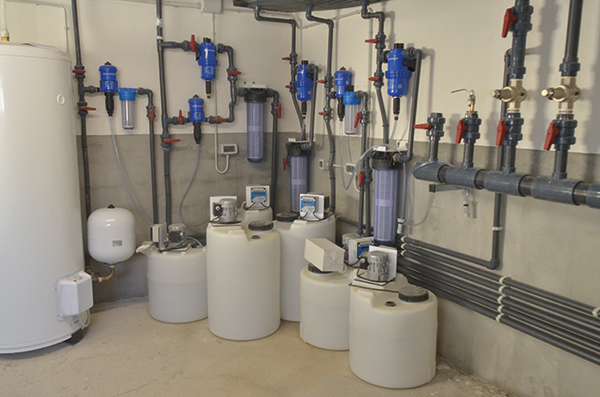
Certain meters should be located outside the biosecure core. Photo: Rotecna.
Turning every entry and exit into a barrier
There are movements that, of course, cannot be eliminated. We need workers, replacement animals must be brought in, certain materials have to be delivered and animals must leave the farm. The points where these flows cross the boundary between the outside and the inside are some of the most important elements of the entire design.
It is advisable to minimise the number of entry and exit points from outside the farm. Therefore, from an external biosecurity perspective, it is generally easier to control a farm with a small number of clearly defined access points than one with numerous buildings and entry points. This does not mean compromising on adequate health compartmentalisation within the farm. In particular, we must avoid grey areas where it is unclear what is clean, what is dirty or how far each person is allowed to go.
At the staff entrance, the separation must be physical. Workers should enter a dirty area, leave their outdoor clothes and footwear there, shower and then move into a clean area where they have access to clothing and boots reserved exclusively for use on the farm. Benches, doors and pass-through showers are more effective than a simple line painted on the floor because they help make the correct route the easiest one to follow.
The loading bay deserves particular attention, as it represents the point of contact between our animals and vehicles that may previously have visited other farms, livestock assembly centres or slaughterhouses. The driver should not enter the clean area, and farm workers should not enter the truck. Animals must move towards the outside without being able to return, and floors and drainage systems must be designed so that, during washing, water always flows towards the dirty area. Physical barriers can also be installed that allow animals to pass through but prevent people from crossing above a certain height.
On breeding farms, it is advisable, whenever possible, to separate the loading bay used for piglets from the one used for sows destined for slaughter, as these two types of transport present very different levels of risk. Replacement animals require even greater attention because introducing animals means opening our health barrier.
If replacement animals are sourced externally, a quarantine facility should be provided, sufficiently separated from the production core, operating as an independent unit with its own entry, handling and exit routes. This makes it possible to check the health status of future breeding females during the isolation period and subsequently carry out the acclimatisation programme established by the veterinarian before introducing them into the breeding herd. Furthermore, if the animals develop any health problems during this period, the risk of these affecting the breeding herd is minimised.
If replacement animals are sourced internally, the replacement unit can be located within the same farm and treated as another separate facility, taking into account its health status in relation to the rest of the facilities and ensuring that its routes do not compromise the breeding herd.
Medicines, semen doses, tools, spare parts and other materials must also have appropriate transfer or decontamination points.
Ultimately, every flow that necessarily has to cross our biosecurity barrier should do so through a single point specifically designed to control the associated risk.
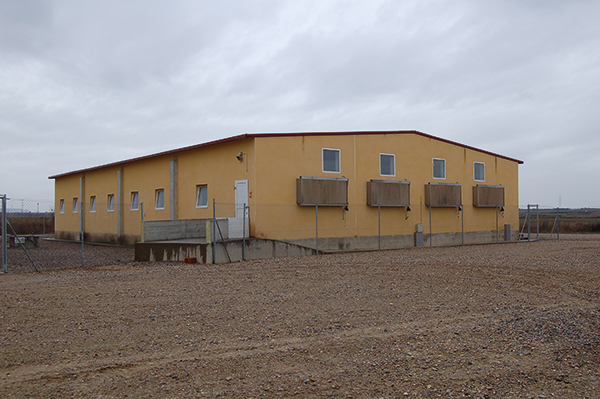
The loading area is a critical biosecurity point due to contact between animals and external vehicles. Photo: Rotecna.
Designing for when biosecurity fails
No matter how many measures we implement, zero risk does not exist. For this reason, a truly well-designed farm should not only answer the question: how do we prevent a disease from entering? We should also ask what will happen if it does enter: how do we prevent it from spreading throughout the entire farm, and how do we prevent it from being transmitted to other farms?
The compartmentalisation of facilities, separation between batches, all-in/all-out systems, avoiding the mixing of animals of different ages and origins, appropriate staff and animal movement routes, and proper cleaning, disinfection and drying all help reduce the spread of disease within the farm itself.
In any case, compartmentalisation must also be balanced with the need to implement consistent health management across the animals. In certain diseases, such as PRRS, when an outbreak occurs, it may be beneficial for the veterinarian to apply the same health strategy to an entire population and prevent the infection from persisting over time as it spreads between different groups of animals. Therefore, the design of the facilities and the organisation of batches must allow both for the initial containment of a disease and, subsequently, for its stabilisation.
But we must also think beyond the farm. If an outbreak occurs, the same elements used to prevent diseases from entering must also make it difficult for them to leave: properly designed loading bays, separate vehicle routes, appropriate carcass management and controlled movement routes for people, materials, animals and slurry. This concept of biocontainment is particularly important in areas with a high density of pig farms. A breeding farm not only houses a large number of high-value animals, but also continuously supplies piglets to other facilities.
Even when the established protocols are excellent, the more biosecurity depends on someone remembering what they have to do, the greater the likelihood of mistakes. A good design is one that makes doing things correctly the easiest option.