Blog
Blog
Gilts: key factors for improving reproductive performance
01st September 2026 - News
The introduction of gilts into the breeding herd is one of the decisions that can have the greatest impact on the future of a sow farm. These females reach their first breeding while they are still growing and must face gestation, farrowing and a first lactation within a relatively short period, while continuing to develop. Therefore, the objective should not be limited to achieving puberty, but rather to preparing animals capable of remaining in the herd for several litters and expressing their reproductive potential throughout their lifetime.
Preparation begins well before first breeding. The selection of future breeding females, their growth, structural development, onset of puberty, health adaptation and body condition are all factors that can influence subsequent productivity and longevity. A review on gilt management specifically highlights that decisions made from birth can influence reproductive performance throughout the sow’s lifetime.
How to select gilts for breeding
The selection of future breeding females should take into account much more than body weight or growth rate. Litter origin, birth and weaning weight, subsequent development, body conformation, leg and foot structure, and the mammary system are some of the aspects that can help identify females with the greatest potential to become productive breeding animals.
Modern genetics have made it possible to achieve animals with high growth and productivity potential, but this also makes it necessary to control how the future sow develops. Selecting only the heaviest females may result in the introduction of animals that have grown too quickly or have structural problems that will eventually compromise their retention in the breeding herd. Likewise, particular attention should be paid to the limbs, as locomotor problems are among the common reasons for sow removal.
The mammary system is another element that should be assessed before introducing a female into the breeding herd. Good conformation and a sufficient number of functional teats are essential for managing large litters and facilitating management during lactation. Likewise, health status and the ability to adapt to the farm environment should form part of the selection criteria.
This assessment makes it possible to carry out an initial screening and focus feeding and management resources on females that genuinely have the potential to remain productive for several parities. Selection should therefore not be viewed as a one-off decision, but as the first step in a process that continues through first breeding and beyond.
Weight and age of gilts at first breeding
Determining when a gilt is ready for first breeding requires a balance between age, body weight and physiological development. Reaching a particular weight does not necessarily mean that the female is ready to cope with gestation, particularly if that growth has occurred too rapidly. As a reference, different studies place the appropriate weight at first breeding at approximately 135–160 kg, although the specific target should be adapted to the genetics, production system and characteristics of each farm. More important than reaching a specific figure is avoiding both insufficient development and excessive body weight and fat.
Age should also be assessed together with other indicators of reproductive maturity, such as the detection of puberty and recording of oestrus, which provide a better understanding of each animal’s development. In this context, boar exposure is an important tool for stimulating and detecting heat, particularly in gilts that reach puberty later.
Consequently, first breeding should take place when the female has reached a degree of development that allows her to cope with her first gestation without compromising her own growth. The decision will be more accurate when her age, body weight, body condition, structural development and reproductive progress are assessed together.
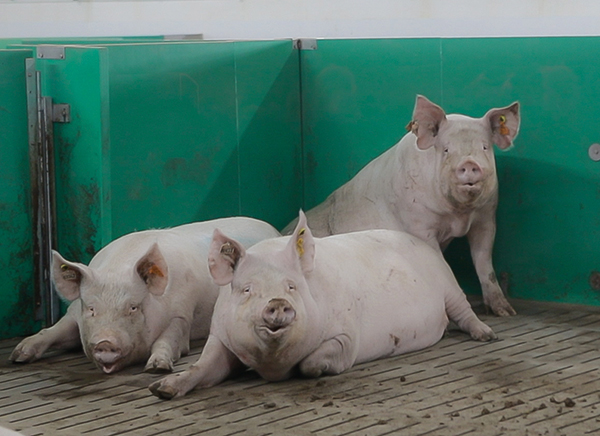
Proper gilt preparation is key to improving reproductive performance. Foto: A.P.
Feeding and management of gilts
Once first breeding has taken place, the future breeding female enters a new stage in which she still needs to complete her own development while supporting litter growth. During the first gestation, therefore, nutrition must meet these two requirements by providing the nutrients needed for body and fetal development without promoting excessively rapid growth or excessive fat deposition. The objective is to reach farrowing with an appropriate body condition, avoiding both insufficient reserves and excessive body weight, which can increase maintenance requirements and contribute to locomotor problems.
In this sense, monitoring body condition makes it possible to adapt management to the individual progress of each female and is particularly important around farrowing and during the subsequent lactation. Gilts that reach farrowing with insufficient reserves will have greater difficulty coping with the high demands of lactation, while excessive body condition is also undesirable. During this first lactation, the sow must maintain high milk production while continuing her own development and retaining sufficient body reserves to recover and face the next reproductive cycle.
For this reason, feed and water intake during lactation requires particular attention. Ensuring adequate access to feed and water, minimising any factors that may limit intake and monitoring gilts individually can help promote higher feed intake and reduce loss of body condition. This management is especially important in young animals, for which first lactation represents one of the greatest challenges of their productive life.
Piglet management completes this stage. Litters from gilts may have different characteristics from those of higher-parity sows, particularly in terms of birth weight and the sow’s milk production capacity. Appropriate management during the first hours of life and throughout lactation can help compensate for some of these differences, support piglet development and improve the overall outcome of the first litter.
How to improve the reproductive performance of gilts
The performance of a gilt should not be assessed solely at the time she enters the breeding herd, but throughout her entire first reproductive cycle. First breeding makes it possible to determine whether she has reached an appropriate level of development and maturity, while the results of gestation, farrowing and, especially, first lactation show whether this preparation has actually translated into productive capacity. To do so, it is advisable to monitor indicators such as age and body weight at first breeding, farrowing rate, total born and born alive, litter weight at birth and weaning, piglet mortality and loss of body condition during lactation.
Beyond the results of the first litter, one of the most important indicators is the gilt’s ability to remain in the breeding herd and progress to subsequent gestations. Replacement represents a considerable investment in genetics, feed, space, health and labour, so keeping a female productive for several parities allows this investment to be used more effectively. Successfully getting through first lactation and adequately recovering body condition are key factors in promoting productive longevity.
Gilt-specific analysis also makes it possible to detect problems that may go unnoticed in the farm’s overall data. A high proportion of females reaching puberty late may point to difficulties during development, while good entry into reproduction followed by excessive loss of body condition may indicate problems coping with first lactation. Relating these indicators helps identify critical points and adjust management accordingly.
Gilt management should therefore be understood as a continuous process that begins before first breeding and extends through the first parities. True success is not simply achieving entry into reproduction, but ensuring that gilts successfully get through their first litter and continue producing throughout subsequent reproductive cycles.