Blog
Blog

How can we manage variability within groups during the nursery phase?
10th September 2026 - News
The average weight of a group of piglets in the nursery phase is a useful indicator for monitoring their development, but on its own it does not show how the animals are distributed within the group. Two groups may reach the same average weight and nevertheless have different levels of uniformity. While weights in one group may be concentrated around the average, in another there may be a greater gap between the more developed animals and those progressing at a slower rate.
This variability after weaning is not always immediately apparent. During the first few days, it may seem like an acceptable difference, but if certain animals fail to maintain the group’s growth rate, the gap may become more evident as the nursery phase progresses. The result can be a group in which animals require different amounts of time to reach the next production targets and arrive at the finishing stage with different levels of development. Therefore, the aim is not to eliminate every difference between animals, but to identify when initial variability begins to develop unfavourably.
The first days shape the development of the group
Weaning represents a major change for the piglet. Milk feeding comes to an end, a new feeding regime is introduced, the environment changes and groups are reorganised. Although all animals go through this process, they do not necessarily adapt at the same rate. Their response during the first few days can influence their ability to maintain stable development thereafter.
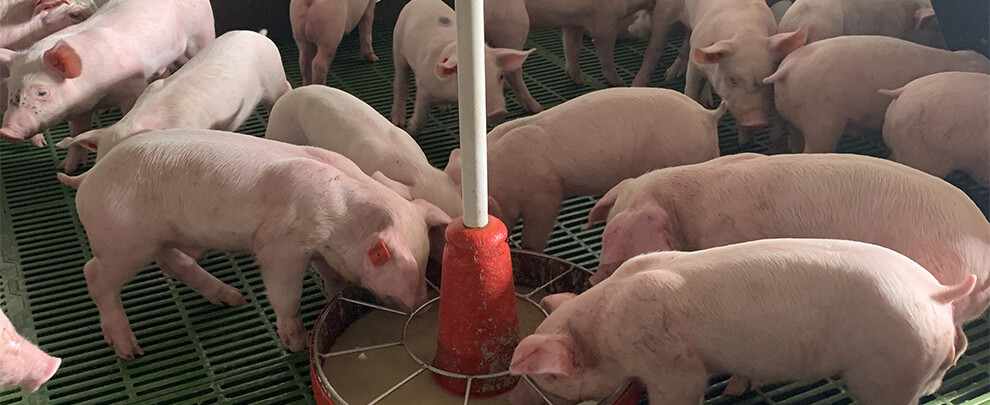
Feed intake becomes particularly important at this stage. Some animals start consuming feed quickly and return to a stable growth pattern, while others need more time to adapt. During this stage, facilitating access to both feed and water can support piglets’ adaptation. Installing adaptation pans increases the number of available feeding points and facilitates access to feed, while constant-level drinkers provide readily accessible water without the animal having to activate any mechanism to obtain it. These conditions help piglets start consuming feed sooner and maintain adequate intake, which is essential to sustain growth and prevent differences between animals from increasing during the transition phase.
Besides, daily observation can provide information that does not appear in weight checks. Behaviour around the feed, activity levels, interaction with the group or the presence of animals that remain apart can help detect adaptation difficulties. These signs do not, in themselves, indicate the cause, but they can justify further investigation before the difference has a greater impact on performance.
It is also important to establish where the differences originate. If part of the variability is already present at weaning, the aim will be to prevent it from increasing during the following weeks. If, on the other hand, it emerges during the nursery phase, it will be necessary to analyse which circumstances are affecting certain animals and why their development is deviating from that of the rest.
Piglet variability beyond average weight
Once the weight differences within the batch have been identified, it is important to observe how they evolve during the transition. Not all piglets that weigh less than the average necessarily have a problem. Differences in weight may be related to weaning weight, development during lactation, or the individual differences between animals. For example, a piglet that starts at a lower weight may maintain a good growth rate and gradually catch up with the rest of the group.
The situation is different when an animal that already starts at a lower weight maintains a lower weight gain during the nursery phase. In this case, the difference is not only maintained but may increase over the following weeks. Therefore, rather than establishing a weight threshold above which a problem is considered to exist, it is useful to monitor how each group of animals develops.
Weight checks throughout the nursery phase make it possible to determine whether initial differences are narrowing, remaining stable, or increasing. Comparing these data with the development of the group helps identify which animals are following a normal development pattern and which are losing pace compared with the rest. This makes it possible to distinguish normal variability within the group from a situation that requires specific attention.

Adaptation to the feed influences the homogeneity of the batch. Photo: Rotecna.
The impact of weight variability during the finishing stage
When weight differences persist throughout the nursery phase, they can carry over into subsequent stages. Animals arrive at the finishing stage with different levels of development, which can make group organisation and planning of marketings more difficult. The greater the heterogeneity, the harder it is for all animals to follow a similar development pattern and reach production targets at around the same time.
The consequences are not limited to weight. A more heterogeneous group may require different amounts of time to complete the production cycle and result in less uniform marketings, affecting space planning and animal flow. Variability in itself does not necessarily imply an economic loss, but a difference that persists across several stages can ultimately affect the organisation and efficiency of the system.
For this reason, knowing only the weight at the beginning and end of the nursery phase provides limited information. Introducing intermediate checks makes it possible to determine whether animals that started at a lower weight are catching up or whether, on the contrary, the difference is being maintained. This information helps assess the situation before the differences reach the finishing stage as an established pattern.
Measuring variability to intervene in time
Managing variability requires data that make it possible to compare the development of groups. Average weight remains a necessary reference, but it can be complemented by measures of dispersion and by the distribution of animals across weight ranges. The aim is not to accumulate indicators, but to use those that make it possible to detect relevant changes and compare them between groups and at different points in time.
These data become more valuable when they are related to other production parameters, such as average daily gain or feed intake. This makes it possible to determine whether animals in the lower weight ranges are developing in line with the rest of the group or whether there is a subgroup whose progress is deviating. The aim is not to intervene in response to every difference, but to have enough information to distinguish normal variation from a trend that could compromise uniformity.
In this sense, variability should be understood as a process rather than simply a snapshot of the group at a given moment. Knowing which animals show differences, when those differences emerge and how they develop makes it possible to act more effectively and prevent a deviation that initially appears minor from ultimately affecting subsequent stages. The nursery phase does not need to produce perfectly uniform groups, but it does provide an opportunity to identify and manage differences before they become a more significant problem.