Blog
Blog
Pig welfare: key aspects of the new European legislation
23rd July 2026 - News
Animal welfare is no longer simply an ethical issue; it has become one of the main factors shaping the future of European pig production. Over the coming years, farms will have to adapt to a new regulatory framework promoted by the European Union, with more stringent requirements regarding housing, management and production conditions.
Although the new legislation has not yet been definitively adopted, the debate has been ongoing for years, and both scientific recommendations and the proposals put forward by the European institutions provide a clear indication of the direction the legislation is likely to take. For the pig sector, this represents a major technical and economic challenge, but also an opportunity to modernise farms and strengthen their competitiveness in an increasingly demanding market. The question is no longer whether changes will come, but rather to what extent farms are prepared to implement them.
What changes does the future European legislation propose?
European animal welfare legislation was adopted more than twenty years ago. Since then, scientific knowledge of animal behaviour and welfare needs has advanced significantly, while sustainability and animal welfare have become increasingly important in both EU policies and consumers' purchasing decisions.
In this context, the European Commission is working on a revision of the legislation as part of the Farm to Fork strategy. Although the legislative timetable has experienced several delays and no final text has yet been adopted, the scientific opinions published by the European Food Safety Authority (EFSA) provide a fairly clear picture of the main directions the future legislation is expected to take.
Among the proposals currently under discussion are increasing the space available for animals, improving access to manipulable materials that promote the expression of natural behaviours, reviewing certain management practices, and strengthening control over environmental conditions within farms. Together, these measures reflect a broader approach to animal welfare, which encompasses not only the absence of disease or suffering but also the opportunity for animals to express natural behaviours.
One of the issues attracting the greatest attention is the future of routine tail docking. European legislation already states that this practice must not be carried out routinely, but only after other measures to prevent tail biting have first been implemented. However, the European institutions intend to reinforce this approach by promoting strategies that progressively reduce the need for tail docking through improvements in management, housing design and accommodation conditions.
In this context, environmental enrichment plays a central role. The availability of suitable manipulable materials, such as ropes, chains, wood or other objects that stimulate exploratory behaviour, is considered one of the most effective tools for reducing stress and preventing undesirable behaviours such as tail biting. Rather than being an isolated requirement, environmental enrichment forms part of a broader strategy aimed at improving animal welfare and encouraging pigs to express more natural behaviours.
Adapting goes far beyond complying with legislation
When animal welfare is discussed, the first thing that often comes to mind is increasing the space available for each pig. However, adapting to the future legislation will most likely require a much broader approach.
Farm design will play an increasingly important role. Beyond the amount of space available, factors such as farm layout, indoor environmental quality, ventilation, temperature and humidity control, permanent access to water, comfortable resting areas and environmental enrichment will need to be integrated into an overall management strategy aimed at preventing behavioural problems, improving animal welfare and enhancing productive performance.
Many farms have already begun this adaptation process. The adoption of new technologies, the gradual renovation of facilities and improvements to environmental control systems are driven not only by the need to anticipate future legislation, but also by the pursuit of greater production efficiency.
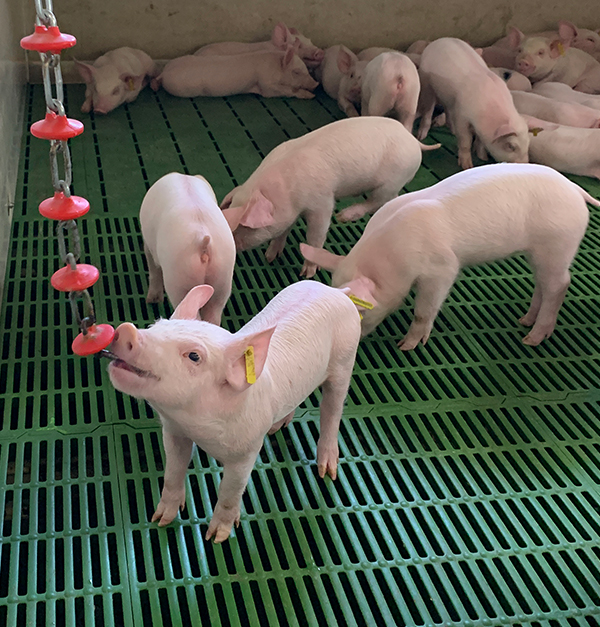
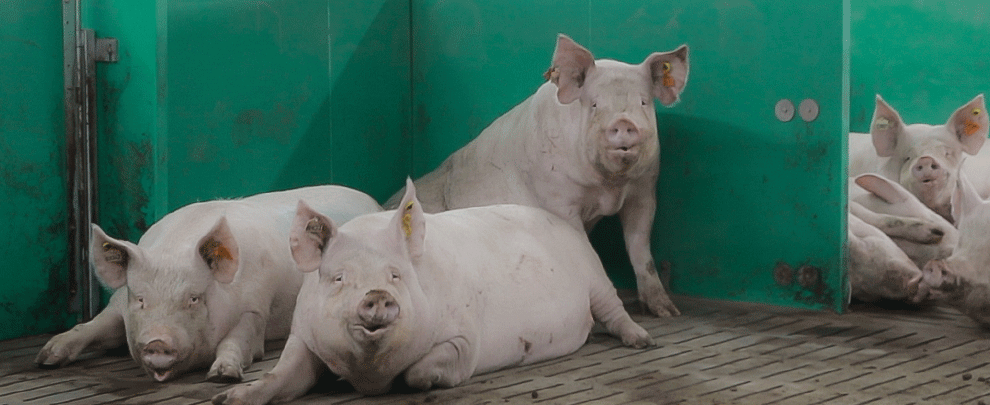
Environmental improvement favors natural behavior and improves the well-being of pigs. Photo: Rotecna.
Technology, data and investment
The modernisation of pig farms is closely linked to digitalisation. In recent years, tools capable of monitoring environmental parameters, water consumption, feed intake and animal behaviour in real time have become increasingly widespread, providing valuable information to support decision-making.
These systems make it possible to detect deviations before they lead to production or health problems, enabling much more precise management of animal welfare. Technology does not replace the farmer's experience, but it does provide objective data that help better understand what is happening within the farm and respond more quickly.
However, this transformation also has a significant economic dimension. Upgrading facilities built many years ago may require substantial investment, particularly if future legislation introduces requirements related to increased space allowances, the incorporation of new environmental enrichment elements or modifications to certain housing systems.
This is of particular concern for smaller farms, which have more limited investment capacity. For this reason, the sector insists that any legislative changes should be accompanied by adequate transition periods and support programmes that enable investments to be made without compromising farm viability.
A challenge for the competitiveness of the European pig sector
The future animal welfare legislation will have consequences not only within farms, but also for the competitive position of the European pig sector in international markets.
Producers support continued progress towards higher animal welfare standards in Europe, but argue that these efforts must be accompanied by fair competitive conditions. If imports from third countries are not subject to equivalent requirements, European farms could face higher production costs without being able to recover them through the market.
This debate becomes even more relevant in a context characterised by cost volatility, international uncertainty and increasing regulatory pressure on livestock production. Maintaining a balance between sustainability, animal welfare and profitability will be one of the sector's greatest challenges over the coming decade.
In this context, anticipation can become a competitive advantage. Farms that invest in innovation, efficiency and continuous improvement will be better prepared to adapt to future regulatory changes and meet the evolving demands of the food supply chain.
Beyond legal obligations, animal welfare is already an integral part of the European pig production model. The future legislation will accelerate a transformation that is already underway and will require the sector to continue evolving. The key will not simply be to comply with the legislation once it enters into force, but to use this process as an opportunity to build farms that are more efficient, more sustainable and better prepared to face the challenges of the future.