Blog
Blog
What factors influence non-productive days in sows?
08th October 2026 - News
Non-productive days (NPD) in sows are days when a sow is neither pregnant nor lactating. Although this indicator is directly related to the number of litters a sow can produce per year and to reproductive efficiency, its causes can arise at different stages of the sow’s reproductive cycle: from weaning to the next mating, in the days following an insemination that does not result in pregnancy, or during the period before a sow is culled. They can also accumulate between a gilt entering the breeding herd and her subsequent insemination or culling. For this reason, looking only at the total number of NPD does not reveal where they are accumulating or which measures could help reduce non-productive days. To use this indicator as a management tool, it is necessary to identify when they occur and which factors are responsible for each interval.
The interval between weaning and the next mating
One of the first aspects to review is the interval between weaning and the onset of heat. Under normal conditions, most sows come into heat within a few days of weaning, although differences may occur between animals and farms. When this period is prolonged, the number of days during which the sow is neither pregnant nor lactating also increases. Systematically recording the dates of weaning, heat detection and mating therefore makes it possible to check whether intervals remain within established targets and identify whether certain sows or groups have unusually high values.
When deviations occur, it is worth analysing which animals are affected and investigating possible causes. Parity, the sow’s condition at weaning, lactation length and feed intake during lactation can all influence the return to reproductive activity. It is also important to check whether heat detection is being carried out correctly and frequently enough. A sow may come into heat on time, but if this goes unnoticed, mating may be delayed, resulting in additional non-productive days. In group-housed systems, automatic heat detection systems can help identify sows at the right time by continuously monitoring their behaviour. This can help detect post-weaning heat as well as returns to heat in previously mated sows. Having this information available makes it easier to identify the onset of heat promptly and adjust insemination timing, helping to reduce the interval between weaning and mating.
Returns to heat and pregnancy losses
Another important source of NPD in sows occurs when insemination does not result in pregnancy. Returns to heat, pregnancy losses and other reproductive failures mean that the sow spends longer without entering a new productive cycle. In these cases, it is not enough to know the farm’s return rate; it is also important to establish when returns occur and how much time passes before they are detected and the sow is mated again. In other words, it is important to distinguish between early, regular, irregular and late returns.
When non-productive days levels are high, it is therefore useful to review reproductive records and check for patterns within specific groups of animals. If returns are concentrated at a particular stage of the cycle or in a specific group of sows, it may be necessary to review heat detection, insemination timing, sow management or reproductive results by parity. The key is not to treat all NPD as a single problem: the stage at which they occur provides valuable information about where action is needed.
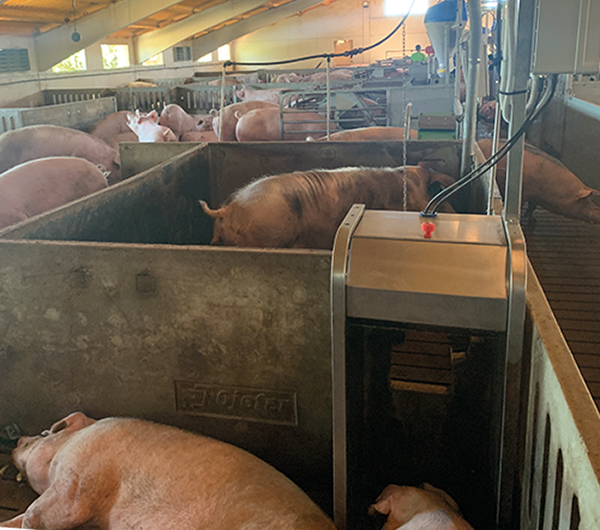
Heat detection systems facilitate identification by monitoring behavior. Photo: Rotecna.
Sow condition during lactation also matters
Maintaining the correct sow body condition when entering the farrowing unit and managing feed intake during lactation can affect the sow’s subsequent reproductive cycle. Poor body condition before farrowing and/or insufficient feed intake during lactation can lead to greater mobilisation of body reserves, resulting in substantial weight loss and making recovery after weaning more difficult. Electronic feeding can play an important role here, both by providing individual feeding according to body condition during group gestation and by maximising feed intake in the farrowing unit while minimising waste. Therefore, when a farm identifies prolonged weaning-to-heat intervals, reproductive results should be analysed alongside what happened during gestation and lactation, rather than treating these periods separately.
It is also important to determine whether performance differs at certain times of the year. High temperatures can reduce feed intake during lactation and subsequently affect reproductive results.
Comparing NPD and weaning-to-heat intervals across different times of the year can help establish whether a seasonal pattern exists. This analysis makes it possible to move beyond a general observation—for example, that NPD increase during certain months—and examine more specifically what happens to sows in the preceding weeks.
Culling and replacement also contribute to non-productive days
Non-productive days do not accumulate only between weaning and the next mating. They can also build up when a sow remains in the herd for an extended period without achieving another pregnancy, before eventually being culled. For this reason, culling and replacement management should form part of the analysis. Keeping animals with reproductive problems for too long, together with inadequate management of sow body condition, can increase NPD and significantly worsen farm performance.
It is important to establish clear criteria for identifying sows with recurring reproductive problems and assessing whether they should remain in the herd. Reviewing the number of returns, reproductive intervals, pregnancy losses and each animal’s history makes it possible to make better-informed decisions. Similarly, well-planned replacement helps maintain a balanced herd structure and prevents culling decisions from being made only after a problem has persisted for several cycles.
Analysing NPD to identify where action is needed
Reducing non-productive days does not involve applying a single measure, but identifying where they are accumulating. To do this, it is more useful to break the indicator down into different intervals: the days between weaning and heat, between heat and mating, between mating and pregnancy confirmation, and the period before culling. Comparing these figures by parity, time of year or group of animals makes it possible to detect deviations that may remain hidden when only the farm’s overall average is considered.
An increase in NPD can have very different causes and therefore requires an analysis of the entire process. Regularly reviewing reproductive records and relating them to sow management helps identify where time is being lost to non-productive days and take action accordingly. Turning non-productive days into an indicator analysed by stage helps identify reproductive problems earlier and supports more targeted decisions about herd management.