Blog
Blog
From data to decision-making on the pig farm
01st October 2026 - News
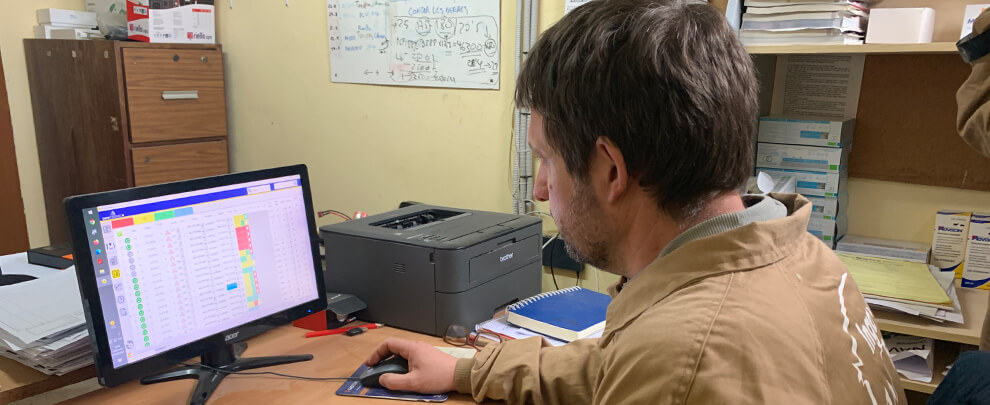
Every day, a pig farm generates a large amount of data related to its animals, facilities and production processes. Feed and water consumption, environmental conditions, changes in body condition and production results are some of the indicators that can provide information about how the farm is operating. When these records are collected continuously and analysed together, they make it possible to move from a view based solely on occasional observations to a more accurate understanding of what is happening over time.
This information complements the experience of the people working on the farm. Daily observation makes it possible to detect changes and assess the condition of the animals and facilities, while data provides an objective reference for monitoring how certain variables evolve. In this way, a change in consumption, a variation in environmental conditions or a change in body condition can be analysed in relation to the farm’s usual values and the trends recorded over previous days, weeks or production cycles.
What data can help provide a better understanding of the farm
The usefulness of data largely depends on what information is recorded and how different data points are related to one another. In feeding, for example, knowing how much each sow consumes in the farrowing unit makes it possible to work more precisely, monitor her progress and maximise feed intake. Electronic feeding systems such as Dositronic M generate this type of information through individual sow feeding, applying feeding curves assigned to each animal and providing a record that can be used to monitor feed intake in greater detail.
It is also possible to obtain information related to changes in the animals. The body condition of gestating sows is a good example, as it can vary throughout the production cycle and provide useful information for adjusting feeding and ensuring that animals reach farrowing in the desired body condition. Technologies such as BodyCheck enable the body condition of each animal to be obtained automatically through image analysis and used together with feeding data. In this way, the information goes beyond simply recording how much feed an animal receives and can be related to changes in body condition, allowing the feeding curve to be automatically adjusted so that the sow remains in the ideal condition.
There is also a large amount of information in nursery and finishing facilities that can be useful for daily management. Temperature, humidity, gases, and water and feed consumption are variables that can be continuously recorded using monitoring systems such as Sensoritronic. Monitoring these parameters makes it possible to understand how conditions in the barn evolve, determine whether animals are consuming feed and growing as expected, and set alerts when certain values move outside the defined limits.
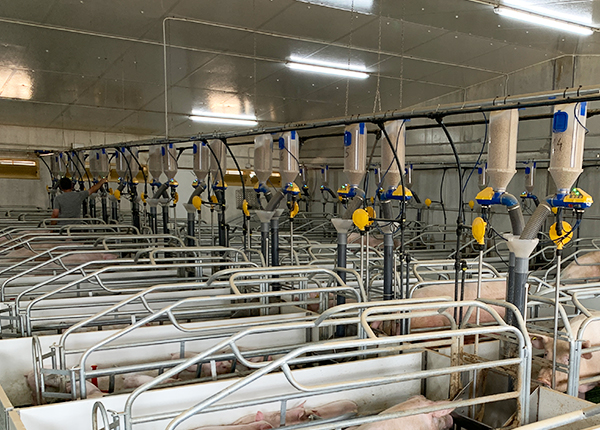
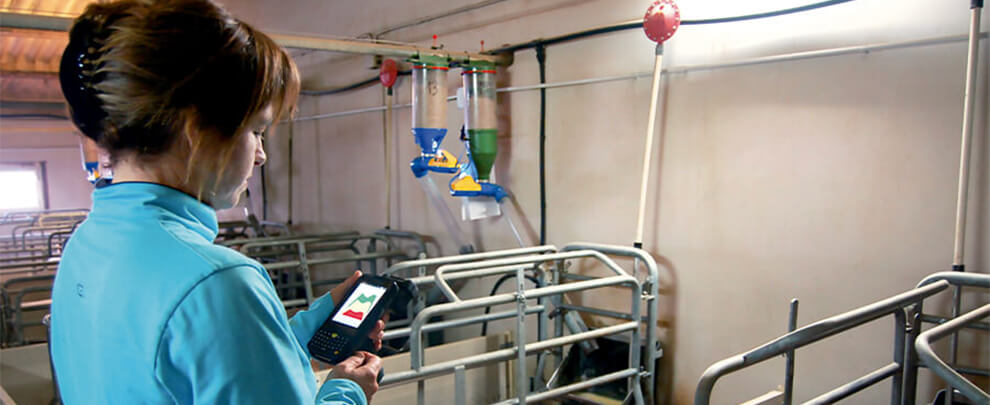
Dositronic M allows for the control and optimization of individual feed intake for each sow. Photo: Rotecna.
From a single data point to historical data
One of the main benefits of continuously recording information is the possibility of building a historical record and identifying trends. A given consumption level has limited meaning when viewed in isolation, but it can provide much more information when compared with the farm’s usual values under the same conditions or with those recorded during previous production cycles. This perspective makes it possible to distinguish an isolated variation from a trend and establish correlations and causal relationships for each facility.
Historical data also makes it easier to assess the results of decisions that have been made. If a feeding strategy is modified, certain environmental parameters are adjusted or a change in management is introduced, subsequent records make it possible to observe how the situation evolves and compare the results with previous periods. In this way, data not only helps detect deviations, but also assess whether the measures implemented are producing the expected results.
For this analysis to be truly useful, it is important to be able to access information in an organised way and relate data from different databases. Centralising information through tools such as Rotecna Cloud facilitates this task by bringing together the records generated by different pieces of equipment and allowing historical data, alerts and reports to be accessed from a single environment, as well as analysing how they influence productivity and costs. The aim is not simply to have more information, but to make it easier to find the information that is relevant to each decision.
When information becomes a decision
The most important step comes when data makes it possible to identify a situation and take preventive action before it is too late. A change in water consumption may lead to a check of the water supply system; a change in environmental conditions may justify a review of the barn’s parameters; and a different evolution in body condition may indicate that the feeding strategy needs to be reviewed. In each case, the information serves as a starting point for analysing what is happening and deciding whether intervention is necessary.
Combining different types of data makes it possible to carry out this analysis from a broader perspective. Feed consumption can be studied together with the body condition of gestating sows or the exit weight of finishing pigs, water consumption can be compared with historical records, and environmental conditions can be analysed in relation to other production indicators. This combined view helps provide a better interpretation of variations and prevents each parameter from being analysed independently.
Information-based management
Using data as a management tool does not mean replacing the farmer’s experience, but rather providing them with more information to support their decisions. Experience makes it possible to interpret the context and assess what is happening on the farm, while records provide an objective basis for observing trends, comparing results and monitoring the progress of the measures implemented.
The true value of information emerges when different data points can be connected and transformed into useful knowledge. Feeding, body condition, consumption and environmental conditions are part of interconnected processes and, when analysed together, can provide a more comprehensive view of how the farm operates. Technology facilitates the collection and organisation of this data, but it is its interpretation that makes it possible to turn it into decisions.
Data-driven management therefore means moving towards a way of working in which decisions can increasingly be supported by objective, continuous and comparable information. The aim is not to accumulate data, but to know which data is relevant, understand what it indicates and use it to act with greater precision.